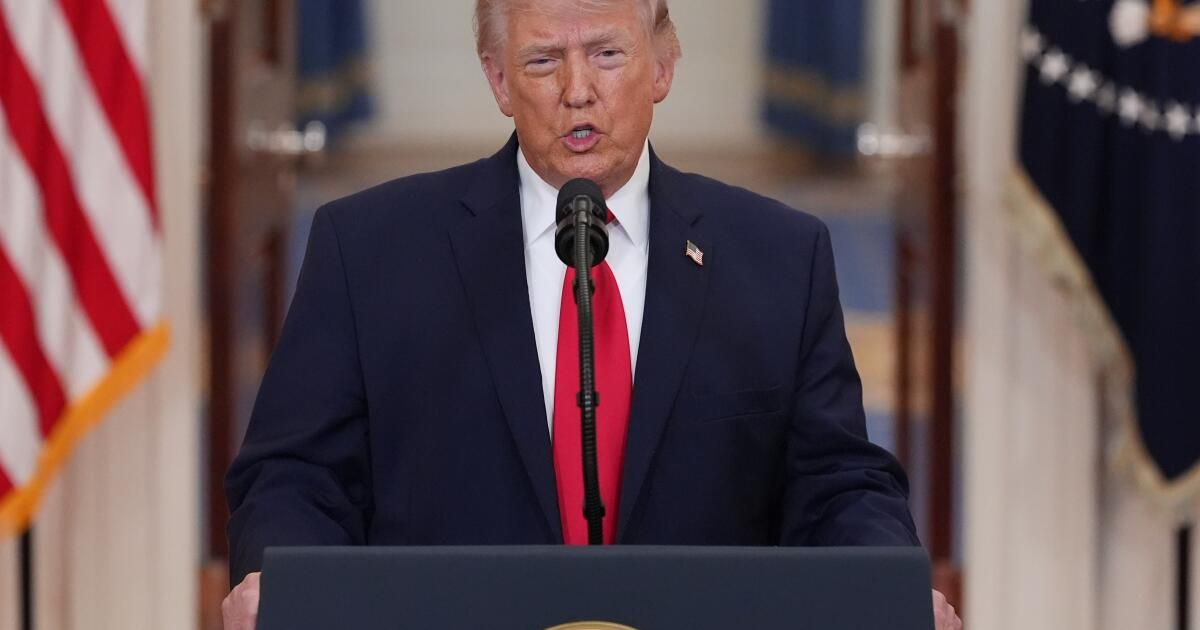
WASHINGTON- In his first formal address to the nation since launching a war against Iran more than a month ago, President Trump on Wednesday night repeated a familiar list of supposed successes (and left out setbacks), while providing little clarity on a clear path to ending the conflict.
“We are going to finish the job, and we are going to finish it very quickly. We are getting very close,” the president said from the White House.
Trump said Iran is “no longer a threat” but spoke of the possible need to escalate the conflict and increase bombing of Iran's energy and oil infrastructure if it continues to counterattack.
“If there is no agreement, we are going to hit each and every one of their electricity generation plants, very hard and probably simultaneously,” he stated. “We haven't hit their oil, even though it's the easiest target of all, because it wouldn't give them even a small chance of survival or rebuilding. But we could hit it and it would be gone, and there's nothing they could do about it.”
Trump said earlier this week that he hopes to withdraw U.S. forces from Iran within three weeks and emphasized that the United States does not have to be in the Middle East, but is only there to “help our allies.”
In his speech, Trump did not set a specific timeline for an exit strategy, but said the United States is “on track to complete all of its military objectives shortly, very soon.”
“We're going to hit them extremely hard over the next two or three weeks. We're going to bring them back to the Stone Age where they belong,” he said. “In the meantime, discussions continue.”
He also repeated his claims, made for weeks, that the United States has basically already defeated Iran and won the war, which he characterized as a “decisive and overwhelming victory.”
He also noted that it is “very important that we keep this conflict in perspective,” before listing (by month and day) the duration of World War I, World War II, the Korean War, the Vietnam War and the Iraq War.
Before Wednesday night's formal speech, Trump had spoken about the war, which the United States and Israel launched against Iran on Feb. 28, only in less formal settings, during media meetings and other public events.
The speech was a key moment for the president, who, 33 days into the war, has struggled to clearly explain the scope and goals of a conflict that has killed thousands of people in Iran and neighboring countries and disrupted global markets.
Trump repeatedly insisted that the United States is doing very well, that it is “in very good shape for the future” and that it does not need the oil that Iran has controlled in the Strait of Hormuz, ignoring the clear effects of the war and those disruptions on the United States, including gas prices.
Those effects are already contributing to fractures within Trump's base. Some have expressed frustration with the administration's decision to enter a new conflict in the Middle East, concerns that could become a political liability for Republicans ahead of November's high-stakes midterm elections.
In his comments, Trump appeared to address those who have criticized him for deviating from his campaign promises by entering the war, saying he had promised never to allow Iran to have a nuclear weapon “from day one” when he announced his first presidential campaign in 2015.
Trump has repeatedly downplayed the economic strain the war has put on Americans, including rising gasoline prices, arguing that the short-term financial strain is necessary for national security. He has also promised that gas prices “will go down” when the conflict ends.
“Gas prices will drop again quickly,” Trump repeated on Wednesday. “Stock prices will go back up quickly. They haven't gone down much. Frankly, they're down a little bit, but they've had some very good days.”
Trump seemed less forceful during his afternoon speech than during some of his previous daytime events, where he consistently maintained an optimistic tone about the war while offering inconsistent accounts about what his administration intended to accomplish, or how long and what it would take to achieve those goals.
Those inconsistencies were evident even hours before the speech. In an interview with Reuters, he said he was not concerned about the enriched uranium held by Tehran, a statement that appeared to undermine a central justification for the war.
“That's so far underground that I don't care,” Trump said, adding that the U.S. military will be “watching it by satellite.”
In public remarks before the speech, Trump said the war was launched to prevent Iran from developing a nuclear weapon, but also that the United States had completely destroyed Iran's nuclear capabilities months earlier in separate attacks over the summer. He also said he was concerned about Iran's enriched uranium, that he wanted the United States to seize it and would even consider sending American forces inside Iran to collect it.
There have also been mixed messages about U.S. intentions for Iran's leadership since Iran's supreme leader, Ayatollah Ali Khamenei, was assassinated at the start of the conflict, leaving a leadership vacuum that was filled by his son, Mojtaba Khamenei, a 56-year-old hardline cleric whom Trump initially called an “unacceptable choice.”
As Iran's clerical rulers maintained a firm grip on the country, Trump administration officials, such as Secretary of State Marco Rubio, argued that US war goals had “nothing to do” with Iran's leadership. But in recent days Trump has repeatedly talked about how “regime change” was achieved.
On Wednesday, Trump said a deal was still possible with Iran's new leaders, whom he called “less radical and much more reasonable.”
Hours before Trump gave his speech, Rubio posted a video in which he began by saying, “Many Americans are asking, 'Why did the United States have to attack Iran now?'” — an apparent acknowledgment that Trump's own answers to that question in recent days may not have resonated.
Rubio also pushed another justification for the war that the administration has been kicking around for the past month, saying that Iran was amassing an arsenal of missiles and drones to protect its nuclear ambitions, and that the war was the “last best chance” for the United States to eliminate those weapons capabilities before it was too late.
“We were on the brink of an Iran that had so many missiles and so many drones that no one could do anything about its nuclear weapons program in the future,” Rubio said. “That was an intolerable risk.”
Others also attempted to frame the war narrative Wednesday.
Before Trump's speech, Iranian President Masoud Pezeshkian issued a public letter denouncing what he described as “an avalanche of distortions and fabricated narratives” by the United States, and argued that Iran is not a threat and has only defended itself against American aggression.
He called on the American people to “look beyond the disinformation machinery” of the Trump administration and come to their own conclusions about the war and its purpose, at one point echoing a question also asked by some in Trump's base: “Is 'America First' really among the priorities of the American government today?”
He noted that Iran was in the middle of nuclear negotiations with the United States when the United States attacked it “as a representative of Israel” and accused American leaders of committing a “war crime” by attacking Iran's industrial and energy facilities.
“Exactly which of the interests of the American people really benefit from this war?” asked.