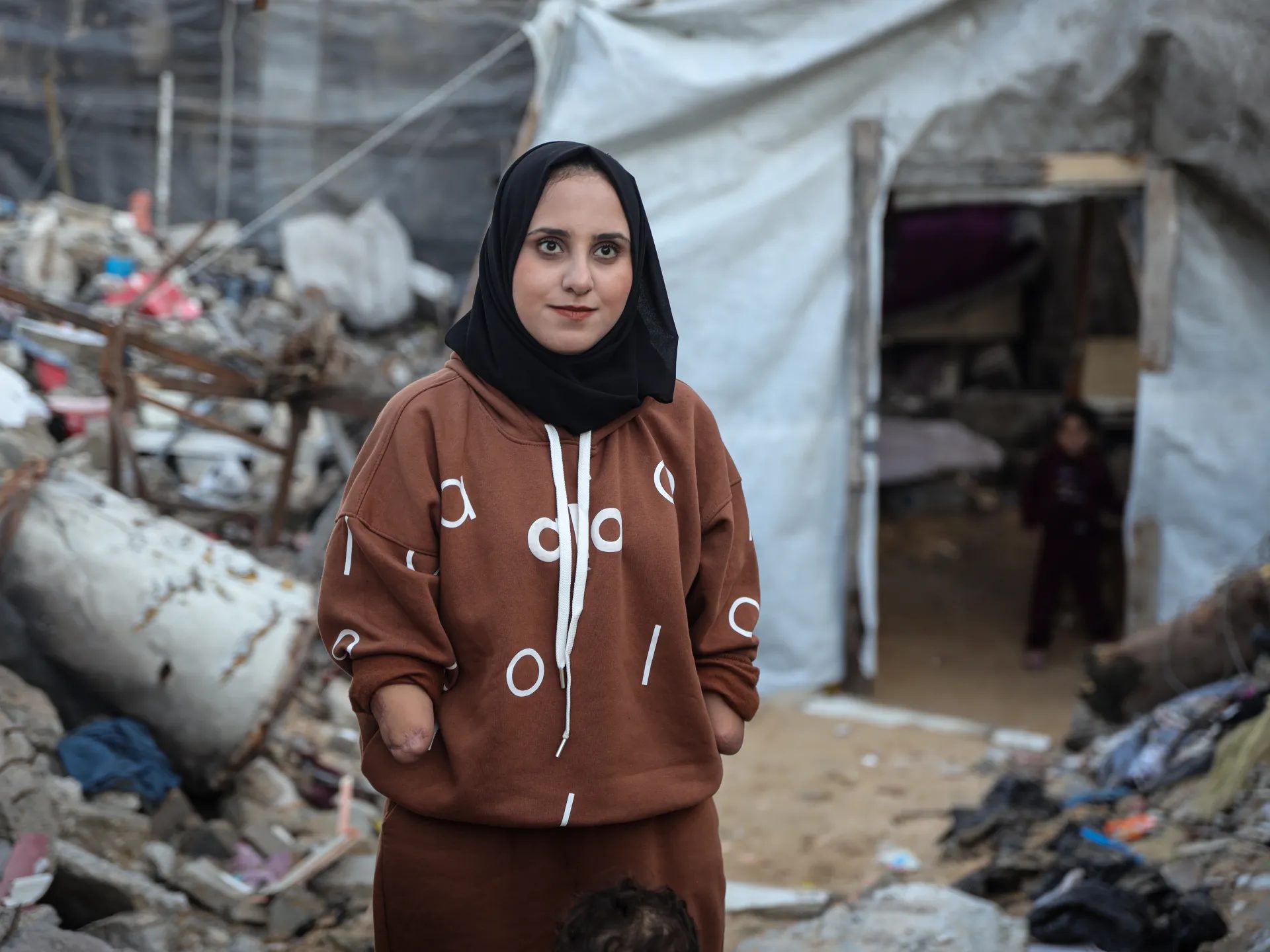
Gaza City – With what remains of his injured forearms, Nebal al-Hessi scrolls on his phone to follow the news about the reopening of the Rafah land crossing from his family's tent in an-Nazla, Jabalia, in the northern Gaza Strip.
Nebal's hands were amputated in an Israeli artillery attack on the house where she had taken refuge with her husband and daughter in the Bureij refugee camp, central Gaza, on October 7, 2024.
Recommended stories
list of 3 itemsend of list
More than a year later, the 25-year-old mother is one of thousands of injured people pinning their hopes on the reopening of the Rafah crossing between Gaza and Egypt as they seek access to adequate medical treatment outside the besieged Palestinian territory.
“It's been a year and five months since I was injured… Every day I think about tomorrow, that I could travel, but I don't know,” Nebal tells Al Jazeera in a low voice.
Recalling the attack, Nebal says she was sitting on her bed holding her daughter Rita, trying to communicate with her family in northern Gaza, when the projectile suddenly fell.
“I was trying to pick up an Internet signal to call my family… my daughter was on my lap… suddenly the projectile fell. Then dust rose up; I don't remember anything else,” says Nebal.
“It was the shell fragments that amputated my hands,” he says.
'Life is completely paralyzed'
Nebal was taken to hospital with serious injuries, including complete amputation of both upper limbs up to the elbows, internal bleeding and a leg injury. He underwent two abdominal surgeries.
He spent about 40 days in the hospital before beginning a new stage of suffering in tents for displaced people, without the most basic long-term care.
Today, Nebal, a graduate in English translation and mother of two-year-old Rita, depends almost entirely on her family for the simplest daily tasks.
“I can't eat or drink alone… or even dress, my mother, my sister and my sister-in-law mainly help me,” she says sadly.
“Even going to the bathroom I need help. I need things in front of me because I can't carry them myself.”
Nebal talks about the pain of motherhood that is suspended, while her daughter grows before her eyes without her being able to hug her or care for her.
“My little daughter wants me to change her, to feed her, to give her milk, to hold her in my arms like other mothers… she asks me and I can't,” Nebal says sadly.
“My life is completely paralyzed.”
Doctors tell Nebal that he urgently needs to travel for further treatment and to be fitted with prosthetics, emphasizing that he needs advanced prosthetics to regain a degree of independence, not just a cosmetic appearance.
“The doctors tell me that I need a State or an institution to adopt my case so that little by little I can return to my normal life,” he adds.
As Palestinian authorities announce agreements to open the Rafah crossing today for groups of wounded and medical patients, Nebal, like many others, lives in a state of anticipation mixed with fear.
According to the Gaza Ministry of Health, thousands of wounded still need specialized treatment that is not available within the Strip, while the scheduling of names depends on complex medical lists and approvals, amid the absence of a clear schedule or publicly announced priority criteria.
Nebal says she received repeated calls over the past few months from medical organizations informing her that she would be among the first on travel lists.
“They contacted me more than once, they told me to prepare… they gave me hope,” he adds. “But this time, no one has contacted me yet.”
Today, Nebal fears that her case will once again go unnoticed or that the opening of the crossing will be a mere formality, without taking into account the urgent needs of patients like her.
“I die a little every day because of my current situation… not in a figurative sense. I've been like this for a year and four months, and my daughter is growing up in front of me while I am helpless,” she says.
![Nebal with his two-year-old daughter, Rita. [Abdelhakim Abu Riash/ Al Jazeera]](https://www.aljazeera.com/wp-content/uploads/2026/02/873A6167-1769968142.jpg?w=770&resize=770%2C513&quality=80)
Uncertain future
Nada Arhouma, a 16-year-old whose life has been completely altered by a single injury, also hopes the crossing will open as soon as possible.
Nada, who was displaced with her family from the Jabalia refugee camp in northern Gaza amid Israel's two-year genocidal war in Gaza, was hit by shrapnel in the face while inside a tent for displaced people in Sheikh Radwan, Gaza City.
The incident resulted in the complete loss of one eye, as well as facial bone fractures, orbital damage and severe tissue tears.
His father, Abdul Rahman Arhouma, 49, says his health deteriorated over time despite attempts at treatment in Gaza.
“She entered the ICU of Al Shifa Hospital, then was transferred to Nasser Hospital. She stayed there for about two and a half months. They tried several times to graft her eye, but each operation failed and the disfigurement worsened,” he says.
According to his father, Nada underwent three surgical attempts using tissue from his hand and other facial areas, but all failed, further complicating his medical and psychological condition.
“My daughter's eye bleeds every day, she has pus and discharge,” he says. “I am helpless, unable to do anything.”
Today, Nada needs constant help to walk and suffers from persistent dizziness and loss of balance. Your vision in the healthy eye is also affected.
“My sisters even help me go to the bathroom. I can't walk alone,” Nada tells Al Jazeera in a low voice.

Nada has an official medical referral and urgently needs to travel to undergo reconstructive surgery and implantation of an ocular prosthesis. But their ability to receive treatments remains uncertain pending the reopening of Rafah, as is the case for other patients and injured people.
“Since I've been in the hospital, I hear every week: next week the crossing will open. Honestly, I feel like they're lying. I'm not optimistic,” says Nada.
His father told Al Jazeera that the continued wait for the Rafah crossing to reopen was “disappointing”.
“Unfortunately, we didn't understand anything. All the reports came from Israeli sources, and it seemed that Rafah seemed like a gate for prisoners, not for travel,” he says.
“Our situation is difficult and it is clear that we face a long wait to guarantee my daughter's right to receive treatment.”
Pilot reopening
Sunday was the first pilot day of reopening in Rafah, amid ambiguity and lack of clarity over the mechanism, particularly regarding the number of patients and injured who would be allowed to travel.
According to the Gaza Ministry of Health, thousands of patients and wounded require urgent medical transfers out of the Strip, amid the collapse of the health system and lack of resources.
The World Health Organization has repeatedly confirmed that Gaza's health system is “on the verge of collapse” and that travel delays in critical cases threaten their lives.
Meanwhile, Israel has said it will only allow those whose names it has approved in advance to cross, without any clear announcement about daily numbers or approved criteria, leaving patients' families in constant anticipation and frustration.
For Nada's family, this “experimental opening” means little so far.
“We can't make plans to stay or leave,” says his father. “The decision is not in our hands. One lives in a whirlwind, without being able to decide what happens. Not even the Ministry of Health has revealed anything.”
'Devastating' fight to access treatment
Raed Hamad, a 52-year-old father of four, is also desperate to leave Gaza to seek treatments and medicines that are not available in the war-torn territory.
Hamad was receiving treatment for kidney cancer a year before the war began. He underwent kidney removal after the tumor was detected to prevent its spread. But the outbreak of war in October 2023 halted his treatment protocol, significantly affecting his health.
Hamad lives in the remains of his destroyed home in Khan Younis, amid the devastation left by the war, in deteriorating humanitarian conditions.
She describes her current struggle to access treatment during the war, along with other cancer patients she meets in the hospital's oncology department, as “devastating.”
“The war has made it almost impossible to obtain medicines and medical supplies. Known cancer treatments and treatment protocols are not available,” he says.
“The food, its nature and the harsh crises we have endured during the war, all of this has greatly affected my health.”
Raed's weight dropped from 92 kg (203 lb) to 65 kg (143 lb) due to complications from the disease, lack of treatment, and malnutrition.
“I continue my treatment whenever I can on my own,” he says. “Every time I go to the hospital, I cannot find my treatment and I see that the capacities in Gaza are extremely limited. My immunity is low and every day I face new difficulties.
“I need to complete my protocol, undergo nuclear scans and obtain some essential medications to continue my treatment.”