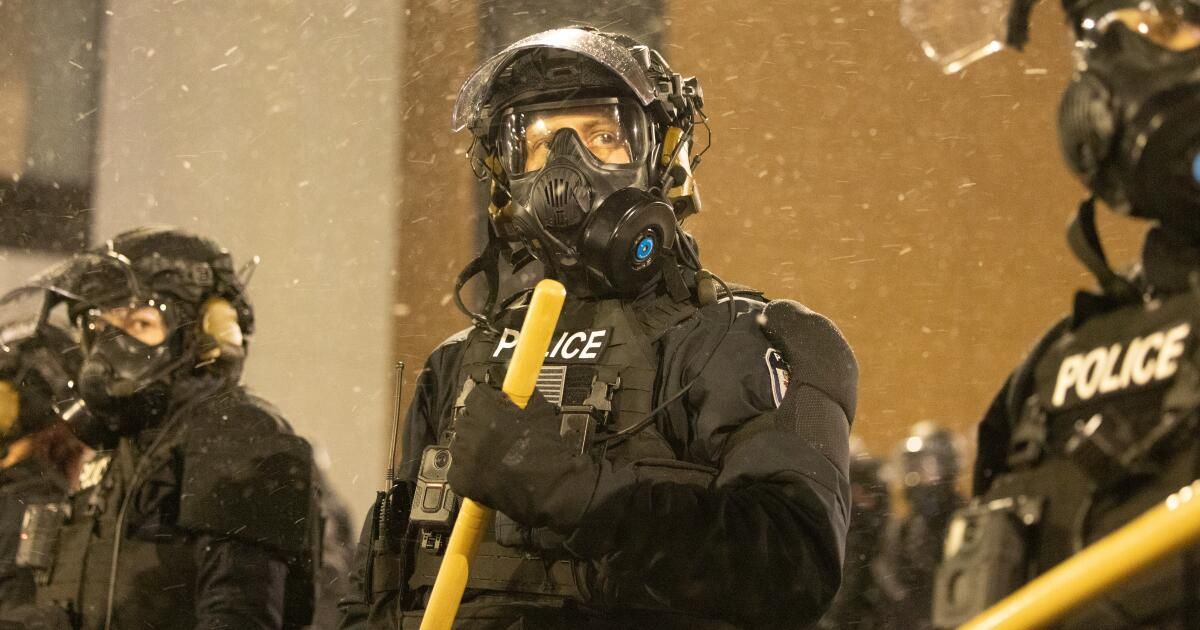
Drawing on decades of experience having dealt with the beating of Rodney King, the murder of George Floyd and more, American law enforcement leaders, civil rights advocates and other legal experts have honed best practices for officers making street arrests, controlling crowds and maintaining public safety amid mass protests.
Officers are trained not to step in front of or touch moving vehicles, never draw their firearms unless absolutely necessary, and use force only in proportion to the threat involved. They are trained to identify themselves clearly, reduce tensions, respect the sanctity of life, and quickly render aid to anyone they hurt.
When police shootings occur, leaders are trained to carefully protect evidence and immediately launch an investigation (or investigations) to assure the community that any potential wrongdoing by officers will be fairly evaluated.
According to many of those same leaders and experts, it has become increasingly clear in recent days that those standards have been ignored – if not completely discarded – by the federal immigration agents who invaded American cities at the direction of President Trump and the administration officials charged with overseeing the operations.
In both small, increasingly routine ways and in sudden, surprising bursts, such as the fatal shootings of U.S. citizens Renee Good and Alex Pretti in Minneapolis, officers have seriously violated those standards, experts said, and without any apparent concern or investigative oversight from the administration.
Officers are entering homes without warrants, crowding moving vehicles on streets, and escalating confrontations with protesters using excessive force, while department leaders and administration officials justify their actions with simple, brazen rhetoric rather than careful, sophisticated investigations.
“It's a terrible disappointment,” said former Los Angeles Police Chief Michel Moore. “These tactics, if you call them that, are far from in tune with contemporary policing standards.”
“This is not law enforcement, this is terrorism enforcement,” said Connie Rice, a civil rights attorney who has worked on LAPD reforms for decades. “They don't follow any laws or any training. This is just bullying.”
“They use excessive force against suspects and protesters, they detain and arrest people without legal cause, they violate the First Amendment rights of protesters and observers,” said Georgetown Law professor Paul Butler, a former federal prosecutor.
“These types of tactics end up harming all law enforcement agencies, not just federal ones, even though states and locals did not ask for these types of tactics and, frankly, have moved away from them for years, recognizing that they undermine trust in communities and ultimately harm their public safety mission,” said Vanita Gupta, associate attorney general under Biden and head of the Justice Department's Civil Rights Division under Obama.
The White House said Trump does not “want any American to lose their life in the streets,” believes what happened to Pretti was “a tragedy” and has called for an “honorable and honest investigation.” But administration officials have also defended the immigration crackdown and the federal agents involved, blaming protesters for interfering with police operations and accusing critics of endangering agents. However, many of those critics said it's the tactics that put officers in danger.
Gupta said Trump's immigration surge “deeply tests the critical partnerships” that local, state and federal law enforcement agencies typically have with each other, and puts local leaders in an “incredibly challenging position” in their communities.
“State and local leaders have to spend 365 days a year building trust in their community and establishing legitimacy…and you get this wave of federal agents who are acting out of control in their communities and creating very unsafe conditions on the ground,” Gupta said. “That's why we're seeing more and more bosses and former bosses speaking out.”
Moore said the tactics are “unnecessarily exposing those officers to harm, physical harm, as well as creating an emotional response and losing legitimacy with the public that they, as an agency, say they are there to protect.”
Problems on the ground
Good was fatally shot while attempting to walk away from a chaotic scene involving federal agents. The Trump administration said the officer who shot him was in danger of being run over. Homeland Security Secretary Kristi Noem accused Good, 37, of being a “domestic terrorist” without evidence.
Experts questioned why the group of officers swarmed Good's vehicle, why the shooting officer moved in front of him and whether the officer was actually in danger of being hit given that Good was turning the steering wheel away from him. They especially questioned his subsequent shots at the vehicle as it passed by them.
According to best police practices, officers should never shoot at moving vehicles except in extreme circumstances, and are trained to avoid putting themselves in harm's way. “You don't put yourself in that position because you have the option of just writing down their badge number and arresting them later if you think they've broken the law,” said Carol Sobel, a Los Angeles civil rights attorney who has pushed for police reform for decades.
Moore said he was trained in the 1980s to avoid interacting with moving vehicles, but “40 years later, you see not just one occasion, but multiple occasions of those tactics” by immigration agents.
Pretti was fatally shot after trying to protect a woman who was violently pushed to the ground by an immigration agent who was also spraying a chemical irritant. The Trump administration said Pretti had a gun and that the officers had acted in self-defense. Without evidence, Noem alleged that Pretti, also 37, was “attacking” the agents and “brandishing” the gun, while White House adviser Stephen Miller alleged that Pretti “attempted to assassinate federal agents.”
Experts questioned why the officers were being so aggressive toward the woman Pretti was trying to help, and why they reacted so violently – with a flurry of gunfire – when he was surrounded by officers, on the ground and already unarmed.
Moore said the officer who pushed the woman appeared to be using “brute force rather than de-escalation efforts,” and that spraying irritants is never appropriate for dealing with “passive resistance,” which appeared to be what the woman and Pretti were engaged in.
In both shootings, experts also questioned why officers wore masks and did not render aid, and lamented the immediate rush to judgment by Trump administration officials.
Gupta said the immigration agents' tactics were “out of line” with local, state and federal policing standards and were “offensive to all the work that has been done” to establish those standards.
Bernard Parks, another former Los Angeles Police Department chief, said videos of the two incidents and other recent immigration operations make clear that officers are “totally untrained” for the operation, which he called “poorly designed, poorly trained,” with a “total lack of common sense and decency.”
Ed Obayashi, an expert on police use of force, said that although the officers' actions in the two shootings are under investigation, it is “obvious” that Trump administration officials have not followed best practices in conducting those investigations.
“The scenes have been contaminated, I haven't seen any evidence or what you would call standard investigative protocols, like freezing the scene, witness checks, neighborhood canvasses, supervisors responding to try to determine what happened,” he said.
The way forward
Last week, California joined other Democratic-led states in challenging the Minneapolis crackdown in court, arguing that Noem's department “has waged an extraordinary campaign of recklessness and disregard for constitutional standards of policing and the sanctity of life.”
On Sunday, the International Association. The Department of Police Chiefs, which has played a central role in establishing modern policing standards in the U.S., said it believes “effective public safety depends on comprehensive training, investigative integrity, compliance with the rule of law, and strong coordination among federal, state, and local partners,” and called on the White House to convene those partners for “policy-level discussions aimed at identifying a constructive path forward.”
On Tuesday, Gov. Gavin Newsom and California Atty. General Rob Bonta reminded California authorities that they have the right to investigate federal agents for violating state law.
Gupta said the Trump administration's failure to investigate fatal shootings by federal agents while “excluding” local and state officials suggests “impunity” for agents and “puts the country in a very dangerous place,” and state investigators should be allowed in to investigate.
Butler said the situation would definitely improve if agents started adhering to modern policing standards, but that problems will persist as long as Trump continues to require immigration agents to arrest thousands of people a day.
“There's just no kind, gentle way,” he said, “to get thousands of people off the streets every day.”