California's potential to lead a national Democratic comeback was on full display when party leaders from across the country gathered recently in downtown Los Angeles.
But is the party willing to bet on the Golden State?
Appearances at the Democratic National Committee meeting by the state's most prominent Democrats, former Vice President Kamala Harris and Gov. Gavin Newsom, crystallized the danger and promise of California's appeal. Harris failed to defeat a politically wounded Donald Trump in the 2024 presidential race and Newsom, now among President Trump's most famous critics, is considered a leading Democratic contender to replace the Republican president in the White House in 2028.
California's policies on divisive issues, such as providing greater access to government-sponsored health care, helping undocumented immigrants, and supporting LGBTQ+ rights, continually serve as a Rorschach test for the nation's polarized electorate, providing comfort to progressives and ammunition for Republican attack ads.
“California is like your cool cousin who comes on vacation, is intriguing and glamorous, but may not fit in with the family all year round,” said Elizabeth Ashford, a veteran Democratic strategist who has worked for former governors. Jerry Brown and Arnold Schwarzenegger and Harris when she was state attorney general.
Newsom, in particular, is quick to boast that California is home to the world's fourth-largest economy, a billion-dollar agricultural industry, and economic and cultural powerhouses in Hollywood and Silicon Valley. Critics, including Trump, paint the state as a dystopian hellhole, plagued by homeless encampments and lawlessness, and plagued by high taxes and an even higher cost of living.
Only two Californians have been elected president, Republicans Ronald Reagan and Richard Nixon. But that was generations ago, and Harris and Newsom are considering proposals to end the decades-long drought in 2028. The two used the moment to court party leaders and activists during the Democratic National Committee's three-day winter meeting that ended Saturday.
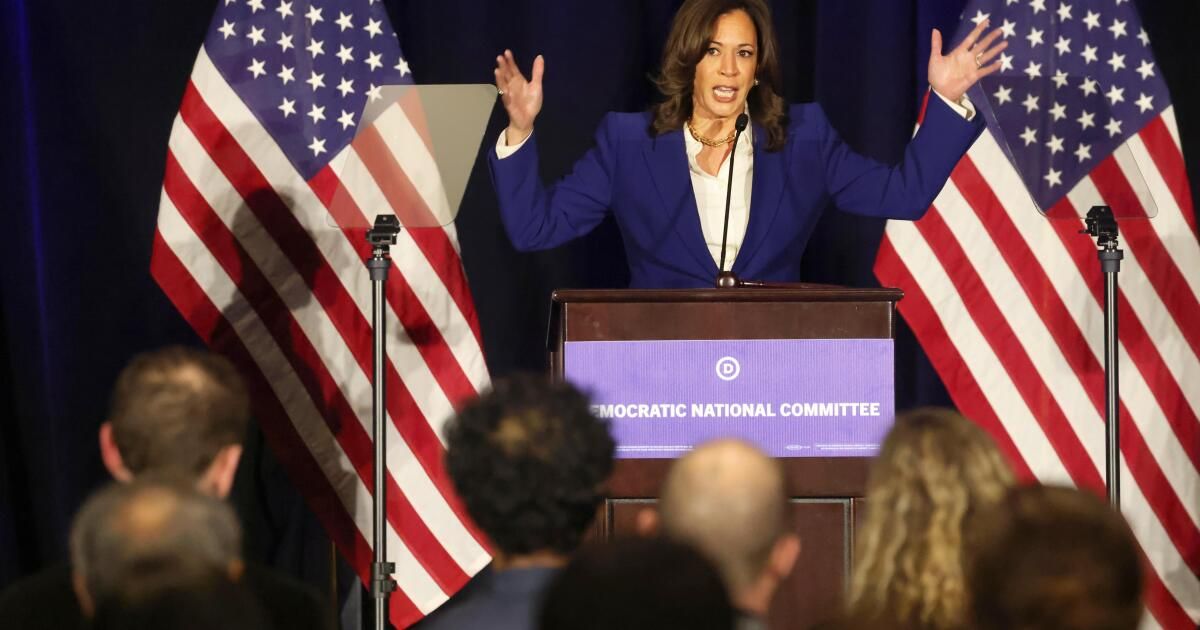
Harris, speaking to committee members and guests on Friday, said the party's victories in state elections across the country in November reflect voter agitation over the impacts of Trump's policies, particularly health care affordability and costs. But he argued that “both parties have failed to retain the public's trust.”
“So as we plan for what comes after this administration, we cannot afford to be nostalgic about what was, in fact, a flawed status quo and a system that failed many of you,” said Harris, who was criticized after her presidential campaign for not focusing enough on everyday issues, including the growing financial strains facing Americans.
While Harris, who ruled out running for governor earlier this year, did not address whether she would make another run for the White House in 2028, she argued that the party needed to be introspective about its future.
“We need to answer the question of what's next for our party and our democracy, and in doing so we need to be honest that, for many, the American dream has become more myth than reality,” he said.
Many of the party leaders who spoke at the meeting focused on California's possible role in determining control of Congress after voters in November approved Proposition 50, a rare mid-decade redrawing of congressional districts in an effort to increase the number of Democrats in the state's congressional delegation in the 2026 elections.
Los Angeles Mayor Karen Bass rallied the crowd by reminding them that Democrats took back the U.S. House of Representatives during Trump's first term and predicted the state would be pivotal in next year's midterm elections.
Mayor Karen Bass speaks at the Democratic National Committee winter meeting at the InterContinental Hotel in downtown Los Angeles on Friday.
(Genaro Molina/Los Angeles Times)
Newsom, who championed Proposition 50, reveled in that victory as he walked the halls of the hotel at the Democratic National Committee meeting the day before, stopping every few feet to talk to committee members, shake their hands and take selfies.
“There's just a sense of optimism here,” Newsom said.
Democratic candidates in New Jersey and Virginia also won elections by significant margins last month, which party leaders said were telltale signs of growing voter dissatisfaction with Trump and Washington's Republican leadership.
“The party, more broadly, has regained its maritime footing and is winning,” Newsom said. “And winning solves a lot of problems.”
Louisiana committee member Katie Darling cried as she watched her fellow Democrats flock to Newsom.
“He's really trying to bring people together during a very difficult time,” said Darling, who grew up in Sacramento in a Republican household. “He gets a lot of flack for talking and working with Republicans, but when he does, I see him talking to my mom and dad, who I love and who I vehemently disagree with politically… I think we need to talk to each other to move the country forward.”

Governor Gavin Newsom speaks as his wife Jennifer Siebel Newsom looks on during an election night meeting at the California Democratic Party headquarters on November 4, 2025 in Sacramento.
(Justin Sullivan/Getty Images)
Darling said she listens to Newsom's podcast, where his choice of guests, including the late Charlie Kirk, and his comments on the show that transgender athletes participating in women's sports are “deeply unfair” have sparked outrage from some on the left.
Illinois Gov. JB Pritzker, another potential 2028 presidential candidate whose family has historically supported Newsom, was also reportedly on site Thursday, holding closed-door meetings. And former Transportation Secretary Pete Buttigieg, also a possible White House candidate, was in Los Angeles on Thursday, appearing on Jimmy Kimmel's late-night show and holding meetings.
Corrin Rankin, chair of the California Republican Party, called the Democratic National Committee meetings in Los Angeles “anti-Trump sessions” and pointed to homeless encampments on Skid Row, just blocks from where committee members met.
“We need accountability and solutions that truly get people off the streets, make communities safer and life more affordable,” Rankin said.
Elected officials across the country are attracted to California because of its source of wealthy political donors. The state was the largest source of contributions to Trump and Harris' campaign committees during the 2024 presidential race, contributing nearly a quarter of a billion dollars, according to the nonpartisan, nonprofit organization Open Secrets, which tracks election finances.
While the Democratic National Committee meeting focused primarily on mundane internal matters, the meeting of party leaders attracted liberal groups seeking to raise money and draw attention to their causes.
Actress Jane Fonda and comedian Nikki Glaser headlined an event aimed at raising the minimum wage at the Three Clubs cocktail bar in Hollywood. California already has one of the highest minimum wages in the country; One of the event's organizers is campaigning to raise the rate to $30 an hour in some California counties.
“The affordability crisis is pushing millions of Americans to the brink, and no democracy can survive when people working full-time cannot meet basic needs,” Fonda said before the event. “Increasing wages is one of the most powerful ways to give families stability and hope.”
But California's liberal policies have been seen as a liability to Democrats elsewhere, where issues such as transgender rights and providing health care to undocumented immigrants have not been welcomed by some blue-collar workers who once formed the party's base.
Trump took advantage of that disconnect in the final months of the 2024 presidential race, when his campaign aired ads highlighting Harris' support for transgender rights, including taxpayer-funded gender-affirming surgery for inmates.
“Kamala is for them, President Trump is for you,” the commercial said. The ad aired more than 30,000 times in swing states during the fall, especially during football games and NASCAR races.
“Kamala had 99 problems. California was not one of them,” said John Podesta, a veteran Democratic strategist who was a senior adviser to former President Biden, an adviser to former President Obama and White House chief of staff to former President Clinton.
He disputed the argument that California, whether through its policies or candidates, will hurt Democrats' chances, arguing there is a broader disconnect between the party and its voters.
“This sense that Democrats lost touch with the middle class and the poor in favor of the cultural elite is a real problem,” Podesta said. “My shorthand is that we used to be the party of the factory, and now we're the party of the staff room. That's not a California problem. It's an elitist problem.”
While Podesta is not yet endorsing anyone in the 2028 presidential race, he praised Newsom for his efforts to not only oppose Trump but the “left-wing extremists” in the Democratic Party.
The narrative that Californians are out of touch with many Americans has been exacerbated this year during the state's battles with the Trump administration over immigration, climate change, water and artificial intelligence policies. But Newsom and committee members argued that the state has been at the forefront of where the nation will eventually go.
“I'm very proud of California. It's a state that's not just about growth, it's about inclusion,” the governor said, before listing a list of California's initiatives, including low-priced insulin and higher minimum wages. “A lot of the politics that's coming out of the state of California promotes not just promises, but a policy direction that I think is really important for the party.”