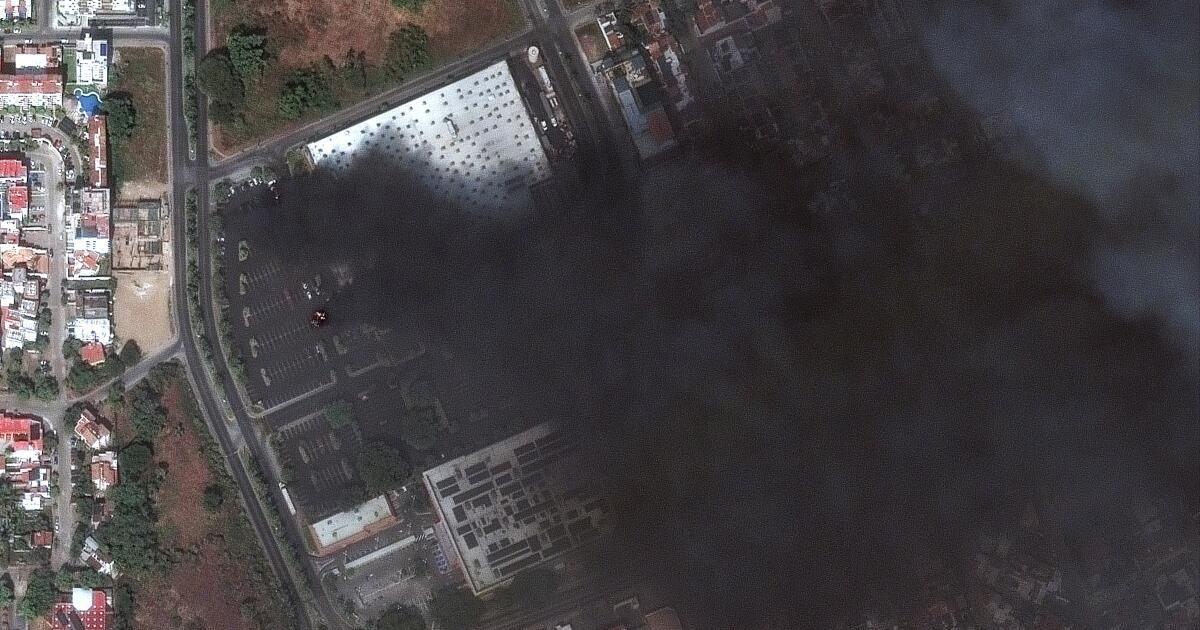
Craig Chamberlain planned to have a leisurely breakfast with his wife on Los Muertos beach in Puerto Vallarta. But when they saw columns of smoke rising from the heart of the city as they drove into the city, they decided to turn around.
About a minute later they were stopped on the highway Sunday and an armed man wearing a black mask approached the window of their Kia Sorento yelling in Spanish.
“I was very excited and agitated,” said Chamberlain, a Newport Beach resident who spends half the year in the bustling coastal city in the Mexican state of Jalisco.
“When someone points a gun in your face, you don't want to respond too much,” he added. “It took us a minute to understand what he was saying. We didn't know if he wanted us to stop or keep moving. We finally realized he was taking our car.”
American tourists and expatriates across Mexico were advised to shelter in place on Sunday as cartel violence engulfed several coastal resort towns after Mexican security forces killed Nemesio “El Mencho” Oseguera Cervantesthe most wanted drug trafficker in Mexico.
In retaliation, gunmen set cars and buses on fire and blocked roads across western Mexico. By late Sunday, the chaos had spread to the popular tourist cities of eastern Mexico: Cancun, Cozumel, Playa del Carmen and Tulum.
For many Californians in Puerto Vallarta, a tourist magnet widely known as one of the safest cities in Mexico, the experience was shocking.
After the carjacking, Chamberlain and his wife walked a few blocks to a restaurant to decide their next move. The restaurant owner let some people in and then locked the doors.
The couple huddled with 15 other people, including a man in his 80s and a mother with her 1-year-old daughter. From the restaurant terrace, they saw fires appear throughout the city.
At one point, a group of men drove a car about 200 feet from the restaurant, doused it with gasoline and set it on fire.
“This mother was walking her little baby back and forth on the porch, teaching him to walk,” Chamberlain said, “and she's laughing while a car is on fire.”
On Monday, the situation returned to normal in many parts of the country, the US Embassy and Consulates said in an updated security alert. But American citizens were still urged to take refuge in Puerto Vallarta, Guadalajara, Ciudad Guzmán, Tijuana, Chiapas and Michoacán.
Wesley Eure, a Palm Springs actor and writer who played Michael Horton on the American soap opera Days of Our Lives, spent Sunday huddled in his apartment after seeing a faint cloud of smoke outside his window.
The smoke grew larger and darker, until it became a thick black column that seemed to swallow the blue sky. Then more fires broke out blocks away.
Eure, who lives on the Mexican coast six months a year, said his local pharmacy was burned and looted. A bus with a propane tank was set on fire and exploded, sending flames into the building that houses his bank and gym. His Mexican landlord urged him not to leave his two-bedroom apartment.
“It seemed like all hell broke loose here in Puerto Vallarta,” Eure told the Times on Monday.
Many tourists were stranded.
Katy Holloman, a makeup artist from El Dorado Hills, was supposed to return home from her vacation in Puerto Vallarta on Sunday when hotel staff told her everyone was sheltering in place.
He booked his flight for Monday, but that flight was also cancelled. “At this point,” he said in a Facebook video, “I really hope that we can return home safely very, very soon.”
The Chamberlains considered themselves lucky. The restaurant staff served them a complimentary lunch, a gesture Chamberlain said is typical in Mexico.
“It's a beautiful place with mostly very nice people,” he said. “It's interesting that even these bad guys, if you want to call them that, are very careful not to hurt people.”
The couple eventually left the restaurant and walked a few blocks to a nearby hotel. If things stayed calm, they hoped to return to their home by the marina tomorrow.
Much of the violence that had gripped the city had calmed by Monday: the hollow hulls of burned cars and buses were removed from the roads and airports reopened to domestic travel.
But there was still no public transportation, which meant some employees couldn't get to work, so businesses remained closed.
Some longtime Puerto Vallarta residents took it in stride.
Elizabeth Shanahan, a California expat who moved from Newport Beach to Puerto Vallarta two decades ago, said television news made it seem like buildings were being devoured all over the city. But the damage he had seen focused mainly on buses and cars.
“They don't seek to harm civilians…” he said. “And it really doesn't seem like civilians of any nationality are being singled out.”
Shanahan, who runs a company that provides professional yacht services, said his clients had not expressed any fear about being in Mexico. She was advising some wealthier clients not to drive into the city with their luxury vehicles and to be careful in any unfamiliar places.
“The truth is, I feel safer here than I do in Minneapolis right now,” she said.
Until this weekend, Eure had never felt unsafe in Puerto Vallarta.
But after hunkering down Sunday in his apartment 90 steps from the beach in the historic Romantic Zone, Eure was ready to venture outside. He hadn't been to the supermarket in a few days and he and his friend were tired of going through boxes of old cereal. He had been informed that one of the Oxxo convenience stores was in operation.
So on Monday morning, he and his friend went out.
“It was like the Wizard of Oz: entering a world of color,” he said. “It was beautiful.”
The sun came out. His neighbors were sitting on the porch. On the Malecón, the city's boardwalk, locals were jogging and walking their dogs.
“Everyone said, 'Everything's fine, don't worry,'” he said. “Everyone is trying to reassure each other.”
A friend pointed him to an open restaurant, where he devoured a salmon roll.
But there were long lines at grocery stores. And when they ventured inland, a few blocks from the beach, they found charred condos and stores surrounded by red “danger” warning tape.
Still, even amid the devastation, he said, everyone was calm, orderly and friendly.
A friend, discovering they had no food in the apartment, invited him and his friend to her ocean-view house for a dinner of pork chops and stuffed portobello mushrooms.
“This is a very close-knit community,” Eure said, “I hope things go back to the way they were before.”