BEIRUT— Supreme Leader Ayatollah Ali Hosseini Khamenei, who was killed in the US-Israeli attack on Iran on Saturday, during more than 30 years in power demonized the United States, called for Israel's destruction and maintained a tight grip on Iran's politics as it advanced its influence across the Middle East.
President Trump announced Khamenei's death on Saturday on Truth Social. Israeli officials also said he was killed.
As Iran's spiritual leader and its highest authority, Khamenei, 86, was the supreme arbiter in state affairs, including the economy, education and defense. He was the longest-serving head of state in the region and the second to serve as supreme leader in Iran.
He furthered the foreign policy of his predecessor and founder of the Islamic Republic, Ayatollah Ruhollah Khomeini, pitting Iran against the combined military might of the United States and Israel. And he ruthlessly suppressed internal challenges to his government, most recently in January, when Iranians took to the streets to demand economic reforms. Thousands of people were killed by security forces.
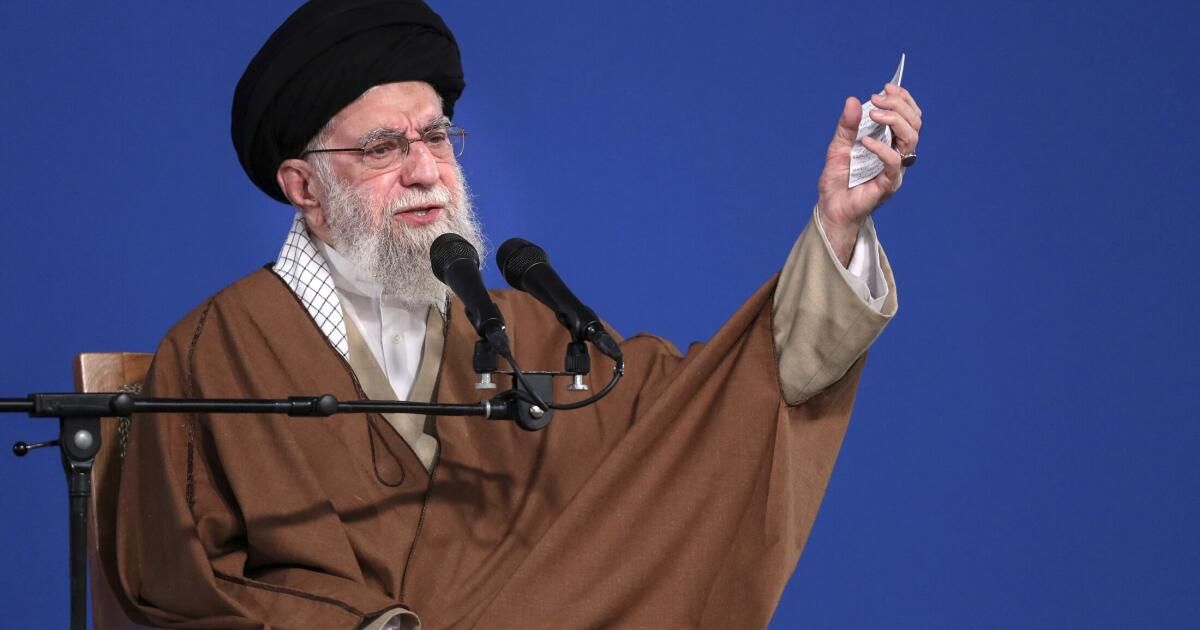
Supreme Leader Ayatollah Ali Khamenei speaks on the anniversary of the death of the founder of the Islamic Republic, Ayatollah Ruhollah Khomeini, shown in the portrait, at his mausoleum in Tehran on June 4, 2022.
(Office of the Iranian Supreme Leader / Associated Press)
Khamenei's death would mark a turning point for his long-isolated nation: Will his successor lean more toward moderation or continue indirect confrontation with Washington, the West and Israel?
Iran's Constitution dictates that a new leader would be selected by an Assembly of Experts, a body of 88 clerics. Khamenei had a hand in selecting the majority of its members, giving him significant control over who would succeed him.
One of the main contenders is the second of Khamenei's four sons, Mojtaba Khamenei. Like his father, the 56-year-old is a cleric who studied in the holy city of Qom.
Washington sanctioned him in 2019 for working with the Quds Force, the irregular warfare branch of the Revolutionary Guard, and the Basij, a volunteer paramilitary-religious force, “to further his father's destabilizing regional ambitions and oppressive domestic objectives,” according to the US Treasury.
During his long rule, Khamenei placed Tehran at the center of an expanding network that included friendly governments, terrorist groups and political proxies, such as the Lebanese militant group Hezbollah and Yemen's Houthi rebels, and made his Arab neighbors nervous. His pursuit of nuclear power, despite his insistence that it was by peaceful means, agitated the West and ultimately brought it into a brief war in 2025 with its enemy, Israel.
Khamenei, a tall, bearded man who might have seemed patronizing if not for his stern countenance, owed his rise to his alliance with hardliners, especially the Islamic Revolutionary Guard Corps, with which he became close during the Iran-Iraq war in the 1980s.
Yet he sometimes tolerated, though never blessed, voices for compromise: In 2015, he reluctantly backed the landmark nuclear deal that ended Iran's nuclear weapons program in exchange for sanctions relief.
Facing an angry public and a battered economy, Khamenei said he welcomed the deal even as he insisted that “my firm recommendation is not to trust the enemy,” a stance toward Washington that he would maintain throughout his rule.
When Trump withdrew from the deal in 2018, he only strengthened the position of Khamenei and other hardliners who harbored reservations about the pact.
“The body of this man Trump will turn into ashes and become food for worms and ants,” Khamenei said a day after Trump's withdrawal, “as long as the Islamic Republic stands.”
That same year, Khamenei wrote on social media that Israel was “a malignant cancerous tumor” that must be eradicated, adding ominously that “it is possible and it will happen.”
Despite his fiery rhetoric, the Iranian leader has almost always retreated from open war, even after Trump ordered a drone strike that killed Khamenei's top enforcer, Maj. Gen. Qassem Suleimani, in 2020.

In 2020, Khamenei visits the family of Major General Qassem Suleimani, depicted in a portrait, who was killed in a drone strike ordered by President Trump.
(Agence France-Presse)
Khamenei was wary of escalating hostilities with the United States, Israel and Iran's neighbors in the Persian Gulf, while other regional autocrats, including Iraqi strongman Saddam Hussein and Libya's Moammar Gaddafi, were toppled after Washington-led offensives.
The strategy came in handy during the 2003 U.S.-led invasion of Iraq, in which Iran gained unprecedented influence over its former adversary. A 1,300-page US military history of the 2003 invasion, completed in 2018, concluded that “an emboldened and expansionist Iran appears to be the only victor.”
After October 7, 2023, when the Palestinian militant group Hamas invaded Israel and killed about 1,200 people and kidnapped about 250 more, war between Israel and Iran, which supported Hamas, seemed imminent. For 20 months, even as Israel killed Hamas chief Ismail Haniyeh in Tehran and Hezbollah leader Hassan Nasrallah in Beirut and then helped topple Syrian President Bashar Assad, Iran responded with waves of ballistic missiles but otherwise held back.
That changed in June 2025, when Israel attacked Iran, saying it was acting to prevent Tehran from developing nuclear weapons. The Israeli attack came just as Tehran and the second Trump administration returned to the negotiating table over Iran's nuclear program.
Talks were reportedly progressing before Israel removed Iran's top military chain of command and top nuclear scientists. The United States then joined the fray, dropping “bunker buster” bombs to penetrate deep-sea facilities. Iran responded with missile launches against Israel, but did not escalate the conflict.

Israeli firefighters work to extinguish a fire after a missile launched from Iran hit Tel Aviv on June 16, 2025.
(Baz Ratner/Associated Press)
Whoever runs would have to face the Revolutionary Guard, which has amassed power under Khamenei's rule and has little interest in giving it up.
That uncertainty reflects the circumstances once faced by Khamenei, whose rise to the top job was not predetermined.
Born on April 19, 1939 in the city of Mashhad, in northeastern Iran, Khamenei was the second of eight children of Sayyed Javad Khamenei, a jurist, and Khadijeh Mirdamadi.
He began his religious instruction at the age of 4 and continued his studies at the venerated hawzaa network of illustrious seminaries. As a cleric in his 20s, he encountered Khomeini, a charismatic religious leader and avowed opponent of Mohammad Reza Shah Pahlavi.
There were other influences: it is said that he was a voracious reader of Victor Hugo, John Steinbeck and Leo Tolstoy. He smoked a pipe and was fond of poetry and gardening. He married Mansoureh Khojasteh Bagherzadeh in 1964 and, together with their sons, they had two daughters.
Khomeini would become his mentor, a figure to whom he remained ever loyal, directing secret missions for him while Khomeini lived in exile. Khameni paid for that loyalty with years of imprisonment and torture at the hands of SAVAK, the shah's secret police.
According to Karim Sadjadpour, an Iranian-American policy analyst at the Carnegie Endowment who has written extensively about Khamenei, that treatment may have been the root of his hatred of the United States and Israel, both of which are said to have provided support and training to SAVAK.
The Islamic Revolution changed Khamenei's fortunes. With the shah gone, Khomeini replaced the monarchy in 1979 with Wilayat al-Faqih, an Islamic Republic. Khomeini became supreme leader and rewarded his devotees with government positions.

Protesters hold a poster of exiled Muslim leader Ayatollah Ruhollah Khomeini during a protest against the Shah in Tehran on December 10, 1978.
(Michel Lipchitz/Associated Press)
Khamenei was appointed to several positions: first as deputy defense minister, then as imam of Friday prayers in Tehran and, crucially, as supervisor of the Revolutionary Guard.
Two years later, in June 1981, while Khamenei was giving a religious lecture at a mosque, the Mujahedin-e-Khalq (MEK), a resistance group, placed a tape recorder containing a bomb near him.
The explosion left Khamenei with his right arm permanently injured (he reportedly greeted people with only his left hand). A few months later, another MEK bombing killed then-president Mohammad Ali Rajai, along with other Iranian officials.
In the chaos that followed, revolutionary elites (backed by Khomeini) called on Khamenei to run for president. He then won two terms, the first with 97% of the vote and the second with 87%.
Succession disarray served Khamenei once again in 1989. Khomeini had separated from his designated heir, Ayatollah Hossein-Ali Montazeri. No one else among the senior clerics was considered qualified and the idea of a so-called leadership council was rejected. That left Khamenei as the leading candidate, even though he was not an ayatollah, as the constitution required.
The Assembly of Experts removed the requirement, at Khomeini's urging, clearing the way for Khamenei to succeed him. The day after Khomeini's death in 1989, Khamenei was elected supreme leader.
“My nomination should make us all cry tears of blood,” Khamenei said. “I am a person with many defects and shortcomings and truly a minor seminarian.”
Considered an ordinary man, lacking the charisma and religious good faith of his predecessor – and with the country emerging from a painful eight-year war with Iraq – Khamenei did not arrive with an ambitious plan for change at first.
Any reluctance soon gave way to a determination to remake the economy and create a shadow government, underpinned by its association with the Revolutionary Guard and Basij.
In 2013, according to a Reuters investigation, Khamenei was at the nexus of an organization called the Headquarters for the Execution of the Imam's Order, which was estimated to be worth about $95 billion and was involved in a dizzying array of industries.
Meanwhile, he placed the Revolutionary Guard at the center of his appointments, winning over members of the body as loyalists who saw Khamenei as their shield against calls for reform.
Khamenei took advantage of that unprecedented economic and military control to quell unrest, including the 2019 fuel protests and the 2022 demonstrations condemning the death of young Iranian-Kurdish woman Mahsa Amini while in police custody.
Even in his final years, Khamenei did not soften his vitriol against the United States and Israel. “We will not surrender to any aggression,” he said after his 2025 attacks. “This is the logic behind the Iranian nation.”