JULIS, Israel— Located in a quiet corner of a picturesque village in northern Israel, the building appears, at first, to house an elegant meeting hall with giant chandeliers, ornate but uncomfortable chairs, and trays of sweets.
But beyond a makeshift divider made of plywood and a stern assistant placing stickers over smartphone cameras, sits a team of volunteers working among large screens and laptops: the nerve center of a hand-to-hand humanitarian operation to help the Druze religious minority in Syria.
Druze in Israel have long sent donations to their co-religionists in Sweida province in southwestern Syria, but since July – when around 1,000 Druze civilians were massacred in a sectarian massacre – a complex aid operation has emerged to care for tens of thousands of people more than 40 miles of hostile territory away.
“What were we supposed to do? Watch them slaughtered and keep silent?” said Muwaffaq Tarif, the spiritual head of the 150,000-strong Druze community in Israel.
The operation, which brings together family ties in Syria and links to Israel's military and government, based in the hall is now providing funding, humanitarian and medical aid, as well as logistical and intelligence support, despite a months-long blockade of Sweida by Syrian forces.
The assistance has become part of a vital lifeline for the province and has empowered Druze militias and spiritual leaders who call for secession from Syria and an alliance with Israel.
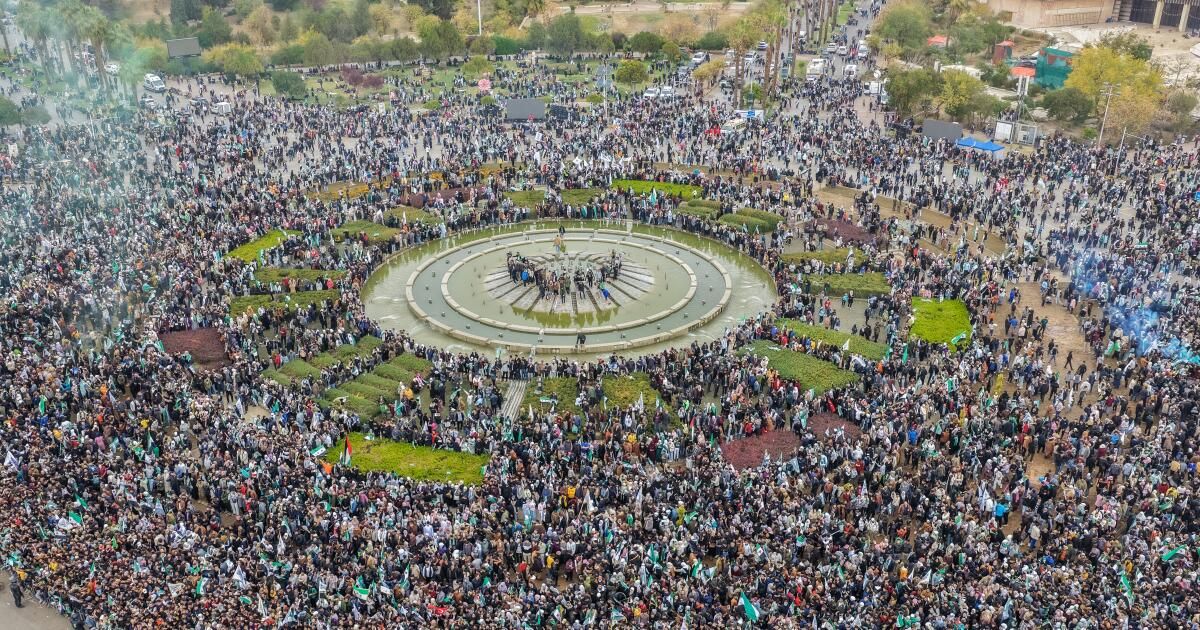
Protesters dance with the Druze flag as they gather in front of the Berlin Cathedral to express solidarity with the Druze communities in Syria on August 30 in Berlin.
(Omer Messinger/Getty Images)
The needs are enormous. As Tarif sat with the volunteers in the room, their phones were piling up with calls and messages, the vast majority from Druze in Syria.
“I get 500, 800, sometimes even a thousand people, every day. They all need my help. It makes you cry,” Tarif said.
The Druze, a sect that combines elements of Islam and other religious traditions, make up 1 million people worldwide; About 500,000 live in Syria, or about 3% of the population. Hardline Muslims consider them infidels.
During Syria's 14-year civil war, dictatorial President Bashar Assad allowed them to establish their own militias in Sweida and manage affairs in the Druze-majority province, as long as they did not fight government troops or allow opposition rebels to enter. But they had little love for Assad or the Islamist-dominated opposition.
After the fall of the much-maligned Assad regime last December, the new president, Ahmed al-Sharaa, sought to allay concerns about the new government's jihadist roots; Al-Sharaa was once a rebel leader affiliated with Al Qaeda, but he renounced the group years ago.

A poster of Ahmed al-Sharaa, Syria's interim president, adorns a windshield in Damascus as Syrians mark the first anniversary of the fall of the Assad regime.
(John Wreford/LightRocket via Getty Images)
Al-Sharaa vowed to protect Syria's minorities and eliminate extremists among its allies. That earned it support from the United States, Europe and its Arab neighbors, but Israel adopted an adversarial stance, occupying swaths of southern Syria and launching thousands of airstrikes to destroy the fallen government's arsenal.
Meanwhile, Al-Sharaa urged Druze leaders to disband their militias and hand over their weapons. Some wanted to cooperate, but Syria's top Druze cleric, Hikmat al-Hijri, refused, saying his groups would only disarm when Al-Sharaa formed an inclusive government.
Syria is home to a diverse collection of religions, and as the new government attempted to establish itself, sectarian unrest erupted. In March, gunmen linked to the government massacred about 1,500 people, mostly Alawites. Clashes broke out in predominantly Druze areas near Damascus in May.
Then came the massacres in Sweida.
They began in early July as kidnappings between Druze militias and Bedouin tribes, but soon escalated into street fighting. The government negotiated a ceasefire and sent in security personnel, but instead of restoring order, they joined the Bedouins in a blood-soaked rampage.
They systematically burned and looted some 32 villages, executed civilians, then mutilated their bodies and abused the men by cutting off their mustaches, which among the Druze is considered a sign of spiritual maturity. And they filmed themselves doing it, proudly posting videos of the trophies on social media.

The United Nations evacuated families in southern Syria in July after violent clashes between Bedouin fighters and members of the Druze community.
(Bakr Alkasem / AFP via Getty Images)
At the end of the massacre, almost 200,000 people were forced to flee their homes. More than 100 women and girls were kidnapped. Dozens remain missing.
Al-Hijri urged President Trump and Israeli Prime Minister Benjamin Netanyahu to save Sweida, adding that “we can no longer coexist with a regime that only knows iron and fire.”
Once Tarif learned what happened, he rushed to act.
“We call everyone, [Israeli] army, the government, the prime minister, the minister of defense, the chief of the General Staff, to stop the massacres. The Syrian government was entering with tanks, drones and artillery. It was an army against civilians with a gun or rifle,” Tarif said.
Israel, which has made overtures to Syria's Druze, mobilized. Netanyahu ordered airstrikes against Syrian personnel shelling the provincial capital of Sweida, along with the Syrian army headquarters in Damascus and the presidential palace.
Al-Sharaa accused Israel of fomenting internal divisions and said Al-Hijri's call for international intervention was unacceptable. He formed a committee to investigate atrocities against the Druze and others, and promised in a speech to the United Nations General Assembly in September to “bring to justice every hand stained with the blood of the innocent.”
Al-Hijri and many Druze who had previously been conciliatory towards Al-Sharaa were not convinced and demanded secession.
At the same time, a tense standoff ensued: Syrian government forces surrounded the province, ostensibly to keep Bedouins and Druze separated, although critics accused them of replicating Assad's surrender-or-starve tactics to force Sweida into submission.
Many Druze in Israel wanted to help.
“The world was ignoring what happened, so we have to do this. Our women sold their gold, people sold properties, others took loans to raise money,” Tarif said, adding that about $2.5 million was raised.
With no land connection between Sweida and the Israeli-occupied areas of southern Syria, the only way to deliver aid was through the Israeli air force. But the quantities were insufficient. That was the spark of the operating room.
Standing in the middle of a series of workstations, a volunteer explained how his team identified sympathetic people to buy medicine and food in Damascus, and middlemen who bribed supplies through government checkpoints into Sweida. They also smuggled equipment and paid workers to rehabilitate water and electricity infrastructure. Some convoys entered with the Syrian Red Crescent with the knowledge of Damascus, Tarif said.
“If we use $10,000 here, it's nothing. But in Syria, they make a lot and buy a lot of supplies,” the volunteer said.
The center funded the conversion of a court building in Sweida into a center for displaced people housing 130 families, with a workshop where women could sew clothing, including uniforms for Druze militias.
Other volunteers contributed their specialties: with Sweida's medical facilities devastated, the center managed four hospitals in the province.
Programmers created an app-based humanitarian ecosystem, allowing Sweida residents to register for medical care, while doctors used WhatsApp messages to consult specialists in Israel and elsewhere.
Other programs coordinated aid requests and deliveries, or helped residents document atrocities.
“We take advantage of our skills to defend ourselves,” said a 28-year-old activist on the operating room technical team, as he pulled out his phone to demonstrate some apps. One for medical procedures included drop-down menus and a simple interface that he said has been used by thousands of people.
Some of the aid was diverted toward intelligence. As Sweida was still threatened, the team, some of whose members retired from military service, followed developments on the ground. They deployed robots to monitor social media posts that could indicate an attack, hacked into the phones of commanders in the area, and passed the information to the Israeli military and Druze militias.
Meanwhile, the Israeli army has supplied the militias with limited quantities of weapons and ammunition, activists in Sweida say, and is maintaining drone surveillance over the area.

Members of the Druze community in the Israeli-annexed Golan Heights gather in July for a rally to show solidarity with the Druze in Syria.
(Jalaa Marey / AFP via Getty Images)
All of this has made the Sweida militias more effective. But it has also strengthened Al-Hijri's plan to secede and ally the province (which is about 60 miles southeast of Damascus) with Israel. In recent speeches, he refers to Sweida as Bashan, his biblical Hebrew name, and forces under his control have raised the Israeli flag alongside the Druze flag. Last week, forces affiliated with Al-Hijri unveiled new uniforms and logos that critics say incorporate the Star of David into their design.
For his part, Tarif, who says he is in daily contact with Al-Hijri as well as Al-Sharaa intermediaries, insists that “the ball is in Jolani's court,” using the nom de guerre of Al-Sharaa.
“Do this tomorrow. Open an international humanitarian corridor to Sweida. Return the people to their homes. Return the kidnapped. Simple,” Tarif said.
At the same time, local opposition to Al-Hijri is intensifying after his forces tortured and killed two Druze clerics whom he accused of “treason” for contacting state authorities.
“He is gathering thugs around him, silencing any voice seeking a solution with the state,” said an activist in Sweida who declined to be identified for fear of reprisals. Many in Sweida feel trapped between Al-Hijri and a Damascus government they have learned to fear.
“As a Druze, if I want to oppose Al-Hijri and his gangs, who can I turn to?” the activist asked. “The State that committed massacres against my people? How can we trust it?”