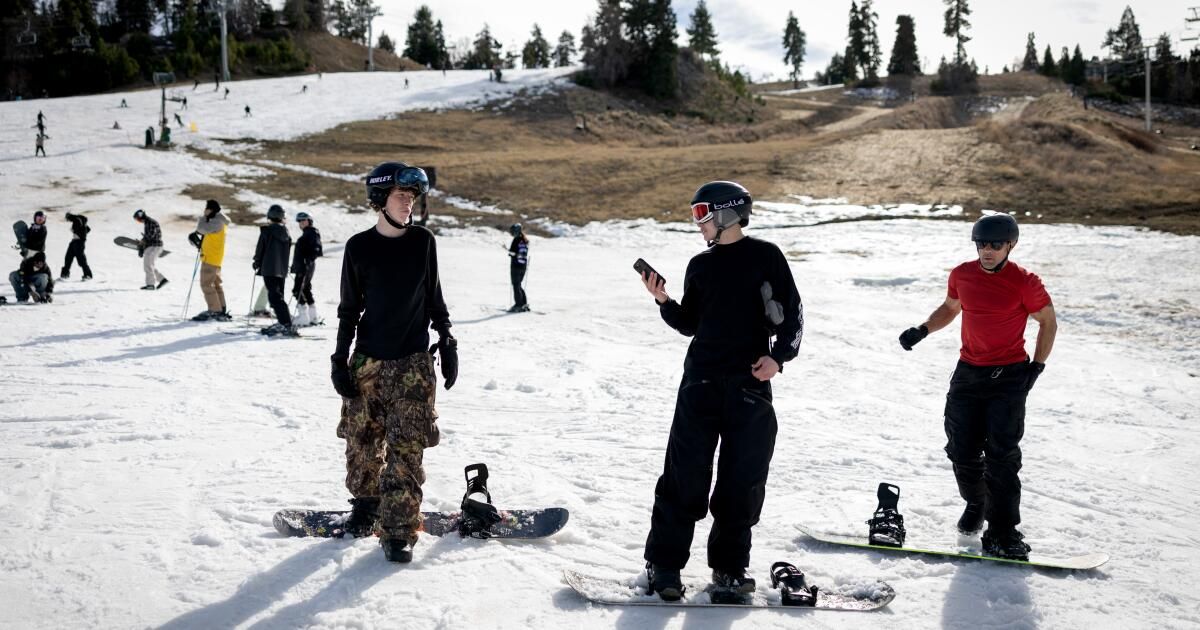
Nothing but dirt and dry brown chaparral rolled beneath the skis and snowboards hanging from a chairlift at Big Bear Mountain Resort on Friday, as desperate adventure seekers joked that they should change the name of the place to “Big Bare.”
The unusually high temperatures even left the impressive array of high-tech artificial snow machines below mostly useless, their fans spinning idly in the warm breeze.
“The word I've been using is 'abysmal,'” said Cameron Miniutti, 29, who was riding the chairlift in a light cotton shirt, the hot sun reflecting off his ski goggles. “This is, without a doubt, the most difficult beginning. [to a season] I have seen it.”
So far this year, similarly bleak outlooks can be found in ski areas across the American West, but especially in California, where a wet November gave way to one of the driest Decembers in recent memory.
People visit Big Bear Village on Sunday, with no snow in sight.
Starting Friday, the state had only 12% of the snow That's normal for this time of year and just 3% of what water managers expect in an average year, according to the California Department of Water Resources.
That's why water managers (and skiers) are hoping for a Christmas miracle when a massive atmospheric river heads for California this week. Heavy rain may threaten coastal cities with flash flooding and nightmarish traffic, but it promises sweet relief for snow-starved thrill seekers from Lake Tahoe to the San Bernardino Mountains in Southern California.
Mammoth Mountain, California's highest commercial ski resort, could receive up to 7 feet of snow this week, according to On the Snow, a website that tracks conditions at ski areas.
Resorts at the north end of Lake Tahoe could see up to 5 feet, and even Big Bear could reach 3 feet, assuming temperatures stay below freezing, according to the website.
This is important for everyone, even non-skiers, because about a third of the water California depends on each year for drinking, growing crops and fighting wildfires accumulates as snow in the mountains during the winter and then gradually melts during the spring and summer, when the state may otherwise be completely dry.

-
Share via
Many California ski areas were forced to delay their openings this year, and even those that launched lifts had to limit skiers to just a handful of runs, often on artificial snow.
That's been the case in Big Bear, where a thin strip of artificial snow meanders from the 8,440-foot summit of the Bear Mountain Express chairlift to the base at just over 7,000 feet. As crews worked diligently to plow artificial snow over exposed rocks and patches of bare dirt Friday, skiers and snowboarders moved like traffic on the 405 Freeway.
“It's crazy,” Miniutti said, “I mean, I can't even imagine what this is like on a weekend.”
And the variety of abilities of people crammed into the same race creates its own unique type of “obstacle course,” Miniutti said.
You have to concentrate on not crashing into the people in front of you (many of whom are absolute beginners and fall into the snow for no apparent reason) while praying that the very good skiers and snowboarders you can hear running behind you somehow avoid hitting you.

People ski and snowboard at Big Bear Mountain Resort on artificial snow Sunday.
“You have the best snowboarders in the world and people on their first day next to each other,” Miniutti said.
But given the circumstances, Miniutti had nothing but admiration for the mountain staff for keeping the trail open despite the seemingly impossible weather.
“I'm still having a great time,” he said, “it's worth coming.”
Devon James, 24, of Pasadena, felt the same way. He was bundled up in long sleeves, which he started wearing after drying off in short sleeves a week ago and “getting cut off.”
One-day lift tickets in Big Bear cost more than $150 this season. At more luxurious resorts, such as Mammoth Mountain, they can easily amount to more than $200 per day. So most serious skiers buy season passes for just under $1,000 which are good for many mountains around the country and around the world.
But that means they feel obligated to work, no matter the conditions.
“I mean, that's the whole game, right?” James laughed. “I have to have at least eight or nine days to equalize again.”

Skiers and snowboarders navigate bare areas at Big Bear Mountain Resort.
Miniutti, a Massachusetts native who learned to snowboard in the icy hills of New England, still prefers the alpine experience on the West Coast.
Even when there are legitimate winter conditions in Big Bear, he loves to get in his car at the end of the day and drive back to Los Angeles, where it's seemingly always 70 degrees and sunny.
“I really can't get over that,” he said, “I'm not complaining.”