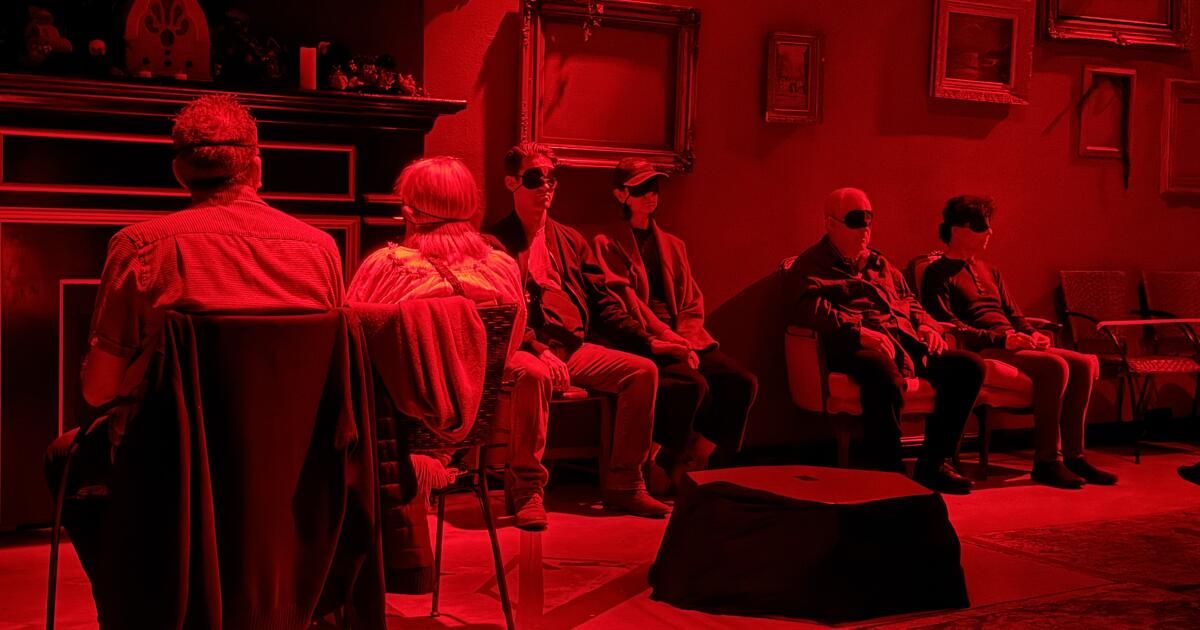
I am blindfolded and sitting in an antique armchair located in the center of a dark room, lit in red and with gothic details. An actor performs nearby. I hear their voice, but of course I can't see them. I suddenly jump up in my seat, alarmed by the contact of some kind of fabric… or maybe a feather? – through my ankles.
I will never be completely sure. Because wearing the small veil over my eyes was a requirement to participate in “Poe: Pulse & Pendulum,” the debut offering from new company Theater Obscura LA. The company's opening performance contains two one-act plays, modern interpretations of Edgar Allan Poe's “The Pit and the Pendulum” and “The Tell-Tale Heart.”
While the stories are familiar to many, Theater Obscura heightens the levels of discomfort. In this room, I sometimes feel uneasy and at the same time follow the movements of the actors while trying to remain hyperaware of any sudden touch or smell. “The Pit and the Pendulum,” the first half of the show, translates especially well to this setting, its dark sense of demented confinement keeping my nerves on high alert.
The objective was to conjure such a state of anxiety.
“If you take away the visual, you're going to feel uncomfortable,” says Paul Millet, who came up with the concept.
There are shocks. The centre's event space, Count's Den, has been outfitted with around 50 speakers for the Obscura shows, which run until April 12. Some are visible before one puts on the blindfold. Many, however, are hidden under seats or sofas, as the audio will follow the actors around the room, or perhaps a sudden knock or opening of a door will cause me to focus my attention elsewhere.
“The Pit and the Pendulum” is a story of torture, and while the narrator, here played by Melissa Lugo, speaks desperately of a sword swinging above, the actors will fan us, synchronizing their waves with each movement. whistle of the audio. He was prepared for it, when a nearby theater companion let out a soft cry as the invisible gestures first arrived above his head.
For many, sight is the most coveted sense. “If you take that away, naturally you already feel uncomfortable,” says Millet. “So we lean into that. We know you're going to feel uncomfortable. We know this isn't the norm. But come on that ride with us. Be willing to be uncomfortable. I think discomfort helps heighten the experience and ideally allows you to trigger the emotional reactions that the story generates.”
“Poe: Pulse & Pendulum” are two audio-centered one-act performances of stories by Edgar Allan Poe.
(Joe Camareno / Dark Theater)
Still, touch is limited in the program. From time to time you could hear the sound of a chair, but little else. The fluttering I felt near my ankles was to mimic the sensation of a creature running. The company will seek consent from the audience and participants may opt out. While I wondered if “Poe: Pulse & Pendulum” would seek to recall more extreme experiences with prolonged renunciations, Millet wanted to keep it light: an audio work, primarily, with just a few in-person cues.
“We want people to feel uncomfortable, but I don't want anyone to be written out of the story because a boundary or a line was crossed,” Millet says.
Scent is also used sparingly. There are times when guests will smell a fragrance that matches the story. Millet sees Theater Obscure's first run as an experiment in how much touch and smell audiences may want to endure. Smell, he says, is tricky, as the scent can linger and become a distraction.
Millet has been perfecting the concept since 2023. Previously, he was part of the team behind Wicked Lit, which ended in 2019 after running for several years in unique locations like Altadena's Mountain View Mausoleum. Those immersive performances would feature casts and guests touring the venue. The Dark Theater, however, is full of seats.

“Poe: Pulse & Pendulum” focuses on the fear that something will happen to us when we lose sight.
(Joe Camareno / Dark Theater)
And while Poe's stories lend themselves to the Halloween season, spooky events increasingly occur throughout the year. The long-running production “The Willows” will wrap in early April, and “Monster Party,” a period piece that takes guests to a devilishly extravagant cocktail party, will be re-released in mid-April. Millet, a longtime theater producer who works daily in television editing, hopes to stand out by avoiding “the excess” of horror events that occur every September and October.
Theater Obscura may face challenges, such as persuading potential guests that “The Pit and the Pendulum” is more than just a live reading with audio effects.
“You can feel the movement of the characters around you,” says Millet. “You're in the environment with the story as it unfolds. You can experience it on a more visceral level.”
Blindfolded, I felt like the Dark Theater was playing on our fears rather than giving in to them, focusing heavily on our anticipation that something might happen to us when we were stripped of our sight. For much of “The Pit and the Pendulum,” Lugo circles the guests, who are seated sporadically around the room, allowing each of us to imagine how close or far we might be from the hole we are told is in the center. Each show addresses claustrophobia in some way, whether of a space or a mind.
“The Tell-Tale Heart” is louder, busier. The sounds of breaking glass and creaking floorboards made my head work overtime to draw a shot, only to then distort it when the actors unexpectedly whispered in my ears to bring out the protagonist's nightmares. While I expected Theater Obscura to be a little more aggressive in its use of touch and smell, it's a show that asks us to live in our heads and sit in our own sense of unease.
“I was intrigued,” Millet says, “to really try to appeal to the public's imagination.”