A snapshot of fire-ravaged Altadena appears before me, floating like a diorama. My eyes focus on a red door, the frame of which is one of the few surviving remains of a house. I bring it closer to me and in a few moments I see a fraction of the house as it was before; Now I'm in a cozy kitchen with blurry but cozy images in the background and a grandpa celebrating a birthday. A voiceover tells me that it was Alexander, a grandfather, who painted the door red.
It's as if a memory has come to life and exists only in the ether in front of me. But in a few seconds it disappeared and I only see rubble: scattered bricks and tiles, tree branches and wooden boards.
I shed a tear, but it was hidden by the virtual reality headset I'm wearing. I’m experiencing a work-in-progress segment of the multimedia documentary “Out of the Ashes,” which will debut Friday night at a Music Center event and demonstrate how emerging technologies can help people process collective experiences like the Los Angeles fires.
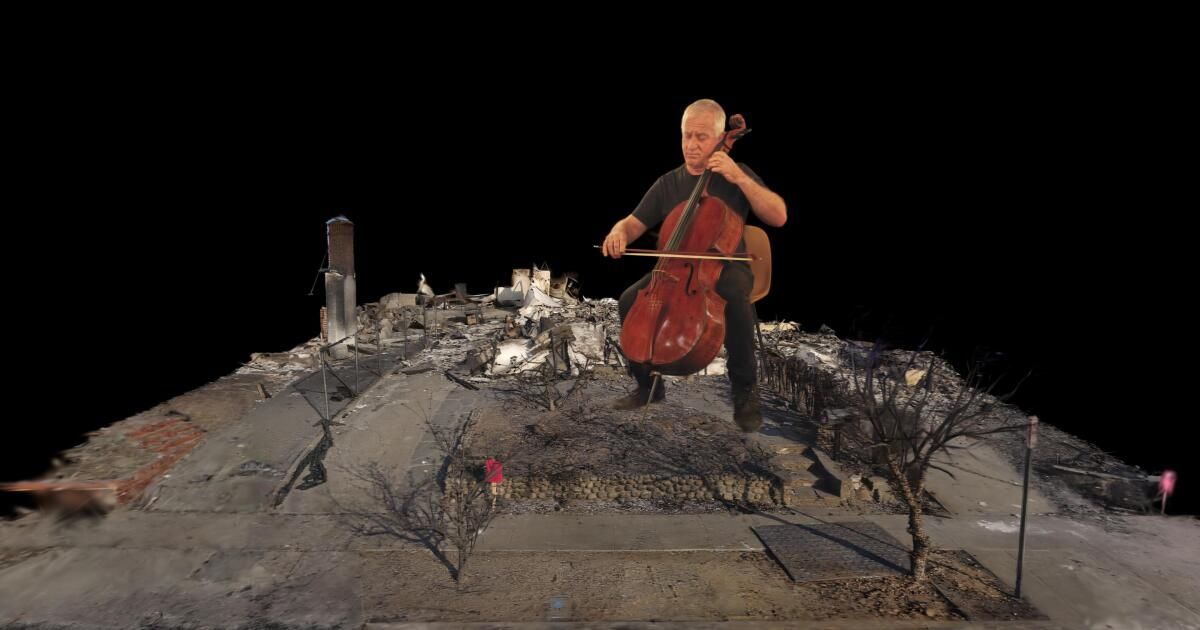
Musician David Low and his family in the virtual reality film “Out of the Ashes,” which shows the destruction (and reconstruction) of the Palisades and Eaton fires.
(The Commercial Agency)
Filming on the project continues, which began a few days after the flames were lit. Filmmaker, academic, and virtual reality pioneer Nonny de la Peña secured media access to the burned areas for herself and a small team through her role as director of the narrative and emerging media program at Arizona State University, operating from its offices in downtown Los Angeles. “I knew that this was going to be a temporary type of situation, that it was going to change quickly,” says De la Peña, co-director of the film with Rory Mitchell. “I've covered enough disaster stories to know how big this was.”
De la Peña has long been at the forefront of merging immersive technologies and journalism. His 2012 project, “Hunger in Los Angeles,” for example, was the first virtual reality documentary to screen at Sundance. “I think this technology is unique,” says De la Peña. “I've seen a lot of helicopter footage, but when you're there, you have a different perspective of what happened.” For this documentary, he teamed up with Mitchell, an independent filmmaker, whose augmented reality experience “The Tent” premiered at SXSW last year.
In my preview of “Out of the Ashes,” a segment takes me to the coast. If I tilt my head down, I see the bright lights of the Santa Monica Pier. However, look slightly up and the sky is charred red and black. I hear a cello and soon musician David Low is standing in front of me, recounting the day the flames started and the rush to get his young son out of school to help rescue some family heirlooms.
The family saved some stuffed animals and a couple of precious musical instruments, but given the urgency to leave, not much else. He is sitting at the kitchen table, reconstructed in virtual reality from family photographs, but the rest of the house has disappeared. When I see glimpses of Low's house before and after the fires, I again feel like I'm standing in a liminal space, a memory but also a reminder. Low exists only as a three-dimensional figure before me, but I wish I could extend my hand.
The instinct to reach out seems natural in virtual reality, as it is visceral and creates a sense of presence. And it also seems part of the mission of “Out of the Ashes,” a work that is as much about the effects of the fires as it is a vessel for collective grief and empathy. “Sometimes you just need someone to tell you, ‘Hey, I'm sorry about what happened to you.’ Sometimes you just need someone to hug you,” De la Peña says. “When you lose so much, sometimes it's hard to understand.”

Landscape architect Esther Margulies analyzes what trees burned and what didn't in the Palisades and Eaton fires in the virtual reality film “Out of the Ashes.”
(The Commercial Agency)
Mitchell adds: “We understand the numbers and the acreage,” he says before listing a series of fire statistics. “But only through history can we begin to understand in our hearts and brains the scale of the emotional devastation and psychic pain that the city has gone through. Perhaps this can provide a way to address this collective pain and a way to talk about it.”
Another aspect of “Out of the Ashes” is augmented reality, which will also be shown at the Music Center event. The technology is used to capture brief snapshots of Altadena and Palisades scenes.
Retired professor Ted Porter, for example, remembers buying a loaf of his late wife's favorite bread when the winds started, thinking he might need something to snack on if the power went out. Melissa Rivers talks about taking photos of her late father and running for her mother's Emmy, and remembers how meaningful the award was to Joan. “I don't know why I grabbed what I grabbed,” Rivers says. “It's just what I did.” They are brief scenes in which a small object floats before us and reflect the unpredictability of life, but also how, in moments of stress, our minds race to the symbols that really matter to us.
“Part of what this process is is trying to provide a space for people directly affected by it, who are trying to rebuild their lives and explain to their children what happened,” Mitchell says. “Everyone is going to process at different speeds and in different ways, but doing it collectively and communally is the hope with this.”
Friday's event, officially called the Music Center's Social Innovation: Reflections on Loss, Hope and Renewal, will also include a live musical performance by survivors of the Eaton Fire. Guests will also have the chance to learn how to use 3D scanning tools via their smartphones to start creating their own short clips filled with memories. Acorns will also be given away as representations of resilience, and audio interviews from those who experienced the fires will be compiled into a sound collage.
The Music Center's social innovation: reflections on loss, hope and renewal
De la Peña and Mitchell say they have more work to do on the film, which, once completed, could be taken to festivals or become its own traveling exhibition. Updates will be posted on Mitchell's production company's Instagram. “We want people to know what we've been through,” Mitchell says.
And what we continue to experience. A virtual reality segment focuses on landscape architect Esther Margulies discussing the effects of climate change and the importance of planting California oaks (“ember catchers,” Mitchell says) instead of palm trees. In the headphones, we see Margulies standing among fire-scorched trees, a desolate and gruesome landscape. However, this is soon contrasted by the surviving oak trees, which are displayed majestically among empty and otherwise deserted streets. In the midst of much despair, they present themselves as a small symbol of hope.