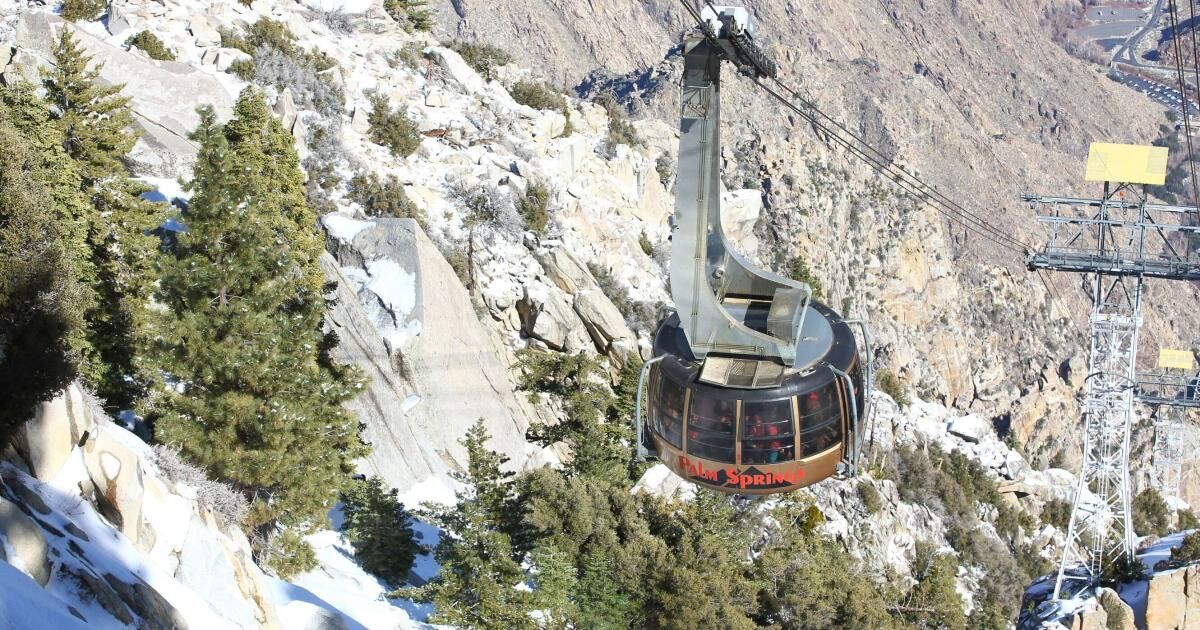
Since 1963, people have taken the Palm Springs Aerial Tramway on a 10-minute, 2.5-mile ride from its Valley station, about 2,650 feet above sea level, to its Mountain station, just over 8,500 feet above sea level, where passengers can continue their adventure at Mt. San Jacinto State Park.
My friends and I have experienced the type of contradictory adventure that this route allows: playing in the snow on the same weekend that we visited an oasis in the shade of enormous palm trees.
That has always been the goal. As a 1937 Times article about the plan to build the tram explained, “Desert dwellers could then go from a one-piece bathing suit swimming in the ultraviolet rays of the sun in the Desert Inn pool to wool underwear and snowshoeing in an hour.” (Although the Desert Inn has since closed, you can find many other hotels in Palm Springs.)
The only downside for anyone looking to visit now is that the winter holidays mark one of the busiest seasons for the tram, especially since it snowed in Mt. San Jacinto around Thanksgiving. Spots fill up quickly online and in-person lines can be long. Here's what you need to know about getting a ticket and planning a trip.
A day on the Palm Springs cable car.
(David Fouts / For The Times)
How do I get tickets for the Palm Springs Gondola?
A limited number of tickets each day are available for pre-purchase on the tram website. Most tickets are sold in person, said Rachel Anderson, public relations manager for the tram.
To avoid long lines on weekends, Anderson said guests should arrive at 7 a.m., an hour before the first tram boards at 8 a.m. The ticket office opens at 7:30 am. “Otherwise, wait times can last several hours during the holiday season,” he said.
Wait times are especially long around Christmas, when children are out of school and out-of-town guests visit Southern California.
The length of the line ebbs and flows throughout the day, he said, reaching its greatest length in the days around Christmas and New Year's, and on weekends when children are out of school during winter break. On weekdays there are fewer people, but there are still lines, he said.
The winter tram schedule, which runs from September 2 to May 21, is: Monday to Friday, the first tram goes up at 10 a.m., the last tram goes up at 8 p.m. and the last tram goes down at 9:30 p.m. On weekends and holidays, the last tram goes up at 8 p.m. and the last tram goes down at 9:30 p.m.
Tickets are $20.95 for children ages 3-10, $36.95 for older children and adults, and $33.95 for adults ages 65 and older.

A balcony where guests can enjoy the stunning desert views.
(David Fouts / For The Times)
What can I do once at the top?
Yodel, dance, snack – the possibilities are endless!
Well, in all seriousness, you can grab a snack or enjoy a great dinner with dishes like vegetarian lasagna or filet mignon, hike anywhere on the 50+ miles of trails, snowshoe, cross-country ski, or just vibe among the Jeffrey pines.
The tram offers hikers who don't feel like taking the strenuous Cactus to the Clouds route: from the tram's mountain station, you can walk 10 miles round trip, saving about 10 arduous miles.
Can I bring my sled and my dog?
Many visitors take the tram to go sledding. Anderson said small plastic sleds are allowed, while inflatable rafts or sleds are not allowed, nor are metal sleds. (Rolling downhill on your own is fine, though!)
Unfortunately, unless Fido is a registered service dog, you'll need to leave your pup at home. Dogs are not allowed on the tram and are generally prohibited on park trails.
Other prohibited items include drones and outside alcohol (but alcohol can be purchased on site).
What is the parking situation?
Parking is $15 for most vehicles and lots open at 9 a.m. Monday through Friday and 7 a.m. on weekends and holidays. A free bus takes visitors to Valley Station, where they can purchase tram tickets.
What else do I need to know?
Personally, I'm a fan of California trivia, so let me tell you more about the history of the streetcar and why it remains a unique opportunity to this day.
I wanted to understand how rare the experience of riding the Palm Springs cable car is, so I spoke with Peter Landsman, editor of LiftBlog, where he's been collecting data on trams and lifts for about 10 years.
Landsman said the Palm Springs tram is special for multiple reasons, but particularly because the car rotates as it goes up and down the mountain, an experience only found on a few trams around the world.
Overall, there are only a dozen similarly constructed streetcars in the United States, and not many are built today. The recently completed tram in Big Sky, Montana, was the first new tram built at a North American ski area since 2008, according to Landsman's blog.
The tram's original construction cost, according to a Times article on its opening day in 1963, was $7.7 million. That's equivalent to about $81.5 million in today's money, according to the U.S. Bureau of Labor Statistics' inflation calculator.
“I would say $7.7 million wouldn't amount to much today,” said Landsman, who works in the ski industry. “That's quite remarkable.”