Disney California Adventure turns 25 this month. Although it is the younger and much smaller sibling of the Disneyland park, the park has become a respectable offering, one that ranks among my favorite Disney parks in North America. No small feat, considering its bumpy and unambitious launch.
California Adventure is today an emblematic example of the best that Disney has to offer. And yet, it remains a work in progress. Being the subject of constant tweaks, another reinvention is on the horizon.
With more Marvel, more “Avatar” and more Pixar to be injected into the park, California Adventure finds itself at a crossroads. But it also carries risks: Will it soon feel like a collection of brand deposits? This, of course, seems to be the vision for the company's theme parks in the recent past. This doesn't always have to be negative. Consider it more of a word of caution.
A “Coco” boat ride is destined for Disney California Adventure. The ride is under construction.
(Pixar/Disneyland Resort)
Few Disney properties, for example, seem more ripe for exploration in a California-focused theme park than “Coco.” Under construction, where Paradise Gardens and Pixar Pier meet, a “Coco”-inspired boat ride will finally give the park a permanent home to recognize our state's Latino culture and heritage. While fans may long for the days of original attractions like Pirates of the Caribbean and the Haunted Mansion, those based on intellectual property (IP in the industry speaking) are not bad, especially when used to enhance the park's overall themes. California Adventure's own Cars Land is a key example.
However, when it starts to feel like a retail store, parks can become tiring. Looking at you, Avengers Campus, a half-finished lot with bombastic orchestral music and familiar urban design that wouldn't be out of place in downtown Los Angeles. In its current state, the land works best as a backdrop for live entertainment, as it lacks the cozy feel of Disney's best creations.
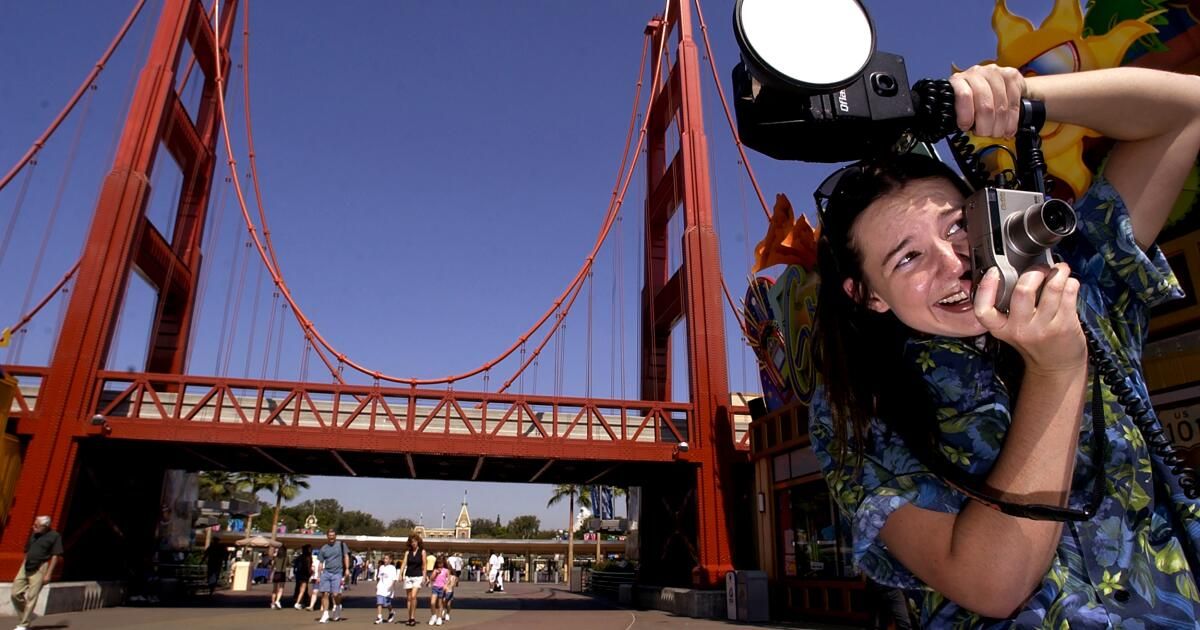
California Adventure, at its most idealized, represented more than just a variety of film properties. Their goal was to showcase the Golden State as a romantic destination, one that in the post-gold rush era has often given America permission to dream. It would capture our people, our nature, our food and our glamor through a joyful and optimistic lens. When completed, the park had a mini Golden Gate Bridge and giant letters spelling out our state's name (which were removed about a decade later).

California Adventure in 2001 was intended to depict a romantic vision of California.
(Mark Boster / Los Angeles Times)
When California Adventure opened in February 2001, it had already undergone many revisions. Walt Disney Co. wanted it to be a West Coast answer to Walt Disney World's Epcot. Their plans at the time were well documented, and the Walt Disney Co. initially gave Westcot, as it would be called, a spherical answer to the Florida park's Spaceship Earth. Over time, and in an attempt to calm the concerns of neighbors, the design of the globe would change until it became a large futuristic needle.
None of it was going to be like that. Financial headaches, caused in part by the struggles of Disneyland Paris's early years, inspired Disney to change course. Disney California Adventure would open with few attractions that rose to Disneyland's level, and yet The Times was gracious in its opening coverage, praising the park's change of pace from its neighbor and admiring how its architecture blurred fiction and reality.
The hang gliding simulation Soarin' Over California was an instant hit and Eureka! A California Parade was Disney theatrics at its strangest, with floats representing Old Town San Diego, Watts and more. But California Adventure's prevalence of costumed county fair-type attractions failed to draw crowds. Disney's own documentary, “The Imagineering Story,” took a tough approach and compared some of its initial designs to those of a local shopping center.

The grand opening of California Adventure in February 2001.
(Mark Boster / Los Angeles Times)
And yet today it's home to one of Walt Disney Co.'s most accomplished areas in Cars Land, which opened in 2012. Flanked by sun-scarred red rocks that look straight out of Arizona, Cars Land is a stunner and on par with Walt Disney Imagineering's best designs (see New Orleans Square, Star Wars: Galaxy's Edge, and Pandora: The World of Avatar). With a nod to our Route 66 history, the land is a neon-lit, 1950s rock-leaning hub of activity, complete with spectacular Radiator Springs Racers.
Cars Land led a major renovation of the park that also included the nostalgic Buena Vista Street, a nod to the Los Feliz era of the 1920s. And by the mid-2010s, many of California Adventure's most unbearable features, such as its cringeworthy puns (San Andreas Shakes was bad, but Philip A. Couch Casting Agency was cringe-inducing), as well as the short-lived disaster of a ride that was Superstar Limo, had started to disappear.

Cars Land, added to California Adventure in 2012, is one of Walt Disney Imagineering's greatest achievements.
(Mark Boster / Los Angeles Times)
With the World of Color nighttime show and plenty of in-park entertainment, pre-pandemic California Adventure started to feel like something akin to a full-day park. It wasn't perfect, of course; no park is.
The Little Mermaid: Ariel's Underwater Adventure, while mildly charming, suffers from being a hodgepodge of familiar movie scenes rather than a narrative picture that can stand on its own. Too many empty buildings clutter the Hollywood Land area, the transformation of Paradise Pier into Pixar Pier did little more than add flashy art with cinematic references to the land, and the transformation of Twilight Zone's Tower of Terror into Guardians of the Galaxy – Mission: Breakout! It was completed at the expense of the park's main Southern California theme.

Paradise Pier in California Adventure in 2002. The land has since become Pixar Pier.
(Don Kelsen / Los Angeles Times)
But there's a lot to love about California Adventure. It shines during the holidays, whether it's the Lunar New Year at the peak of the year or the back-to-back combination of the Halloween and Christmas seasons near its end. This is when California Adventure's entertainment comes to the fore, bringing the park to life with cultural stories that ultimately reflect the diversity of the modern theme park audience.
However, how great would it be if California Adventure were lucky enough to have this level of entertainment year-round. The Hyperion Theatre, a 2,000-seat venue at the edge of Hollywood Land that once hosted shows inspired by “Frozen,” “Aladdin” and “Captain America,” sits empty today. If the Walt Disney Co. can't justify funding the theater, scrap it with the park's next redevelopment, as it serves as a reminder of how fickle the corporation can be when it comes to live performances (also gone, the newsboy-inspired street extravaganza).

California Adventure staff put the finishing touches on the letters that spell “California” before the park opened in 2001. The letters once stood at the park entrance.
(Mark Boster / Los Angeles Times)
Looking ahead, I expect Disney to deliver a powerful “Avatar”-type attraction, and early concept art has shown a thrilling boat attraction that appears to use a ride system similar to Pirates of the Caribbean: Battle for the Sunken Treasure of Shanghai, which is hailed by many as one of the company's strongest modern additions. However, how the pure fantasy landscape of “Avatar” fits into a park that still nominally attempts to reflect California and our diversity is worthy of debate.
And does that matter?
The company would likely argue that if the ride captivates visitors and extends the “Avatar” brand to another generation, it doesn't. But Disneyland, next door, is not timeless because it has “Peter Pan” and “Star Wars.” It has endured for 70 years because its attractions generally reflect cultural myths. And it's a park we want to spend days in, thanks to its beautiful scenery, the relaxing Rivers of America, and the human stories of greed, unity, and romance sprinkled throughout its attractions.
For theme parks, after all, you can jump the shark, so to speak. Spend some time, for example, sitting in California Adventure's San Fransokyo Plaza. It's an unnecessary post-pandemic makeover. What was once a simple food court has been transformed into a noisy corner filled with a gift shop and “Big Hero 6” encounters. You will be transported, but to a place more like a marketing event.
Very happy 25th, Adventure in California. We love you and you are a park worth celebrating, but like most post-college kids, there is still room to learn.