The man I'm talking to tells me he doesn't have a name.
“Hey” is what he responds to, and he says he can best be described as a “travel agent,” a designation said with a sly smile to clearly indicate that it's code for something more illicit.
About eight of us are crammed with him in a small area hidden in the corner of a nightclub. Normally, maybe this is a makeup room, but tonight it's a hideaway where he'll give us psychedelics (they're just mints) to escape the brutalities of the world. It's also loud, as the sounds of a rambunctious funk band next door work to permeate the space.
Celeste Butler Clayton as Ursa Major and Ari Herstand as Copper Jones lead a group of theatergoers in a pre-show ritual.
(Gabriella Angotti-Jones / For The Times)
“Close your eyes,” they tell me. I let the mint begin to melt as I try to pretend it's a gateway to a dream state. The more the mints peddler talks, the more it becomes clear that he suffers from post-traumatic stress disorder from his days in Vietnam. But the atmosphere is not gloomy. We don't need any imaginary substance to capture his idea, particularly his belief that even if music doesn't change the world, it can at least provide us with much-needed comfort.
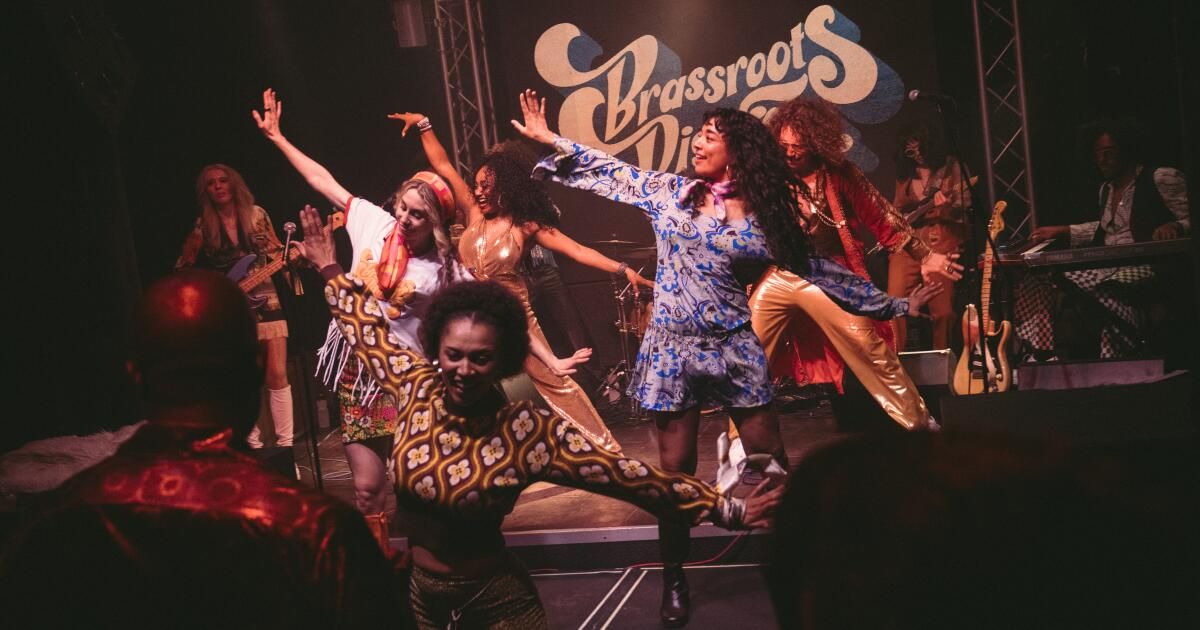
“Brassroots District: LA '74” is part concert, part participatory theater and part experiment, attempting to intersect an evening of dance and joy with high-stakes drama. How it plays out is up to each audience member. Follow the cast and discover war stories and insights into how the underground music scene became a haven for the LGBTQ+ community. Watch the band and witness a near-destroyed concert as a group about to release their debut album weighs community versus cold commerce. Or ignore it all to dress up and enjoy the music that never stops.

Members of the public are encouraged to participate in a “Soul Train”-style dance display.
(Gabriella Angotti-Jones / For The Times)
Now on Catch One, “Brassroots District” aims to invent a fantastical vision of 1974, but creators Ari Herstand and Andrew Leib aren't going for pure nostalgia. The fictional band at the heart of the show, for example, is clearly a nod to Sly and the Family Stone, a group whose musical vision of unity and perseverance through social upheaval still feels ahead of its time. “Brassroots District” also taps directly into Catch One’s history, with a character inspired by the club’s pioneering founder, Jewel Thais-Williams, a vital figure in the Los Angeles music scene who envisioned a sanctuary for black queer women and men, as well as trans, gay and musically adventurous revelers.
“This is the era of Watergate and Nixon and a corrupt president,” Herstand says, noting that the year 1974 was chosen intentionally. “There are very clear political parallels from the early '70s to 2026. We don't want to slap anyone for it, but we want to ask questions about where we come from.”
This is not the first time a version of “Brassroots District” has been performed. Herstand, a musician and author, and Leib, an artist manager, have been perfecting the concept for a decade. It began as an idea that occurred to Herstand while spending time with his family in New Orleans to work on his book, “How to Succeed in the New Music Business.” And initially it started simply as a band, and perhaps as a way to create excitement around a new group.

Ari Herstand as musician Copper Jones in an intimate moment with the audience.
(Gabriella Angotti-Jones / For The Times)

Celeste Butler Clayton (Ursa Major), from left, Ari Herstand (Copper Jones), Bryan Daniel Porter (Donny) and Marqell Edward Clayton (Gil) in a tense moment.
(Gabriella Angotti-Jones/for The Times)
However, as the couple fell in love with immersive theater (a term that generally implies some form of active participation on the part of the audience, usually through interaction and improvisation with actors), Brassroots District, the band, gradually evolved into the “Brassroots District” show. Like many in the space, Herstand credits the long-running New York production “Sleep No More” for bringing him to the scene.
“This is really an alternative experience to a traditional proscenium show, giving the audience autonomy to explore,” Herstand says.
Eleven actors star in the show, directed by DeMone Seraphin and written with input from Los Angeles immersive veterans Chris Porter (The Speakeasy Society) and Lauren Ludwig (Capital W). I only interacted with a handful of them, but “Brassroots District” builds to a participatory finale that aims to get the entire audience moving as the band jumps into the crowd for a group dance. The night is one of wish-fulfillment for music fans, offering the promise of backstage action as well as an idealized vision of the communal power of funk.
In favor of “Brassroots District” is that, ultimately, it is a concert. Brassroots District, the group, released their debut “Welcome to the Brassroots District” earlier this year, and audience members who don't want to hunt down or chase the actors can sit back and watch the show, probably still picking up on its broad plot of a band weighing a new record deal with a potentially sleazy record executive. However, Herstand and Leib estimate that about half of attendees want to dig a little deeper.
On the show's opening weekend last Saturday, I can even bet it was more than that. When a split occurs mid-concert that forces the band's two co-leaders, Herstand as Copper Jones and Celeste Butler Clayton as Ursa Major, to run offstage, the audience immediately knew to follow them to the other room, even as the backing band continued to play. Leib, borrowing a term from the world of video games, describes them as “side quests,” moments in which the audience can get to know the performers, the club owner, and the event director better.

“Brassroots District: LA '74” is the fulfillment of music fans' wishes, providing, for example, access to the artists as well as backstage. Here, Celeste Butler Clayton plays musician Ursa Major and is surrounded by ticket-goers.
(Gabriella Angotti-Jones / For The Times)

The costume of a member of the public.
(Gabriella Angotti-Jones / For The Times)
However, those who remain on the main stage will still have some moments of spectacle, as this is where a journalist will face off with a record executive. The two will stay on the floor and chat with willing guests, perhaps even offering them a business card with a number to call after the show to advance the story beyond the confines of the club. If everything goes according to plan, the audience will begin to feel like an artist. In fact, the central drama of “Brassroots District” often begins when an attendee finds some intentionally abandoned props that allude to the group's record label drama. The actors, Herstand says, will “freely guide” the players to the right place, if necessary.
“The thing is,” says Leib, “that you, as an audience member, are also playing a character. You can shake the place up.” And with much of the crowd dressed in their best '70s outfits and smartphones strictly prohibited (they're placed in bags before the show starts), you may need a moment to figure out who the actors are, but a microphone usually helps you out.
“They're a better version of themselves,” Herstand says of the public's inclination to come to “Brassroots District” in costume, even though they don't have to.
“Brassroots District,” which runs about two hours, is scheduled to run through the end of March, but Herstand and Leib hope it will become a full-length performance. Previous iterations with different stories were set outdoors, as they were first held in the months following the worst days of the pandemic. Inside, at places like Catch One, was always the goal, the two say, and they both leaned into the history of the place.
“Brassroots District: LA '74”
“It's in the essence of the building that this was a respite for queer men and the black community,” Leib says. “There's a little bit of this being a safe space to be yourself. We're incorporating some of these themes into the show. It's resistance through art and music.”
A message like this is conveyed in a song. One of the band's central songs is “Together”, an allusion to Sly and the Family Stone's “Everyday People”. It's a light number built around finger snaps and the vision of a better world.
“We are stronger when we come together,” Herstand says. “That's the hook of the song, and what we're really trying to do is bring people together. That's how we feel like we can really change society.”
And tonight, that's exactly what progress looks like: an exuberant party that reaches out for everyone to dance with a neighbor.