GSMA, the G6 group of leading African operators and leading OEMs join forces with agreement to pilot affordable next-generation 4G smartphones for millions of people across Africa
March 3, 2026, Barcelona: The GSMA announced today that six African countries – Democratic Republic of the Congo (DRC), Ethiopia, Nigeria, Rwanda, Tanzania and Uganda – have been identified by the GSMA Handset Affordability Coalition as initial pilots to introduce affordable 4G smartphones and hope that governments will support their efforts.
The Memorandum of Understanding (MoU), signed between the GSMA, the G6 group of major African operators and original equipment manufacturer (OEM) partners, formalizes the collaboration to pilot affordable entry-level 4G smartphones in Africa in 2026.
The pilots build on the minimum requirements for low-cost 4G devices presented at MWC Kigali in 2025 and represent an important step forward in turning industry alignment into tangible impact on the ground.
The GSMA Handset Affordability Coalition brings together mobile operators, original equipment manufacturers, financial institutions and international organizations, including the World Bank Group and the ITU. It aims to reduce the cost of basic smartphones worldwide and accelerate digital inclusion in markets where affordability remains a key barrier.
However, the current increase in the overall cost of memory prices is making it increasingly difficult to reach the critical level. Price between 30 and 40 US dollars rank required to unlock mass adoption. In this economic context and considering that there are few opportunities to reduce materials and manufacturing costs for entry-level devices, it has become even more important to reduce or eliminate taxes and import duties on entry-level 4G smartphones.
Vivek Badrinath, Director General of the GSMAsaying: “Affordable smartphones are the gateway to digital and financial inclusion, economic opportunities and innovation. 3.1 billion people have mobile coverage but are not connected to mobile Internet. Together with the G6 group of major African operators, we are sending a clear demand signal to bring low-cost 4G devices to the market. In a global context of rising memory costs, governments have an important role in closing the usage gap. Eliminate taxes and import duties on top-level 4G smartphones basic will be essential to achieve scale.
A great untapped opportunity
Africa continues to host one of the largest mobile internet usage gaps in the world. Millions of people live within broadband coverage but remain offline, with phone affordability consistently cited as the biggest barrier to adoption. Affordable 4G smartphones at scale could bring tens of millions of people onlineunlocking access to education, healthcare, financial services, e-commerce and AI-based tools.
Enabling local innovation in AI
The impact of rising memory costs extends beyond connectivity. Memory-intensive technologies are essential for on-device AI, local language processing, and the growth of regional technology ecosystems.
In this context, the GSMA-led AI language models initiative – built in Africa, by Africa and for Africa – is advancing scalable and locally relevant AI models.
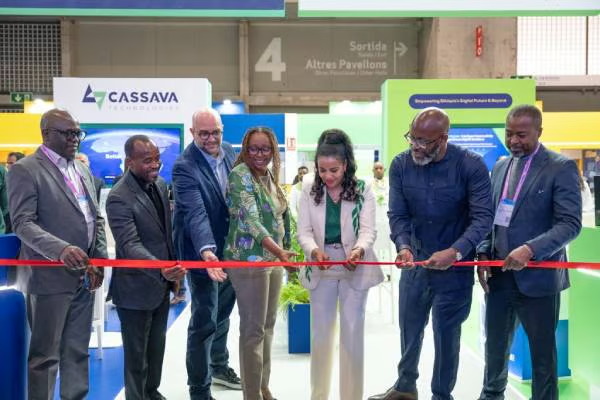
At the first Africa Pavilion at this year's MWC26 Barcelona, the initiative will showcase:
- He Launch and live demonstration of the first open reasoning model in Swahili in collaboration with MeetKai Zambia.able to navigate and translate online content to reduce language barriers to digital services;
- Expanded access to computing through strategic partners AMD and Cassava.
- Benchmarks and tools to ensure models reflect African languages, cultures and real-world use cases;
- A continental map of AI talent highlighting researchers, engineers and institutions driving innovation in the local language.
“AI has the power to amplify Africa's voices, languages and innovation.” Badrinath added. “But without affordable devices and sustainable component prices, their benefits risk remaining out of reach.”
A call to coordinated action
With pilot markets identified and industry collaboration underway, the foundation for scale is in place. Public sector support will be critical to turning progress into sustained impact, both in Africa and beyond.
The GSMA and coalition members will once again bring together industry leaders and policymakers at Kigali World Congress (June 16-18, 2026) to assess progress and advance discussions around mobile phone affordability, closing the usage gap and innovation in locally relevant AI.
-ENDS-
About the GSMA
The GSMA is a global organization that unifies the mobile ecosystem to discover, develop and deliver critical innovation for positive business environments and social change. Our vision is to unlock the full power of connectivity so that people, industry and society thrive. Representing mobile operators and organizations across the mobile ecosystem and adjacent industries, the GSMA offers its members three broad pillars: connectivity for good, industry services and solutions, and outreach. This activity includes advancing policy, addressing today's biggest societal challenges, supporting the technology and interoperability that make mobile devices work, and providing the world's largest platform to convene the mobile ecosystem at the MWC and M360 series of events.
We invite you to learn more at gsma.com
Media contacts
GSMA Press Office
[email protected]