It is well known that most televisions today generally do not have the built-in sound to match the picture quality, especially the mid-range or cheaper models. This is where one of the best soundbars comes to the rescue, but not everyone has the space or budget for one of the truly large, immersive systems.
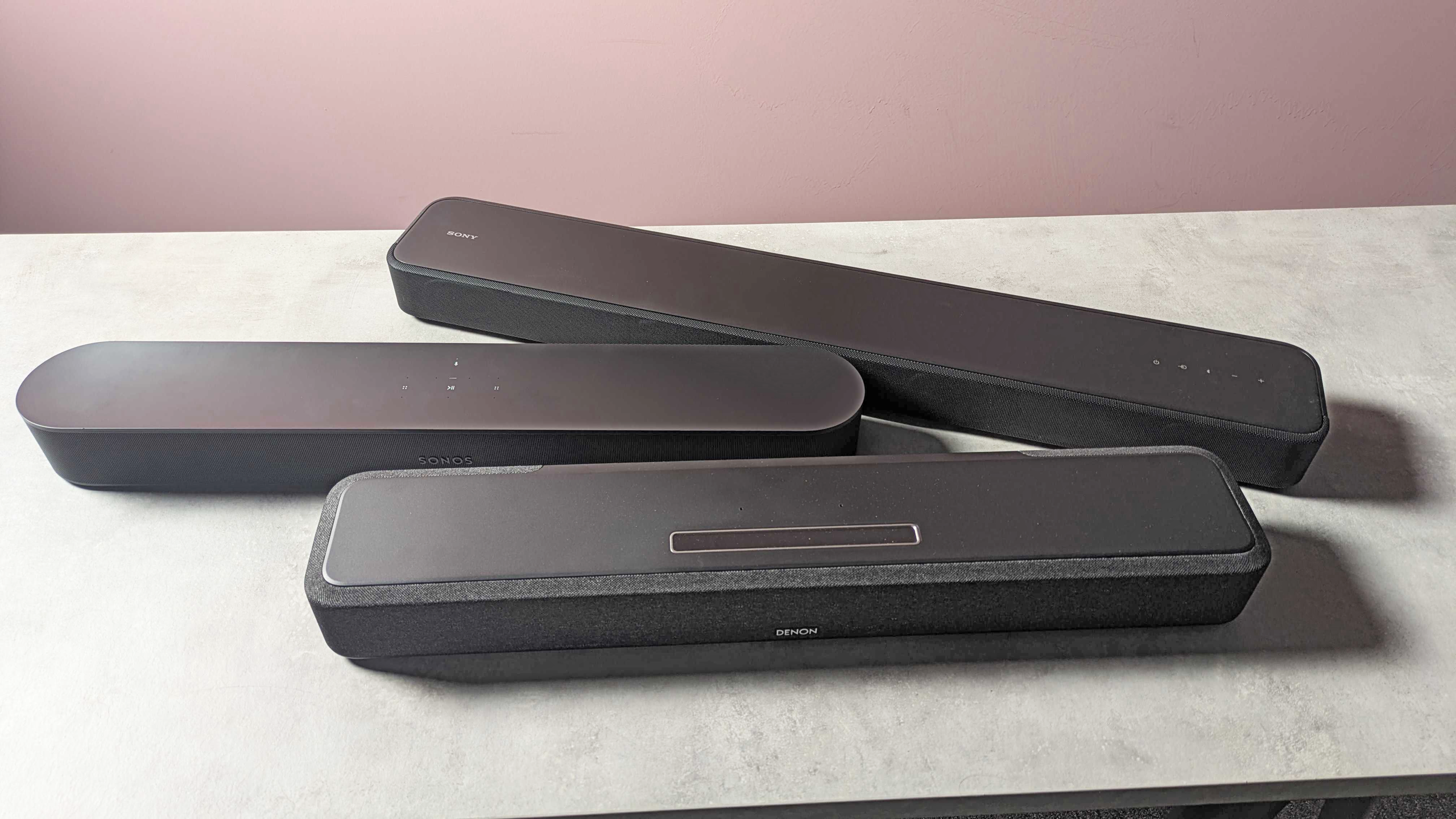
So what you need is a humble, compact, all-in-one soundbar, and we had three of the best available in our test lab: the Sonos Beam (Gen 2), Denon Home 550 and Sony HT-S2000, the latter of which has been our top budget recommendation for a while now.
Article continues below.
the batman
My favorite test scene for TV soundbars and audio, the Batmobile chase scene from the batman It's a perfect test for all audio elements: sound mapping, bass, voice, Dolby Atmos, and surround effects. It's easily one of my favorite Atmos scenes.
The first thing I noticed was how effectively the three sound bars delivered the roar of the Batmobile's engine. The Denon had plenty of initial bass that was well controlled, but the Sonos felt a little more refined with good space between the engine's bass and other elements. While the Sony's bass was thinner than the other two, it was still decent.
The Denon delivered a surprisingly wide soundstage with plenty of room-filling power. Its Dolby Atmos virtual processing created a dome effect despite its compact size. The Sonos also had a wide soundstage with plenty of depth, but it wasn't as convincing as the Denon. Sony delivered decent Atmos, but again felt a bit thinner in sound overall.
All three soundbars were highly accurate, mapping effects (like the bullet firing from the Penguin's gun, skidding tires, and blaring car horns) precisely between the soundbar and the action on the screen. Once again, the Denon was more accurate, but the Sonos came in second. The Sony also sounded accurate, particularly with the Batmobile's engine flame on.
While the Denon primarily shined in this scene, I found that various sound effects could look cluttered at times, with the score getting lost in explosions, while the Sonos was able to give each sound element more room to breathe. The Sony had good detail, but felt narrower than the other two, meaning some elements weren't as clear.
The mask

A semi-recent addition to the testing list, The mask It has excellent sound design highlighting one area in particular: the location and direction of the sound. All of The Mask's zany, cartoonish sound effects, especially its tornado, are brilliant audio evidence.
Once again, all three soundbars demonstrated impressive sound placement, accurately conveying the movement of The Mask's tornado around your bedroom with life-like accuracy. Denon and Sonos had the advantage in sound power, which made the tornado effect more appealing, but Sony did a good job in its own right.
While the Denon was bolder and more direct in the scene, the Sonos had a nice width that was perfect for giving a greater sense of space as the Mask moves around the room. This was also evident later, when bounced shots again had more space on the Sonos, but had more impact through the Denon. Again, the Sony didn't have the impact of the other two soundbars, but there's no denying its accuracy, it just wasn't as exciting.
Wicked

It's not just a normal disc for me when I test the TV's picture quality, Wicked is, of course, excellent for testing audio, as it is a musical with many elements to test a sound system. No song does this better than Defying gravitynot only because of its great score and great voice, but also because of Elphaba's movement on the broom.
Elphaba's voice is big, bold and powerful, and the three soundbars do it justice. The Sonos had the most clarity on vocals, while the Denon had the absolute power, and the Sony really struck a good balance between the two.
One thing that surprised me was how Sonos handled the rest of the soundtrack (the score itself, the sound of the wind when Elphaba flies on the broom) because these were pushed to the back of the Sonos soundstage, with the vocals receiving most of the power. This took away from the shocking and dizzying nature of the scene.
The Denon, on the other hand, managed to strike a delicate balance between each element, as did the Sony (it just sounded thinner than the Denon).
In terms of sound amplitude, Sonos proved to have the greatest amplitude. The Denon opted for a direct approach, which meant it didn't sound as wide in places. The Sony again offered a wide sound with good space, but not as much as the others.
oppenheimer

While there are plenty of scenes you could use oppenheimer To show off his home cinema, both video and audio, it's actually the scene where Strauss shows Oppenheimer a tour of the University that I used to test the dialogue.
All three soundbars delivered clear speech throughout the scene, even without any speech enhancement features activated. I found that Sonos and Sony had the most authentic sound, and by that I mean they accurately conveyed Strauss and Oppenheimer's echoey voices while they were in the office. The Denon sounded much cleaner and fuller, but it's not really the most accurate for film.
Once again, all three soundbars showed excellent tracking, as they were able to replicate voices accurately whether from behind, to the side, or when both characters were at a distance. I also tested the voice enhancements of all three sound bars, and while they were effective, they limited other aspects of the sound. Frankly, none of them needed these improvements.
Top Gun: Maverick

Top Gun: Maverick is another benchmark test disc with plenty of scenes so your home theater can really flex its muscles. A common one that I use (and that companies often use in tech demos) is Darkstar's test flight at the beginning of the movie, because it's a perfect Dolby Atmos high-rise scene.
What I really wanted to test out in these three soundbars was their virtual Dolby Atmos processing, since none of them have overhead speakers. I had glimpses in the batman and Wickedbut it's really the moment in this scene where Maverick flies over Admiral Cain that will make or break the height channels.
Honestly, all three did well considering their compact size and lack of loud speakers. They all demonstrated quite convincing Atmos, providing insight into the flight path of Darkstar traveling overhead. While it didn't fill the room or completely go over my head like I had with the Samsung HW-Q990F or the Sonos Arc Ultra, it was a valiant effort.
The Sonos had the most spacious feel, giving the Atmos room to breathe, while the Denon again had that punch of power that felt more authentic to the aircraft. Sony was arguably the most impressive, however, as its virtual Atmos positioning was more effective and compelling than I thought.
Which one to buy?
Image 1 of 3


For their size and price, these three sound bars impressed me. While Sony had a bit of an uphill battle, it's still a really good soundbar for its price. When it comes to price, all of these soundbars have been in the region of $399-$499 / £399-£499 / AU$799-AU$899 before. However, the Denon is generally the most expensive in the US, sometimes reaching $699, and as much as I liked it, it's a big jump from the other two models.
Since Sony is hard to get and Denon is much more expensive, Sonos still reigns supreme in the US. Elsewhere, where prices are closer, it all comes down to preference.
The Denon and Sonos apps work similarly and both have extra ecosystems and speakers you can add, while the Sony is an impressive budget option. For me, if the price were right, I'd go with Denon and its particular combination of power and positioning abilities, but I wouldn't be mad at either of these soundbars.

The best sound bars for all budgets
Follow TechRadar on Google News and add us as a preferred source to receive news, reviews and opinions from our experts in your feeds. Be sure to click the Follow button!
And of course, you can also follow TechRadar on YouTube and tiktok for news, reviews, unboxings in video form and receive regular updates from us on WhatsApp also.