By
Portugal Textile
Published
December 5, 2025
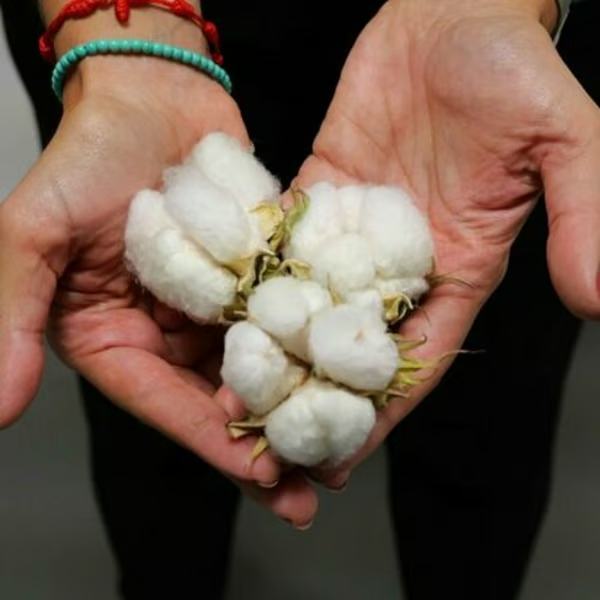
A partnership between Agromethod Labs and CITEVE is promoting hydroponic cotton cultivation, a project that could make Portugal the only country in Europe that hosts the entire cotton value chain, from fiber to clothing.
Agromethod Labs was founded earlier this year with the mission of developing more sustainable and future-oriented agricultural solutions. Its founder, Raquel María, a chemist by training and with a long career in academic research, explains that the drive to create the start-up It arose from a personal concern.
“Academy allows us to change the world on a small scale. I felt it was time to bring that knowledge to the real world and have a greater impact on future generations,” he told Portugal Têxtil.
Although Agromethod Labs works in several fields, cotton quickly stood out, based on previous research, in particular that of researcher Filipe Natálio, currently at the Applied Biomolecular Sciences Unit (UCIBIO) of the Faculty of Science and Technology of the Nova University of Lisbon (NOVA FCT). “But we want to continue working on other types of crops and other seeds. Agromethod Labs is bigger than cotton,” he says.
The approach to CITEVE marked a turning point. According to the founder, the hydroponic cotton project “was practically on paper” and required an initial investment and a solid technological partner. “CITEVE was decisive. It came at the right time and finally gave us the opportunity to start with something that we had already thought a lot about, but that was not yet in a position to move forward,” he says.
The collaboration has made it possible to implement a functional mini pilot, already with measurable results, and prepare the next phase: a larger-scale pilot that will incorporate vertical farming to maximize the production area.
Advantages and challenges
Hydroponic cultivation offers important advantages, says Raquel María. “We can grow anywhere in the world, without depending on sunlight and without geographical limitations,” he explains. It also allows for continuous production. “We are no longer limited to one annual crop. We can get three or four crops a year,” he says.
Early results also show improvements in fiber. “We have obtained cotton with better mechanical properties and greater whiteness, which allows us to reduce some stages of textile processing,” says Raquel María.
Still, the founder of Agromethod Labs acknowledges that there are challenges, particularly in terms of costs, since this cultivation technique is more expensive. However, incorporating vertical farming into the new pilot could help. “If we double the production area, we will be able to get closer to the economic viability we want,” he believes. Considering the higher costs and added value of the fiber, the raw material produced “in the initial phase will be directed to specialized markets,” he says.
Small-scale production carried out in a CITEVE room has already made it possible to produce threads from hydroponic cotton. The next symbolic objective will be “to make a t-shirt and be able to say that it is made with cotton produced in Portugal would be wonderful,” confesses Raquel María.
With the expansion planned for the next six months, the objective will be to significantly increase production and take an important step towards the market. According to the founder of Agromethod Labs, the Portuguese textile industry has already begun to show enthusiasm. “There have been several expressions of interest. We are completely open to collaborating with Portuguese companies,” he says.
However, the ambition goes beyond fiber production. “Portugal could be the only country in Europe that has the entire value chain – from raw materials to the final product – in a single territory. That would be a milestone for the country,” concludes Raquel María.
This article is a machine translation. Click here to read the original article.