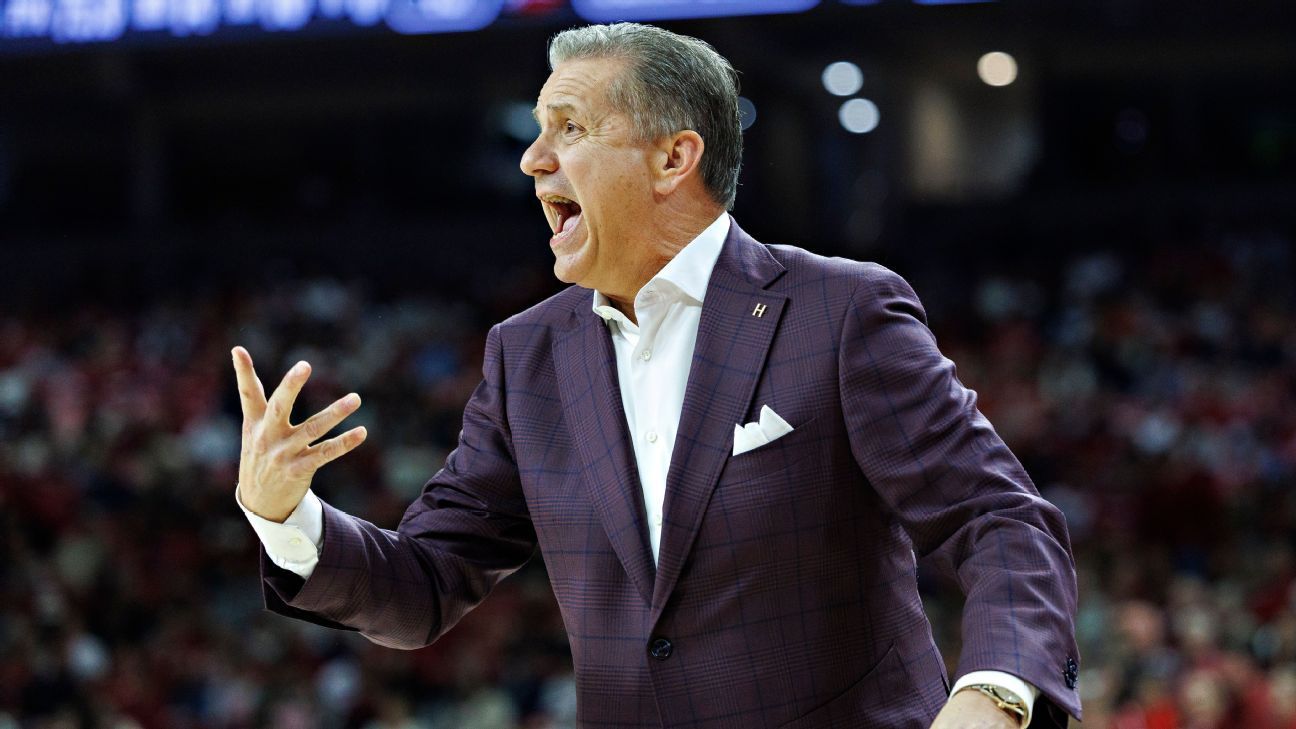
Without new rules preventing teams from adding players with professional experience to their rosters, the value of American high school players will rapidly decline, John Calipari said in a postgame State of the Sport speech Monday night.
In a six-minute response about college basketball, days after Baylor announced the addition of former NBA draft pick James Nnaji to its roster, Calipari said the sport's youngest talents will suffer if players who have played professionally, at the national or international level, are allowed to compete.
“Does anyone care what this is doing for America's 17- and 18-year-old kids? Do they know what this opportunity has done for them and their families? There won't be any high school kids,” Calipari said after Arkansas' 103-74 victory over James Madison. “Who, other than dumb people like me, is going to recruit high school kids? I get so much satisfaction from coaching young kids and watching them grow and succeed – and their families and their lives change – that I'm going to keep doing it. But why anyone else, when you can get NBA players, G League players, 28-year-old kids, kids from Europe? Do we really know their transcript? Do we have anyone there? Do we really know their birth certificate or not?”
“We don't have rules.”
Both Louisville (London Johnson) and Santa Clara (Thierry Darlan) recently signed players with G League experience to their rosters, but Nnaji, a 7-foot center who played professionally overseas after being selected 31st overall in the 2023 NBA draft, is the first player selected to be cleared to play by the NCAA.
While Scott Drew defended his decision to add Nnaji and said he was “happy” he was allowed to play, UConn's Dan Hurley, Gonzaga's Mark Few and Michigan State's Tom Izzo criticized the rules that allowed this to happen.
“Now we're taking guys who were drafted in the NBA,” Izzo said. “If that's what we're going to do, shame on the NCAA. Shame on the coaches too. But shame on the NCAA. Because the coaches are going to do what they have to do, I guess.”
Calipari expressed those feelings on Monday. He listed a set of proposed rules that he believes could stabilize the sport, including four years of eligibility over a five-year period for each athlete and the elimination of all mid-season additions.
“This is easy. We can do it, NCAA,” he said. “Don't talk to me about lawsuits. If you join a program mid-season, you can't play that season.”
Calipari said he would make an exception for students who were not academically eligible during the first semester but were in good standing to compete in the second semester. However, he did not offer any exceptions for players who entered the NBA draft, saying that all players in that situation should be suspended.
“Very simple. Rules are rules, so if you put your name on the [NBA draft]”I don't care if you're from Russia and you stay in the draft, you can't play college basketball,” Calipari said. “'Well, that's just for American kids.' What? If your name is in that draft and you were selected, you can't play because that's our rule.”
NCAA President Charlie Baker posted a statement on social media Tuesday addressing the eligibility issue, saying in part: “The NCAA has not and will not grant eligibility to any prospective or returning student-athlete who has signed an NBA contract (including a two-way contract). As schools increasingly recruit individuals with experience in international leagues, the NCAA is exercising discretion in applying the actual and necessary expenses statute to ensure that prospective student-athletes with experience in American basketball leagues do not disadvantaged compared to their international counterparts.
Baker added that he would work with “DI leaders in the coming weeks to protect college basketball” after “recent outlier decisions” regarding eligibility.
It's unclear what else the NCAA will allow in the near future regarding players with professional experience as it seeks congressional intervention to fix the situation. But Calipari said stakeholders within college basketball should act now to preserve its future.
“How about we just do those things?” said. “We can do it without Congress and the Senate getting 60 votes.”