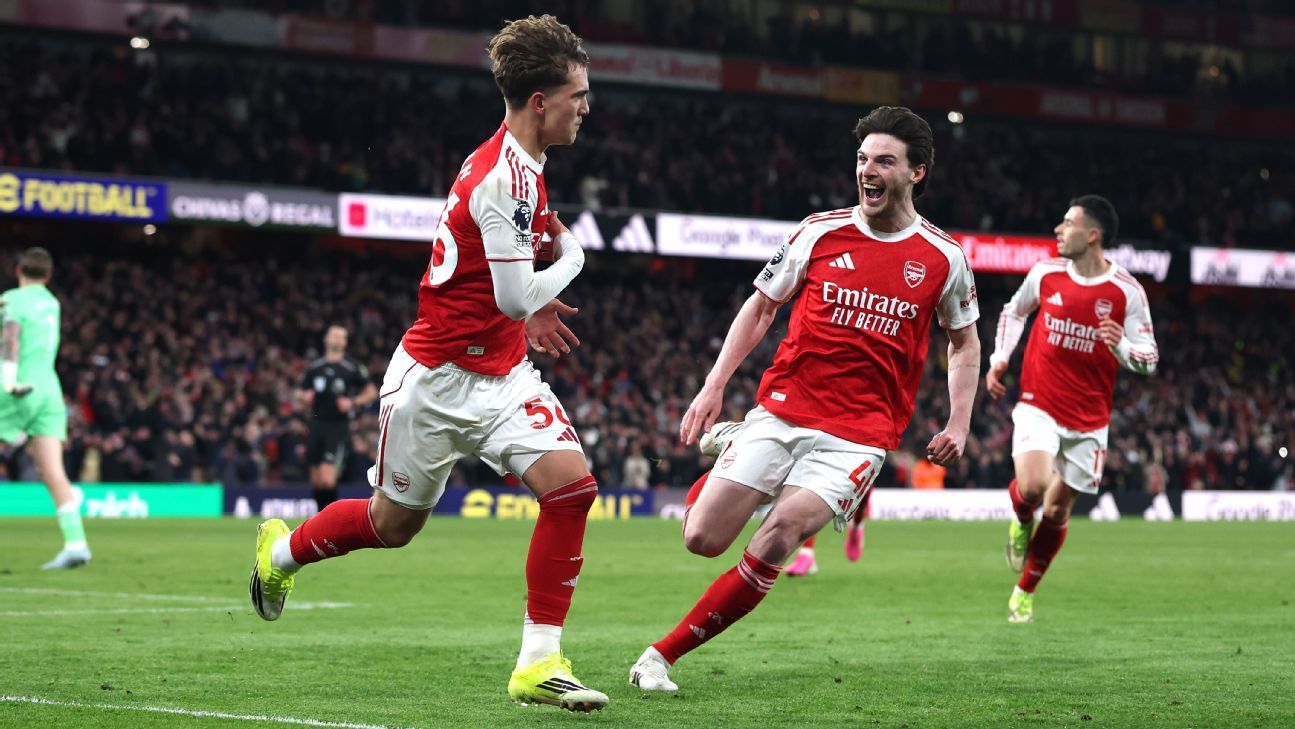
Max Dowman could have done more than simply score a historic and potentially decisive goal in the Premier League title race to seal Arsenal's 2-0 victory against Everton at the weekend. The 16-year-old prodigy could also have achieved the improbable: making Mikel Arteta's team likable.
“Lovable” would probably be taking things too far, considering the negativity that has built up around a team that is still on pace for an unprecedented quadruple this season.
Brighton & Hove Albion manager Fabian Hurzeler criticized Arsenal's tactics and “waste of time” during the 1-0 defeat earlier this month, while former Manchester United midfielder Paul Scholes said the Gunners would be the “worst team to win the league”. Peter Schmeichel, a five-time title winner with United, said Arsenal play “ugly football that is annoying to watch”.
– Arsenal turned to teenager Dowman and it paid off enormously.
– VAR review: Why Arsenal should have had a penalty against Everton
– Predict who wins the Champions League based on previous winners
But even Arsenal's most strident critic would struggle to ignore the good vibes of a teenager who returned to school on Monday morning after scoring the injury-time goal, shortly after creating the opener for Viktor Gyökeres, which secured a crucial victory for the Premier League leaders and made him the competition's youngest goalscorer.
Dowman's late intervention was everything that was good about football. Their goal was risk, adventure, individuality and the freedom to play spontaneously. Maybe that's why it created such a stir.
The goal showcased all the attributes that Arteta's Arsenal have not only lacked this season, but perhaps even deliberately stifled by reducing their game to one of percentages: a game where risk and individuality are seen as dangerous elements rather than imperative factors for a trophy-winning team.
And this is the great contradiction of Arteta's Arsenal. His team might be less than three months away from becoming the first English team to achieve major trophies by winning the Premier League, UEFA Champions League, FA Cup and Carabao Cup in the same season, but no one outside the Emirates Stadium likes it.
When Arsène Wenger's 2003-04 team became known as the “Invincibles” by winning without a single league defeat, their impressive style earned them worldwide admiration. A quadruple for Arteta would eclipse Wenger's team as the best year in the club's history. They would also surpass the treble-winning teams of Manchester United and Manchester City from 1998-99 and 2022-23, respectively.
But if they win all four trophies this season, even if they win just the Premier League, Arsenal's success would be considered a step backwards for football and even a bad thing for the game because of the way Arteta's team plays. Success leads to imitation. Everyone wants to be a winner and the shortcut to winning can often be simply copying the best.
Just look at how many teams around the world have adopted a model based on Pep Guardiola's possession and control philosophy activated by a ball-playing goalkeeper. Guardiola has evolved his approach many times, and his City team now has a goalkeeper in Gianluigi Donnarumma who would not have been suitable for Guardiola's best teams, Barcelona, Bayern Munich and City.
But Guardiola's influence has run deep because his philosophy brought success and, if Arteta's direct approach delivers trophies at Arsenal, it will have a similar impact. In fact, we have already seen 'Artetaball' gain a foothold in the Premier League with rival coaches putting greater focus on set pieces (particularly corners) due to the success Arteta, aided by set piece coach Nicolas Jover, has had in turning Arsenal into one of the most consistent teams in Europe.
Arsenal have scored 21 goals from set pieces in the Premier League this season, more than any other team in Europe's top five leagues. That totals 34.4% of his goals in the league. Before this season, Blackburn Rovers (1994-95) and Manchester United (2007-08) recorded the most set-piece goals as champions at 35% each.
Sir Alex Ferguson's United won the Premier League and the Champions League that season with a forward line of Cristiano Ronaldo, Wayne Rooney and Carlos Tevez, so they did not rely too much on goals from set pieces. However, Arsenal don't have a Ronaldo, Rooney or Tevez, and that could go some way to explaining why Arteta's team focuses so much on set-piece goals.
All of the best teams in recent years have had prolific scorers and attacking players capable of reaching double figures in goals. City have won trophies with goals from Erling Haaland, Sergio Agüero, Kevin De Bruyne and Phil Foden. Liverpool did the same with Mohamed Salah, Luis Díaz, Sadio Mané and Roberto Firmino.
In Europe, over the last decade, Real Madrid have featured Ronaldo, Karim Benzema, Vinícius Júnior and Kylian Mbappé, while Paris Saint-Germain won the Champions League last season with Ousmane Dembélé, Gonçalo Ramos, Khvicha Kvaratskhelia, Désiré Doué and Bradley Barcola scoring 99 goals between them in all competitions.
The sensational attacking football played by Luis Enrique's side last season was evident again last week when PSG defeated Chelsea with three goals in the final 20 minutes of their 5-2 victory in the first leg of their Champions League round of 16 tie in Paris.
Before Dowman's latest show against Everton, it would be difficult to remember any similar moment at Arsenal this season because their forwards are less prolific and lack the flair and freedom of PSG's stars or the attacking players of those big teams Real, City and Liverpool.
Only Gyökeres (16) and Gabriel Martinelli (11) have reached double figures for Arsenal so far this season, but Arteta's side remain the Premier League's top scorers. It's Arsenal's aesthetic and their goals that make them difficult to sympathize with, but Arteta has certainly hit on a winning formula by reducing the game to a battle of marginal gains.
And that is a problem that football will have to overcome. Arteta's approach has already led to imitations, and they will increase if Arsenal win major trophies. Not even a wonder goal from Max Dowman will change that.