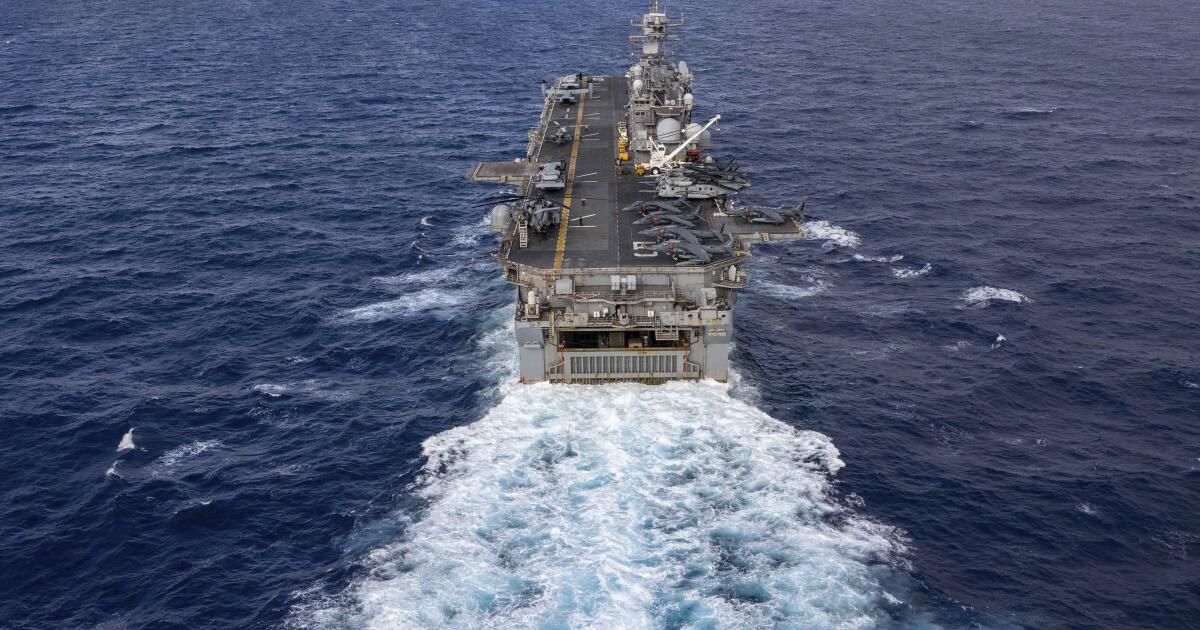
The Strait of Hormuz was the obvious answer. Anyone involved in serious planning for a conflict with Iran would know that the most likely consequence is an attack, intended to impose costs asymmetrically and ensure that a regional war is felt far beyond the battlefield.
The most foreseeable measure was always for Tehran to threaten the narrow waterway through which a fifth of the world's oil measures, turning a regional war into a global economic shock. Which could disrupt movement across the strait. in a few days The description of the initial attacks tells us something more significant than who controls a body of water: this war appears to have begun with careful attention to what the American force could attack and much less thinking about what its use would set in motion.
Although this episode has exposed serious deficiencies in the less glamorous but essential parts of American naval power, it is not fundamentally a niche issue of maritime warfare. The Strait of Hormuz is important because it is where the force meets the broader system it is supposed to protect: energy, trade, alliances and political space to maneuver. A government can destroy targets and still fail in the most important task of preserving order after the other party reacts. That is the true meaning of the strait. It's not just a disputed waterway. It was there that the gap between strength and strategy proved impossible to ignore.
The US military has spent enormous quantities of artillery in an effort to break the Iranian government, and Iran has reacted in a completely predictable way. What the effective closure of the strait exposed was not only the difference between the effectiveness of the attacks and the ability to control the consequences. It exposed something deeper and more familiar: America's repeated failure to match military power with equally serious strategic thinking. We remain so militarily dominant that our leaders continue to behave as if force itself will impose the political outcome they desire. But example after example has shown the opposite. The United States has not translated its military superiority into lasting strategic success in decades. And here we are again.
What was the obvious answer for Iran has become a central problem for the United States. Once keeping the strait open became part of the central challenge of the war, the true options underlying this war became clear. None of them are good. The United States can expand and prolong its own commitment in an effort to restore order by force. It can pressure reluctant allies to shoulder more of the burden, even as many of them remain unconvinced of the strategic logic that brought us here. It can resort for a time to emergency economic measures to mitigate the shock, but such temporary solutions lose value if Iran is able to make the disruption last. Or you can find a way to declare success and move on, leaving the underlying problem unresolved. Those were always the options behind the rhetoric. The strait simply forced them into the open air.
The evidence of these stark choices is already clear. The administration is pressing allies to help reopen the strait, but many remain reluctant or unconvinced. European leaders have shown no appetite for an EU naval mission. Japan and Australia They have made it clear that they are not planning escort missions of their own. Middle East oil exports already dropped sharplyand the International Energy Agency has fixed a record release of emergency reserve to mitigate the impact.
Those are not signs that a strategy is developing as planned. They reveal a government struggling to manage the consequences of a foreseeable disruption for which it did not seriously prepare. That dynamic is now getting worsewhile Trump has threatened new attacks on Iranian energy infrastructure, and Tehran has responded by threatening to close the strait entirely.
This is the deepest problem. The United States continues to use force as if military force excuses the hardest work of strategy. It's not like that. Leaders have yet to think seriously about what force is intended to achieve, how an adversary is likely to respond, and what conditions would need to exist for a lasting political outcome. Military power is indispensable, but it is not in itself a strategy. When leaders treat force as if it will somehow make the rest work, they continue to rediscover – at great cost – that the battlefield is only the beginning of the problem.
Iran did not discover any exotic weaknesses in the American position. He looked for the most obvious lever available and that exposed the deepest flaw. The fact that Washington still appears to have been unprepared for this is not just an operational failure. It is the clearest evidence yet that military escalation was confused with strategy from the beginning. Each new threat only deepens the consequences of that mistake.
Jon Duffy is a retired naval officer. Writes about leadership and democracy.
Perspectives
Perspectives from the LA Times offers AI-generated analysis of Voices content to provide all points of view. Insights does not appear in any news articles.
point of view
Perspectives
The following AI-generated content is powered by Perplexity. Content is not created or edited by the Los Angeles Times editorial staff.
Ideas expressed in the piece.
-
The United States launched Operation Epic Fury on February 28, 2026, apparently focusing on what US military force could destroy rather than the consequences that would follow, particularly the predictable Iranian response of threatening the Strait of Hormuz.
-
The operation exposed a fundamental gap between military capability and strategic planning, as the US military successfully carried out nearly 900 strikes in 12 hours but failed to prepare for Iran's foreseeable disruption of one of the world's energy critical points through which 20 percent of the world's oil passes.
-
The Strait closure revealed a deeper pattern in U.S. foreign policy, where leaders treat military superiority as a substitute for serious strategic thinking about how adversaries will respond and what conditions would create lasting political outcomes.
-
The difficult choices now facing the United States—expanding military commitment, putting pressure on reluctant allies, relying on temporary economic measures, or declaring victory while leaving underlying problems unresolved—demonstrate that the conflict began with inadequate preparation for managing the consequences of military strikes.
-
The refusal of key allies to contribute significantly to the reopening of the strait indicates that the operation lacked a compelling strategic justification; European nations rejected an EU naval mission, while Japan and Australia rejected escort missions.
-
The administration's hasty response, including record releases of emergency oil reserves by the International Energy Agency, is evidence that the government was unprepared for a completely foreseeable disruption despite years of tensions with Iran over its nuclear program and military reach.
Different points of view on the topic.
-
The operation achieved important strategic objectives by eliminating Supreme Leader Ali Khamenei and dozens of other senior Iranian officials in precisely coordinated strikes, and US and Israeli officials carefully timed the initial assault to strike the leadership before it could go into hiding.[1].
-
Iran entered the conflict from a position of weakness following previous military damage, years of international sanctions, destabilizing domestic protests, and the diminished standing of its regional allies during the Israel-Hamas war, suggesting the timing represented a genuine strategic window.[1].
-
Despite the Strait of Hormuz disruption, Iran's economy has been significantly damaged by the war as the country continues to attempt to export oil to China, indicating that the attacks caused substantial damage to Iran's military and economic infrastructure.[2].
-
The global economic shock caused by the closure of the Strait, while severe, is modeled as a temporary disturbance with the potential for recovery; If the conflict ends within weeks and structural damage to energy infrastructure remains limited, confidence could gradually return to the region's energy sector, limiting long-term economic damage.[2].
-
The war has created strategic opportunities for other regional actors and demonstrated weaknesses in Iran's position; Egypt and North African nations will benefit from increased demand for alternative trade routes and rising commodity prices as a result of the disruption of Gulf supplies.[2].