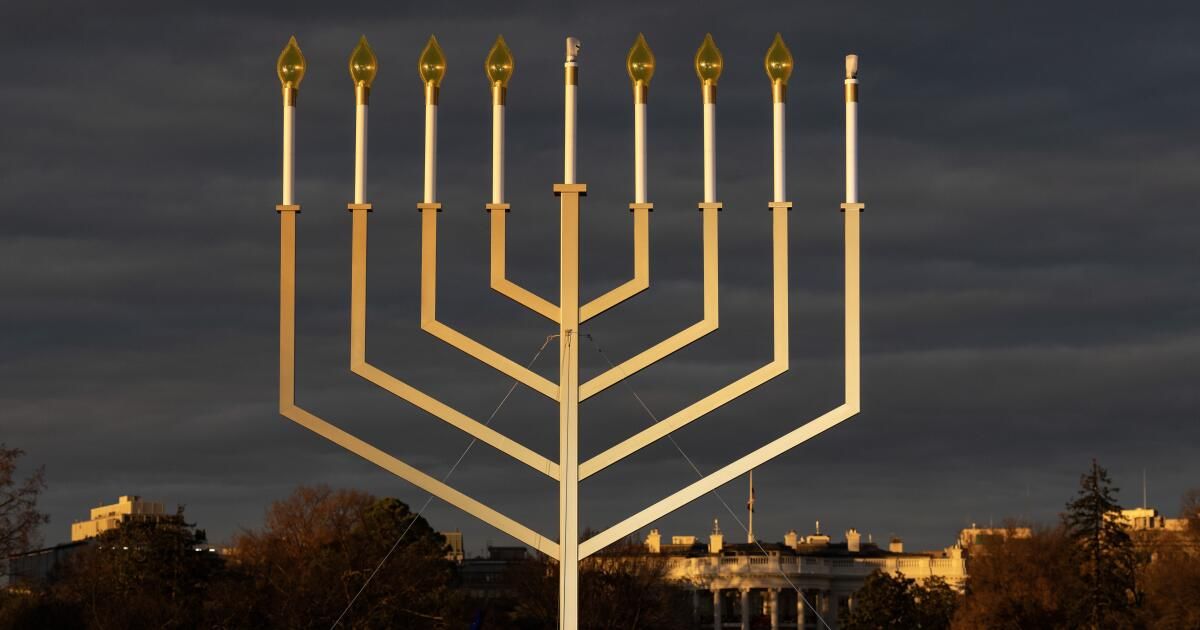
Of all the holidays on the Jewish calendar, Hanukkah, which began last Sunday night, has always been one of my favorites. Even when I was younger and much less observant, I appreciated the well-known rituals and customs of the holiday: lighting the menorah, spinning the top, eating potato latkes, etc. My given Hebrew name – “Maccabeus,” because Judah Maccabeus was nicknamed “the hammer” – is also synonymous with the hero of the holiday story.
Due to the timing of the holiday and the general desire of American businesses and elected officials to include American Jews in the annual Christmas holiday, Hanukkah is the most commercialized Jewish holiday and one of the most discussed. Hanukkah marketing is bland, if a bit distracting. More problematic is the proven tradition of American politicians distorting the meaning of the holiday, often for selfish reasons.
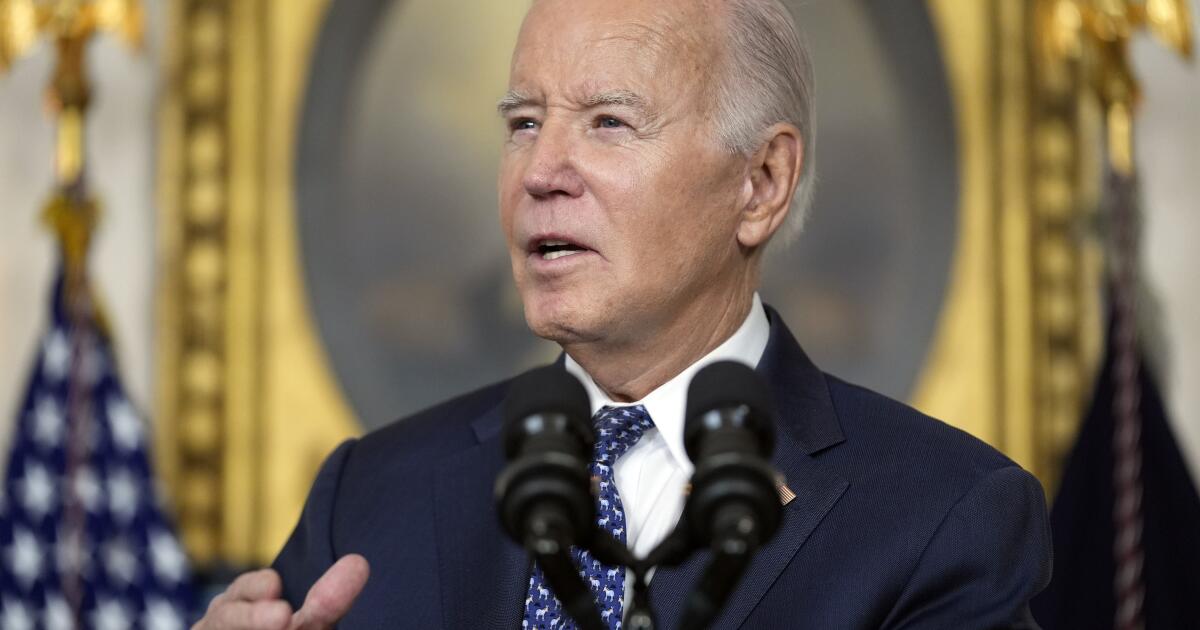
For as long as I can remember, liberal politicians have sought to invoke images of the light of the Hanukkah menorah to pontificate on abstract universalist principles like justice and liberty and, as President Obama said Put it two years after leaving office.about an occasion to “recommit ourselves to building a better future for our families, our communities and our world.” Sometimes they even get the most basic facts of the Hanukkah story wildly wrong, like then-Jewish second gentleman Doug Emhoff. did it two years ago.
I have always found this recurring humiliating ritual to be worse than embarrassing. It's offensive.
I have always thought that Hanukkah is the particularistic and nationalistic holiday par excellence of the Jewish people. It is a story about the Maccabean revolt against the Greco-Syrian Seleucid Empire, which occupied Judea and attempted to Hellenize the Jews, crush them physically and subjugate them spiritually. Many are familiar with the miracle that followed the victory of the Maccabees: the scant oil found in the courtyard when the Temple was repurified and rededicated lasted eight nights. But the most impressive miracle was the military victory over the Seleucids and the Hellenized Jews who joined them.
The central message of Hanukkah, then, is one of traditionalism and cultural preservation in the face of threatening and assimilationist forces, both internal and external. That is the true meaning of the holiday: not exchanging gifts or waxing poetic about universalist topics.
However, paradoxically, especially in light of recent tragic eventsSomething occurred to me for the first time: this stridently particularistic Jewish holiday does they have broader (indeed, global) relevance. It's just not the relevance that liberal politicians have attributed to Hanukkah. In fact, it is exactly the opposite.
The Maccabees were able to prevail and thus preserve Judaism, against all odds, because they had a purpose and a conviction. They believed that Judaism stood for something important: they believed that ethical monotheism was important, that the Hebrew Scriptures were true, and that the Land of Israel belonged to the Children of Israel. In short, the Maccabees had national and civilizational pride, and it was because of that pride that they fought so bravely and refused to bend the knee to Hellenistic assimilation. They rejected the universalist cri de coeur that all cultures and peoples are equal (and perhaps interchangeable).
In recent decades, and even more acutely in recent years, Western civilization has had to learn that lesson again. Human beings, although all made in the image of God and therefore deserving of dignity and moral worth, are immensely complicated. We are not reducible to gadgets on an economics blackboard. Our inherited cultural traditions and our learned customs and gestures are often very different from each other. We do not all value the same things, pursue the same goals, uphold the same social standards, or believe in the same political institutions.
We are, in short, different. The Maccabees understood that there was something special about the truths, values and principles that Judaism introduced to the world. They were not willing to sacrifice those truths, values and principles to the siren song of Hellenistic universalism. Today's Western nations must learn that same lesson again. The modern Maccabees senselessly murdered last Sunday on Sydney's Bondi Beach appear to be the latest victims of modern Hellenism, as one culture attempts to erase another.
It doesn't have to be like this. A culture can be proud without being chauvinistic. And a people can be self-confident without being imperious. If there will be fewer Bondi Beach-style massacres in the future, Western cultures and nations will have to rediscover and redefine the priorities that made them great in the first place. They will have to remember that human beings and the specific societies they constitute are unique. They cannot, and should not, be exchanged or frivolously exchanged as goods in a market. We have our traditions, values and ways of life that are worth appreciating and preserving from one generation to the next.
It may not be politically correct, but this is how we can apply the true lesson of Hanukkah.
Josh Hammer's latest book is “Israel and Civilization: The Fate of the Jewish Nation and the Fate of the West.”.” This article was produced in collaboration with Creators Syndicate. UNKNOWN: @josh_hammer