On Thursday morning I woke up before dawn to the news that Andrew Mountbatten-Windsor, the former prince, had been arrested in England on suspicion of misconduct related to his ties to Jeffrey Epstein. I immediately thought of the late Virginia Roberts Giuffre, the brave survivor of the Epstein and Ghislaine Maxwell sex trafficking ring, who had won a civil settlement with Mountbatten-Windsor after she accused him of rape (and whose memoir I co-wrote).
My next thought was this: so far, only about half of the 6 million documents that make up the Epstein files have been made public, but in the UK their contents are already causing a stir. Why doesn't that happen here in the United States? I know at least part of the answer.
Since the Jan. 30 release of 3.5 million pages of Justice Department investigative files, many concerned citizens around the world have been trying, in earnest, to dig themselves out of the quagmire. It's not an easy job. Part of that seems to be by design. The documents are not organized to help readers understand their context. Instead, each page is just a fragment of an exploded puzzle, and trying to put that puzzle together without all the pieces (and without knowing what a complete picture should look like) is proving difficult for even the most seasoned experts on the Epstein and Maxwell crimes.
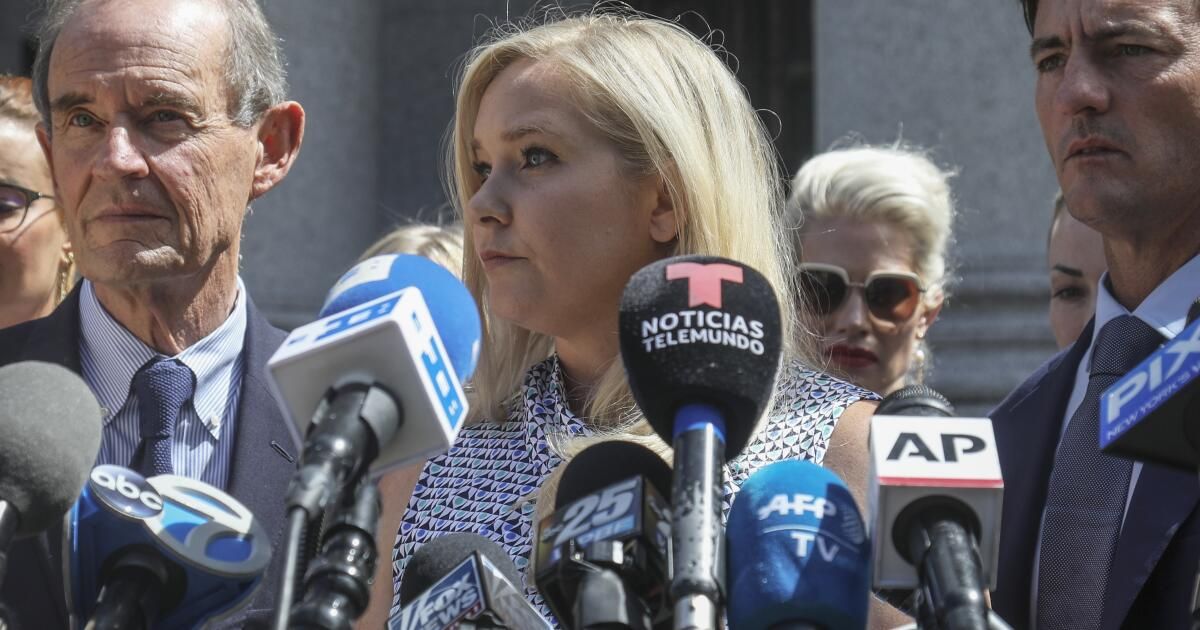
In the avalanche of news that has followed, the names in bold have grabbed the attention: Epstein helped director Woody Allen's daughter get into college, Commerce Secretary Howard Lutnick spent time with his family (and nanny) on Epstein's island, supermodel Naomi Campbell asked to fly on Epstein's plane. But despite the valiant efforts of so many outspoken survivors, the heart of this vile conspiracy has been strangely relegated to the background: the brutal reality of what it feels like to be a girl caught in Epstein's web.
Imagine you are a 14-year-old girl, recruited by an older woman, who is led to an upstairs room in Epstein's mansion in Palm Beach, Florida. The man you've been told to call “Jeff” comes in wearing only a towel and tells you to take off your clothes. You are afraid. Trapped. So you finally strip down to your underwear. He orders you to do things to him. He masturbates. He gives you $300 and tells you to leave him your phone number so he can call you again. Imagine that you later get into a fight at school with a classmate who calls you a prostitute. Imagine you are then involuntarily admitted to a youth education center “due to disciplinary issues that have recently escalated.”
I worked for four years with Giuffre on her memoir, “Nobody's Girl,” and the scenes I just asked you to imagine are in her book. But Giuffre is not the central girl in that story (Giuffre was 16, two years older, when Maxwell lured her to his lair). No, the above story describes the experiences of one of more than 30 underage victims that Florida investigators interviewed in 2005 and 2006, leading to Epstein's first arrest and ultimately his conviction as a sex offender. The girl in that story had her life ruined. two decades ago. Imagine.
We now know that hundreds, if not thousands, of girls and young women were abused by Epstein and Maxwell and their friends. And yet, the cruel ruin of these young people continues to emerge from the front pages. Is it because it's too disturbing to imagine? Is it because it's old news?
I'm a journalist, so I understand news cycles. But I'm still bothered by the way the visceral suffering at the center of this rotten story doesn't consistently claim its rightful place in the front of our minds. I get it: there's a lot to read about Epstein these days. But letting our attention drift to talent agent Casey Wasserman's sexting with Maxwell, say, or Atty. General Pam Bondi's crisis over the high Dow Jones Industrial Average is what In fact It doesn't matter, we run the risk of losing the plot.
This, for the record, it's the plot: In 1996, a 14-year-old girl named Annie Farmer was flown to Epstein's ranch in New Mexico, where Maxwell told her to undress and began massaging her breasts; Epstein later jumped into bed with her and told her he wanted to hug her. This type of grooming behavior was experienced by dozens of girls and young women, many of whom reported it to authorities. And this abuse often led to rape.
For Giuffre, what followed was being forced to sexually service Epstein and Maxwell's influential friends. In sworn statements that have been made public, Giuffre named Mountbatten-Windsor and several other of these men, who strenuously denied it. Some of these co-conspirators' names have appeared in the latest batch of public records, but Giuffre is no longer here to hold them accountable, having committed suicide last April.
Only by keeping our focus on what these girls and women endured will we Americans have the strength to demand that the Trump administration give us our due. Some survivors say they cannot find their interviews in the files that have been released so far, showing that the Justice Department has not yet met the requirements of the Epstein Transparency Act. The solution is clear: publish the remaining 2.5 million pages of Epstein's files, removing only the names of the survivors. Next, law enforcement must rigorously question the men and women who exchanged friendly emails with Epstein and played in his gruesome sandbox. Until these two things happen, basic accountability and justice will remain out of reach. Even based solely on what we already know, we should all consider it unimaginable.
Amy Wallace is a journalist and author who collaborated with Virginia Roberts Giuffre on her memoir, “Nobody's Girl.”