As a psychologist in the occupied West Bank, I have spent my career sitting in front of children who carry burdens that no child should ever bear: lives determined not by playgrounds or classrooms, but by constant fear.
I recognize that fear because I experienced it myself. I remember when I was less than five years old, Israeli soldiers broke into our house in the middle of the night and dragged my father out of his bed. The knocks on the door, the screams, the terror… those memories are still alive.
Children who wake up from nightmares convinced that Israeli soldiers will come for their families.
Children who shudder at the slam of the door.
Children who can recognize the sound of drones and fighter jets before they can multiply or divide.
I've helped them process arrests, home demolitions, settler violence, checkpoint humiliations, and the silent, exhausting stress of growing up never feeling safe.
I joined the Palestinian Red Crescent in 2021 because I knew it was one of the few aid organizations willing to go where the need was greatest: red zones, near the separation wall, near illegal settlements and even in active conflict zones. Mental health services are scarce and often inaccessible to Palestinians. If children were suffering in the hardest to reach places, I wanted to be there with them.
I thought I understood trauma.
I thought I knew how to guide children through fear.
I thought I had the tools.
Then, on January 29, 2024, the phone rang. It was a call from Gaza.
Five-year-old Hind Rajab was trapped in a small car, surrounded by the bodies of her six relatives, who had just been murdered. The Israeli tanks were approaching. Gunshots could be heard in the background. She was whispering into the phone so no one nearby could hear her.
“I'm afraid. They are shooting at us… Please come and get me,” he repeated over and over again.
For hours we tried to locate her. Our ambulance was a few minutes away, but needed permission from Israeli authorities to enter the area. We waited for permission which came hours later, only to be ignored.
Inside our operating room in Ramallah, time slowed to a crawl. With each passing minute, the frustration and helplessness grew.
All I could do was talk to her.
How can I keep a girl hopeful when she's trapped alone among her dead relatives?
How can I make her feel safe when tanks surround her?
How can I keep her conscious and focused on anything other than the immediate trauma?
I kept reminding him to breathe. To continue talking. To stay awake.
Above all, one thought kept repeating in my mind: She is 5 years old. Only 5 years. He's barely old enough to tie his shoes. She's barely old enough to read on her own. And yet she was alone, asking strangers to come save her.
Near the end, his voice became weak. She told me she was bleeding. “Where from,” I asked. “My mouth, my belly, my legs, everywhere,” he whispered. I tried to stay calm and told her to use her shirt to wipe the blood off. Then he said something I will never forget: “I don't want to, my mom will get tired of washing my clothes.”
Even then, alone, terrified, hurt and hungry, she thought about her mother, who would have more clothes to wash. Those were the last words I heard.
That day we lost Hind. We also lost two of my brave colleagues, Yousef Zeino and Ahmad Almadhoun, when their ambulance was attacked after receiving clearance. They were only a few minutes away.
Hind's story is no exception. He is one of tens of thousands of children in Gaza.
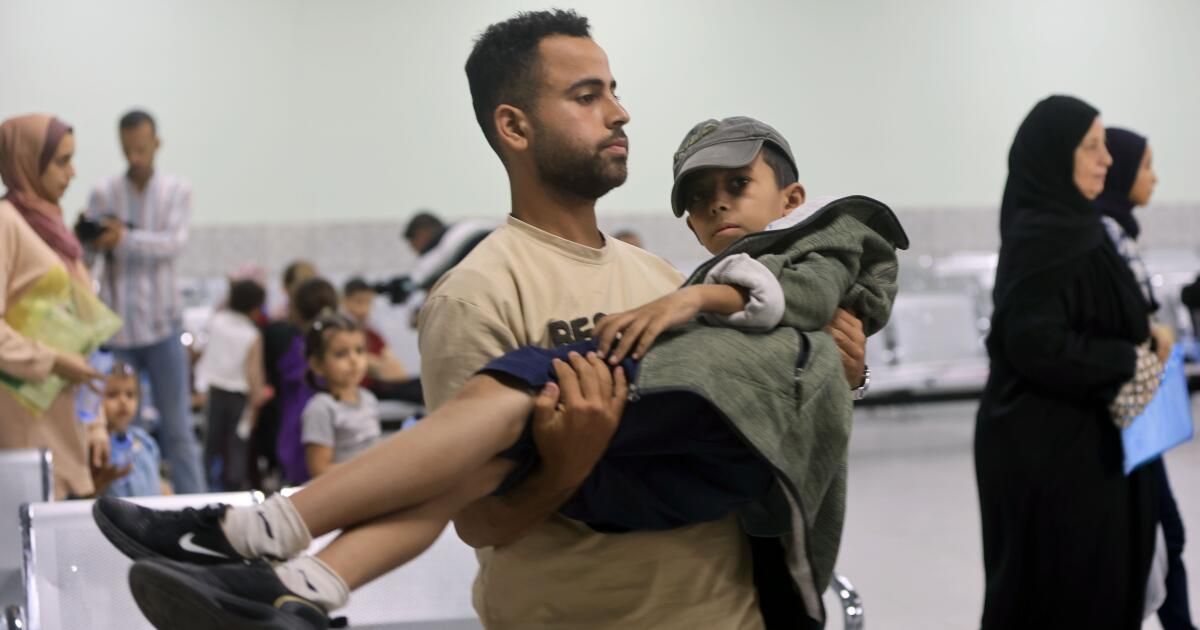
For more than two years, children in Gaza have opened their eyes every morning to displacement, loss, violence and poor access to even the most basic needs. At least 20,000 children have been murdered since October 2023, an average of at least 24 children murdered every day, the equivalent of an entire classroom. And we recognize that this is a gross undercount, as many children remain buried under the rubble. Tens of thousands have been forced to leave their homes. The schools have collapsed. Hospitals have been destroyed and doctors and health personnel have been detained and attacked.
This is not just a man-made humanitarian catastrophe. It is also a mental health crisis.
Children in Gaza not only survive bombs and displacement; They carry an overwhelming psychological burden that grows heavier every day. Almost all children are at risk of famine or illness from preventable diseases. More than 650,000 not having access to school, and more than 1.2 million Children need immediate psychological support. Reports from the field show that more than 39,300 children have lost one or both parents, including some 17,000 who have been orphaned. Hundreds of thousands of people are trapped with nowhere safe to go, living in a world defined by fear and instability.
Healing is impossible when the threat never ceases and when schools and health systems have collapsed. The trauma does not disappear in these unbearable conditions; it accumulates. The consequences could be irreversible.
We are witnessing the psychological damage of an entire generation.
Immediate action is imperative. A real and permanent ceasefire is the first step towards stability, but it must be followed by a rapid restoration of healthcare and education, with sustained investment in mental health and psychosocial support. Mental health cannot be an afterthought in a humanitarian response, but must be central from the beginning. Without these interventions, the psychological toll will only deepen, shaping an entire generation with long-term consequences for their well-being and the future of the Palestinian people.
And above all, children must be protected from ongoing violence, because no therapy can compete with ongoing trauma.
Hind's last words will haunt me forever. The world failed him. He has failed the children of Palestine. But there is still time to save those who remain. Through the movieHind Rajab's voice”, her voice will continue to travel across borders, carrying the truth of what children in Gaza and the West Bank endure day after day.
It's not just another story. It is a call that we must answer.
Nisreen Qawas is a psychologist with the Palestinian Red Crescent Society.