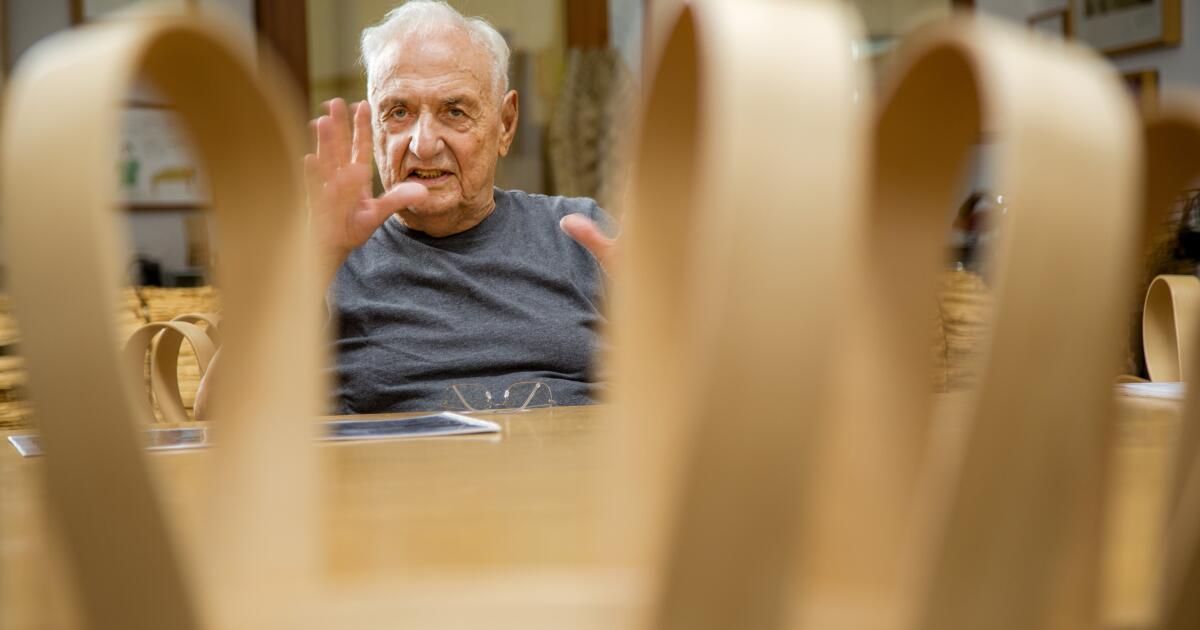
Frank Gehry taught students at our country's most prestigious private universities and California's most under-resourced public schools that their signatures were invaluable. He asked them to compare and contrast theirs with those of their classmates: it was a simple but profound lesson in self-expression, about the importance of knowing yourself and holding on to that knowledge throughout your life.
Frank's life was his work: in architecture, in teaching, in public life. His artistic creation was life-giving. He wanted more years, more time to create, to apply the signature he had perfected for almost a century, until his death on Friday at the age of 96.
Frank was a true teacher. He aspired to master the craft of architecture. For him it was an art, as it was for the Romans and Greeks, not the bloodless work of engineers and applied mathematics. He was an apprentice to the great artists, ancient and modern. Frank invented an architecture born from his signature; He dreamed of primordial designs that he translated technically. He drew the human world he wanted and inspired others to do so as well.
Frank wanted to be understood, felt, and expressed himself through the disciplined mastery of his craft, but perhaps more deeply through the painstaking study of himself. His life's quest was a dynamic, visceral continuation and celebration of what he found moving in art, sculpture and classical music. He designed fantastic but intimate cathedrals for the worship of artistic disciplines, volumes to house sacred aesthetic time, magnificent vessels for personal emotional experience.
A master inspires devotion, and that is why people from all over the world make pilgrimages to experience his creations, to be fascinated by his art, to feel elevated by the ethereal signature of Frank Gehry, prominent here in Southern California, from his own home in Santa Monica (the Gehry Residence) to the Walt Disney Concert Hall in downtown Los Angeles to the Grand LA at Bunker Hill.
Frank's work was about feelings. I knew that art had the power to transform, unite, generate empathy. In Frank's office there is a large bronze painting of the “Charioteer of Delphi” from 500 BC. He initially saw it in Greece with Ed Moses, on his own artistic pilgrimage. Frank said of the experience: “I looked at it and looked at it, and I started crying. The idea that someone 2,500 years ago working in an inert material could transmit feelings through the ages to someone, that's my North Star. If I can do that, if I can make a building that makes people feel something and transmits feelings through inert materials, then that's my job. And it's hard to talk about.” Frank Gehry said in stone, titanium and glass what was and is beyond words. His creativity surpassed the everyday limitations of public commissions. His passionate learning exceeded even his own expectations.
Frank was esteemed, but above all he fulfilled the objective he had set for himself, and like the unknown sculptor of the Auriga, his work emanated emotion through the inert materials of his craft. He gave life to concrete, illuminated chain links, made cardboard fluid. Frank's creative process was a kind of learned reverence. He exemplified an understanding of the role of the mind in guiding the self toward the apex of its spiritual journey, the heart toward the ultimate purpose of the soul, overcoming obstacles with unwavering loyalty to the true self, fearless and steadfast.
Frank has finally completed his physical journey and we are left with his wonderful signature, his eternal essence communicated in form. I think that's why he supported art education, because he knew that without his, he might not have discovered his soul's unique purpose. I wanted to show you everything you can be. He wanted more than anything to be known, seen deeply, and he wanted that for all young people.
Venturing into the unknown of each artistic project allowed Frank to rediscover a pure faith in himself. This was one facet of his greatness, the great teacher who founded and funded Turnaround Arts California, an arts education nonprofit, from his offices. Not glamorous, but glorious, was her intention to serve others, to support creative opportunities for children who benefit the most and, too often, those who receive the least.
It is inescapable that people have focused more on Frank's curvilinear, sculptural forms, on his luminous exterior surfaces, and yet what I find most profound about his architecture is how he enchanted and enlivened space. He drew shapes that contain and express something sacred, eternal, places for values he held dear. He cared about people. I witnessed how children's lives changed through play, sensitive listening and artistic creation.
Composer Gustav Mahler, revered by Frank, said: “Everything that is not perfect down to the smallest detail is doomed to perish.” Frank's perfectionism was fastidious, honing every angle, every undulating curve, but it was also intentionally emotional, relative to the communal experiences felt by the inhabitants of his worlds, another legacy of Mahler, who once described writing a symphony as “world-building.” Frank's own world was composed like a symphony: his “orchestras” united Palestinians and Israelis in Berlin, marginalized students with teachers, modern musicians with compositions from centuries and genres. He was a master of deconstructionist jazz of liminal space.
Our architectural charioteer was a wizard boy from Canada, a student and teacher of wisdom, a shooting star from the far north, he was a gift to our pale, profane world of careless creation and disdain. He was a magician, a linguist who reinvented and constructed his own emotional vernacular.
A rabbi once told Frank's parents that their son had “hands of gold.” Those hands drew beauty across our planet and worked their magic for almost a century. His hands held ours as we created art that brought us together; Its walls did not divide, but rather invited you to enter. Like Matisse in old age, drawing from his bed Frank's protean creativity, his legacy of artistry is eternal. He blessed us with his prolific work, a lasting heritage of towering temples in space and time, to transform and inspire us. He left us creations within which we could find and feel the best of ourselves.
Malissa Shriver is president and co-founder, with Frank Gehry, of California Changing Arts.