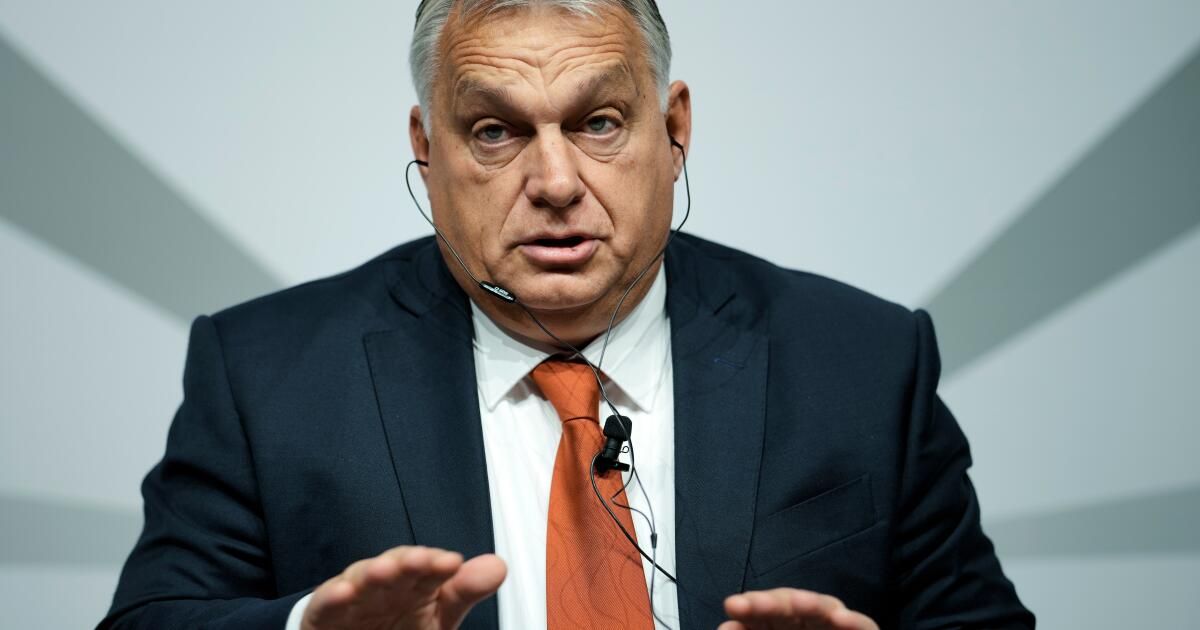
Viktor Orban, Hungary's proudly “illiberal” prime minister, beloved by several New Right nationalists and American MAGA intellectuals, was crushed at the polls this weekend.
Over the last decade, Hungary has become to the New Right what Sweden or Cuba were to the Old Left. For generations, various American leftists loved to cite the Cuban model as better than ours when it came to health careor education. Some would even make wild claims about freedom under Fidel Castro's dictatorship. famous Susan Sontag proclaimed in 1969 that no Cuban writer “has been or is in prison or is unable to publish his works.” This simply wasn't true. The still young regime had already imprisoned, tortured or executed dozens of intellectuals. (Sontag later recanted.)
Senator Bernie Sanders and Representative Alexandria Ocasio Cortez still talk about the Nordic countries as if we have a lot to learn from them, even though the Nordic model is strongly depends on taxing the poor and middle class, not on soaking up the rich. Now, distinctions matter. The Nordic systems are democratic and decent. Cuba is a Marxist basket case and a police state. But the only thing that unites both fan clubs is the tendency to see the countries they imagine they are instead of reality.
President Trump, Tucker Carlson, and JD Vance (most recently while campaigning for Orban) have praised Hungary. Patrick Deneen, a prominent intellectual of the New Right saw in Orban's Hungary “a model of a form of opposition to contemporary liberalism that says: 'There is a way in which the state and the political order can be oriented towards the positive promotion of conservative policies.'”
The Heritage Foundation, a once-respected conservative think tank that has abandoned its devotion to the Constitution and traditional conservatism, agrees. Its wayward president, Kevin Roberts, called in 2024 Orban Hungary is a “conservative governance model.”
This reflects Orban himself explanation: “The Hungarian nation is not simply a group of individuals but a community that must be organized, strengthened and, in fact, built,” he explained in 2014. “And, in this sense, the new State that we are building in Hungary is an illiberal State, an illiberal State.”
Don't be put off by the word “liberal” here (or by Deneen and Roberts' tendentious use of “conservative”). Orban and his followers do not talk about mere leftist policies. The “liberal” here is the liberalism of liberal democratic capitalism, John Locke, Adam Smith, and the American founding fathers.
“Checks and balances are an American invention that, for some reason of intellectual mediocrity, Europe decided to adopt,” Orban said. Checks and balances It's actually not an American invention. But it is a vital liberal bulwark against authoritarianism and corruption.
When the U.S. Supreme Court said President Biden couldn't, on a whim, forgive student loan debt or ban evictions, or when it ruled that Trump couldn't apply unilateral tariffs to the world or deploy troops indiscriminately to American cities, these were checks and balances at work.
Claims that Orban was an authoritarian may be exaggerated. but he was moving in that directionfilling the courts, universities and state media with loyal politicians and, until this weekend, rewriting electoral laws to stay in power.
But his corruption was not exaggerated, and his corruption is the reason he lost. Orban diverted state resources to his cronies, family and hometown friends on a massive scale. But that doesn't mean he broke the law. He wrote – or interpreted with the help of crony judges – the law to legalize favoritism. It turns out that kind of favoritism is incredibly bad for the economy because it distorts the market, misallocates scarce resources for self-serving political goals, and discourages investment. It's okay to say that Orban lost because the Hungarian economy and healthcare system were a disaster. But that mess arose from Orban's corruption.
In the United States we tend to think that corruption is illegal; accepting bribes, stealing taxpayers' money, etc. But in many parts of the world that is not illegal or even corrupt. This is how business is done. In many developing countries – and for most of human history – the government operates like a family business. Special treatment for family and allies is natural. What is not natural is the modern liberal way of putting contracts out to bid and treating taxpayer money as sacrosanct.
No country is perfect in this. This is one of the reasons we have checks and balances. Each branch is supposed to be vigilant against the abuses of the others, and all are supposed to be subordinate to the rule of law, not the law of the rulers.
Orbanism is not a new model, or “wave of the future.” It was a tide of the past. And it's good news that it's going backwards.
UNKNOWN: @JonahDispatch