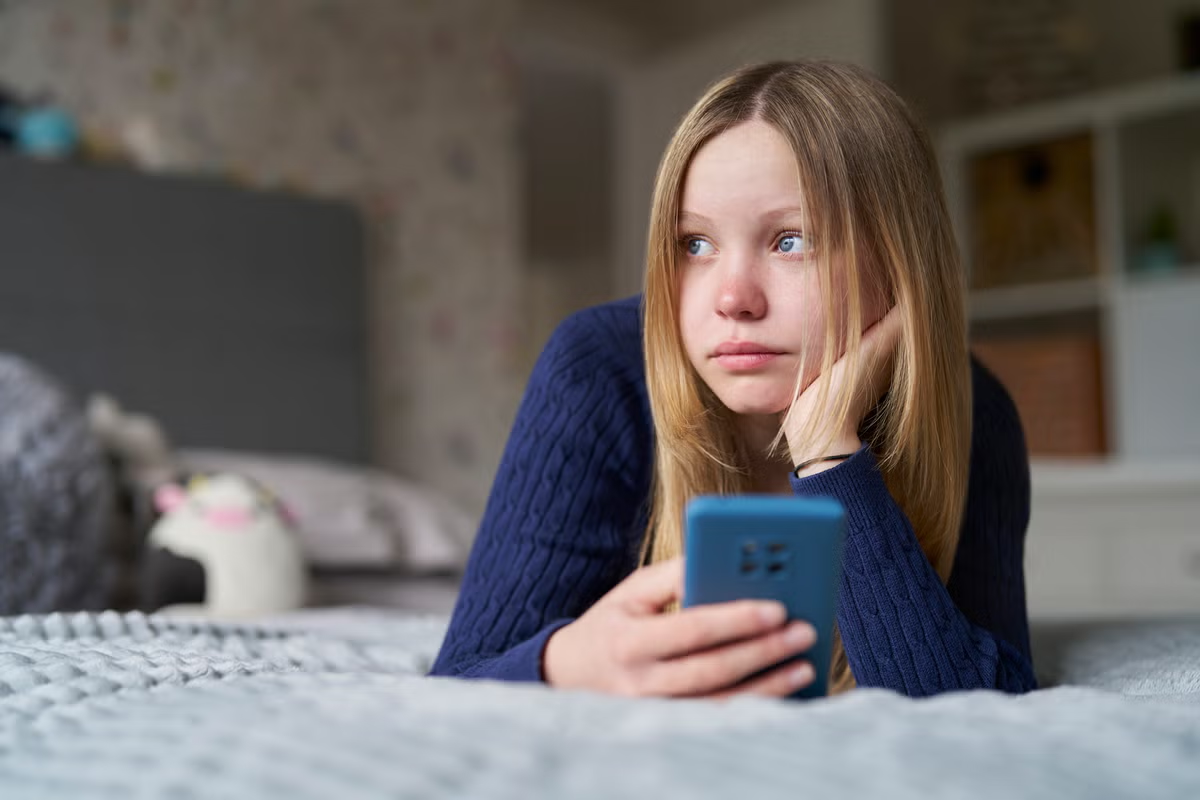
tThirteen-year-old Ella from Sydney uses social media to keep in touch with her friends and to help her sleep. Pressing play on an autonomous sensory meridian response (ASMR) video, which features calming sounds like whispers or jingles to induce relaxation and ease insomnia and anxiety, has become a ritual to help you fall asleep after a long day at school. “I listened to those videos every night,” he says of that habit. “It was my routine. Now it's gone.”
From midnight on Tuesday 9 December, Australia will become the first country in the world to ban children and teenagers under 16 from using social media after the law was successfully passed this summer. Included are apps including Meta's Facebook, Instagram, Threads, X, TikTok, YouTube and Snapchat, as well as the Amazon-owned live streaming service Twitch. Tech companies will face fines of up to A$49.5m (£25m) for non-compliance, and Meta has already started closing thousands of accounts belonging to children under 16 a week before the deadline.
Michael 'Wippa' Wipfli, Australian radio presenter, comedian and father of three under 16s, was among those leading the campaign to bring this historic legislation into force. “[Social media] “It was the number one thing, not only did it keep parents up at night, it kept them out of every sports field,” he says. “Very quickly, it became the largest petition ever signed on this issue globally… I think a lot of people were surprised to learn that the law previously said children could be online at 13. That was actually invented by tech companies.
“We talked to a lot of professionals, pediatricians, developmental pediatricians, parents and educators to find out if we can give these children another three years (36 months) to grow and develop healthily as adolescents,” he says, explaining the groundwork that was done before the law. “My kids, Ted is 10, Jack is nine and Francesa is five… What we've been saying a lot is that we need to give these kids the chance to know themselves before the world does,” adds Wippa.
Clinical psychologist Dr Danielle Einstein, whose research helped inform and shape the ban on social media for under-16s, says evidence has shown that, despite the use of videos such as ASMR, over-reliance on social media is linked to depression, anxiety, eating disorders, loneliness, sleep disorders and academic difficulties. “Far from being a source of protection, these platforms amplify self-focus, insecurity, and impair brain functioning in the early years of high school, before adolescents have the hardware to limit reflective thinking about their use,” he adds.
Ella's mother Sally, who works closely with an MP in her role at an constituency office outside Sydney, initially agreed with the social media ban, until she heard more about the planned implementation. “I thought it was a great idea. I was worried that my own kids were spending too much time on social media, and as a parent, when they have their phone in their hand, it's hard to control that… Unfortunately, I started to realize that the legislation seemed very rushed… It didn't seem like the input of under-16s was taken into account.”
In addition to her concern about losing her late-night ASMR videos, Ella worries about the increased social isolation that could come from the ban. “I usually send my friends videos that I can relate to and post some videos on a private account,” he says. “A lot of my friends are really worried about the ban. I have one whose childhood friend lives in another country. She communicates with her a lot on TikTok and Snapchat. Nobody wants this to happen.”
Two nights before the ban went into effect, Ella shared a TikTok video lamenting the fact that the December 10 release date coincided with International Human Rights Day. As of this writing, the post has over 44,000 likes, 1,300 comments, 5,300 shares, and over 258,000 views. “This country has become a dictatorship,” one person commented. “So, I only have a few more hours to enjoy my favorite part of the day?” Another user lamented.
Like kicking any addiction, Sally suggests that quitting cold turkey may not have been the best idea. “Just saying, 'Let's get rid of social media,' is going to create a lot of anxiety,” he says. “It's what they're used to. Taking it away from kids without discussing it or suggesting what to do instead is totally wrong. You need proper planning. You need proper counseling. That would have been wonderful and could have been presented.”
Furthermore, Dr. Einstein says that one law is simply not enough to achieve effective change. “History shows that one-time measures rarely change deeply ingrained behaviors,” he says. “Just as tobacco control requires taxes, restrictions on advertising, public education and smoke-free environments, protecting children from the harms of social media will require a multi-layered strategy.” Einstein believes it is a vital additional step to equip parents and schools with the knowledge, time and money to make changes, as well as introducing duty of care regulation on social media sites, so that all Australians, not just children, can feel better about using technology. “Let's be clear: this regulation means the beginning, not the end, of our efforts to find balance.”
Wipfli acknowledges that its blanket ban on all under-16s may not be perfect. Many parents and critics have already informed you that children can bypass the ban by using VPNs (virtual private networks) or even by placing a photo of their parents or a celebrity in front of the age control camera. “No one expects it to be perfect,” he says. “There will always be a way to fix things, but we have to start somewhere. There is no silver bullet. We need to change behavior. Therefore, we need education. That will be the next step.”

Could a social media ban come to the UK? Wipfli says there has been interest in his campaign among leaders in Britain, Europe, Japan and the Philippines. In the United Kingdom, a petition was launched that obtained more than 100,000 signatures, so it was debated in parliament in February this year. “The government is not currently prepared to support a ban for children under 16,” was the response. Instead, the priority was said to be working with Ofcom to effectively implement the divisive Online Safety Act 2023 so that all social media users can benefit from much-needed protections, with tech companies facing fines of up to £18 million or 10 per cent of their worldwide revenue (whichever is greater) for non-compliance.
However, despite its addictive nature, there are statistics that show that social media (in the age of AI posting and Keir Starmer having a TikTok account) might not be so interesting anymore. While “junk” might give users an easy dopamine fix, this endless brain-destroying content may ultimately be driving people away from screens in favor of more analog activities.
In fact, time spent on social media peaked in 2022 and has steadily declined since, according to an analysis conducted for Financial times by digital audience insights company GWI. Use among adults 16 and older is now about two hours and 20 minutes per day. It's still high, but it's down almost 10 percent compared to three years ago. Interestingly, the study found that usage declines most significantly among teens and users in their twenties.
In an essay for New Yorker This summer, writer Kyle Chayka suggested that society is moving toward what he calls “publishing zero”—that is, a point at which people feel like it's not even worth spending time sharing their lives online. Gen Z users are embracing this silence and leading the Posting Zero movement by stepping away from social media apps entirely, sharing only to private accounts of their close friends, or choosing to scroll silently instead of sharing themselves.
Apparently, for teen and young adult users, we may have approached a stage with social media where the experience of being online is so degraded thanks to AI-generated content that users have actually been shaken out of their apocalyptic stupor and encouraged to look out the window and touch the grass. Yes, social media is dangerous, but what could really kill it is when a generation defines it for what it is: boring.
Prohibition is the beginning, but banality will be the end.