The owner of the legendary Clifton's in Los Angeles has given up on reopening the closed establishment.
It's too difficult to do business in the historic downtown core, he says.
Andrew Meieran purchased Clifton's on Broadway in 2010 and invested more than $14 million in repairs, renovations and improvements, adding additional bar and restaurant spaces to the four-story building. In 2018, it found that demand for cafe food was too low to be profitable, and opted for a nightclub and lounge concept called Clifton's Republic, which offers multiple places to eat and drink. Meieran has tried out elaborate themed settings, such as a tiki bar and forest playgrounds, and has rented out the venue for large events to drum up more interest.
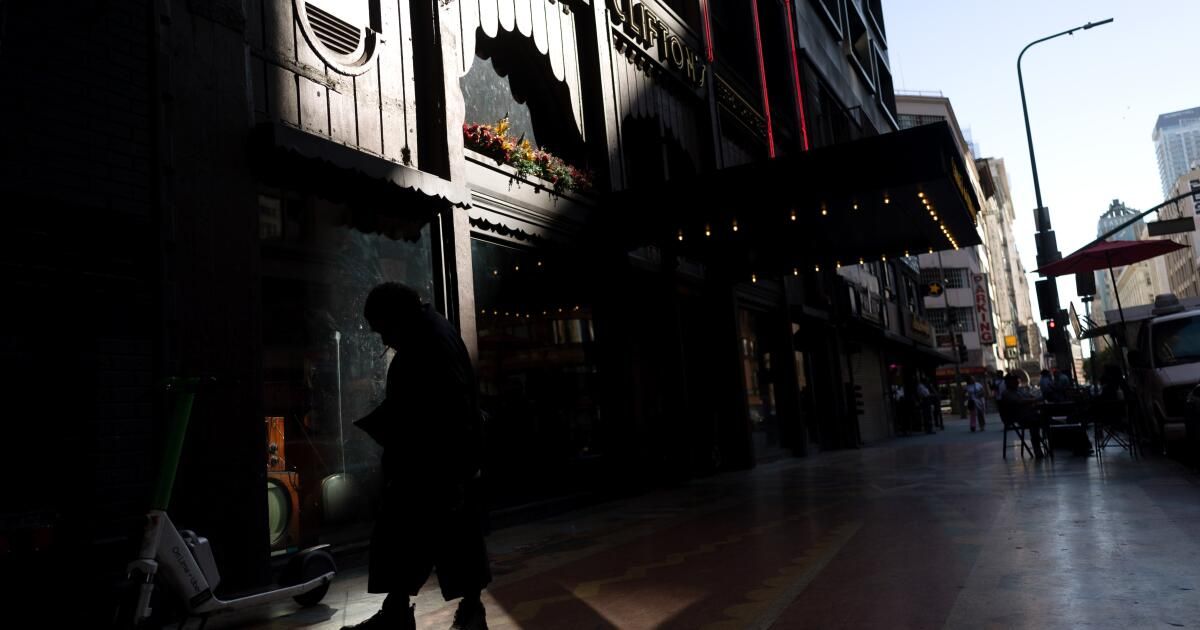
It was never easy, but during and since the pandemic, the neighborhood has become increasingly unsafe as downtown has emptied of office workers and visitors.
Storefronts are closed due to vandalism in the historic district of downtown Los Angeles on Tuesday.
(Eric Thayer / Los Angeles Times)

The alley behind Clifton's coffee shop in the downtown historic district on Tuesday.
(Eric Thayer / Los Angeles Times)
Vandalism has been rampant and graffiti appears on the historic structure almost daily. Vandals used acid or diamond glass cutters to deface windows, often breaking the glass. It would cost Meieran more than $30,000 each time to replace the windows. Insurance companies stopped offering policies covering vandalism or raised premiums by as much as 600%, he said.
There has been ongoing crime in the area, he said, including multiple assaults on people in front of his building. The last time he closed the place was last year, hoping that things would improve and he could return with a business that could work. Now he has given up. Someone else can take over the space or even the name of the historic place, but they no longer try.
“We've lost our way,” Meieran said. “I want to stand on top of skyscrapers and shout that people need to pay attention to this.”
The disenchantment of a business leader who used to be one of downtown Los Angeles' biggest patrons highlights the lingering safety concerns, rising costs and declining foot traffic that have made it increasingly difficult for even iconic businesses to survive.
The once-popular institution dates back to 1935, when it was a Depression-era diner and kitschy oasis that sold up to 15,000 meals a day when Broadway was the city's entertainment center.
It serves traditional cafe fare, like stew, mashed potatoes, and Jell-O, in a wooded grotto among faux redwoods and a stone-wrapped waterfall reminiscent of Brookdale Lodge in Northern California.
It's not the only once-prominent destination that has failed to find a way to thrive in today's market. Cole's, one of Los Angeles' most famous restaurants and often credited with inventing the French sandwich, closed last month after 118 years in business.
“The biggest problem for us and the rest of the industry is the high cost of doing business,” said Cedd Moses, who used to operate Cole's and has supported many other bars and restaurants in historic downtown buildings for decades. “That's what's killing independent restaurants in this city.”

Outside Clifton's cafeteria.
(Eric Thayer / Los Angeles Times)

Clifton's Republic owner Andrew Meieran stands next to a boat on the top floor of the historic restaurant in 2024.
(Wally Skalij / Los Angeles Times)
Clifton's opened and closed repeatedly during the pandemic and, more recently, after a burst pipe caused extensive damage. Meieran opened it for special events like last Halloween, but otherwise it has been closed.
Unfortunately, police are understaffed and hampered by public policy, said Blair Besten, president of the downtown Historic Downtown Business Improvement District, a nonprofit that organizes graffiti removal, trash pickup and safety patrols in the area.
Businesses and residents in the area would like to see a greater police presence, but there have been protests against that from people not from downtown, he said.
“People are starting to see the fruits of the defund movement,” he said. “It hasn't gotten us to a better place as a city.”
The Los Angeles Police Department is making progress downtown, Capt. Kelly Muniz said, with violent crime down more than 10% from last year.
“Even though we are working very hard to solve crime, to prevent crime, there are still elements like litter, open drug use, homelessness and graffiti,” he said. “We are going in the right direction.”
Retailers have opted out of downtown Los Angeles, said real estate broker Derrick Moore of CBRE, who helps arrange leases for commercial properties. Brands have targeted more vibrant nearby neighborhoods, such as Echo Park and Silver Lake.
“Many operators are simply choosing to skip the center,” he said. “They are renting space elsewhere, where they feel they have a better chance of achieving higher sales.”

A man walks past a pile of abandoned trash on the street in the historic district.
(Eric Thayer / Los Angeles Times)
While some businesses are struggling, many downtown residents say their perception of safety is improving and the area is regaining some vitality.
“A lot of people live here. I think people forget,” Besten said. “We are all surviving. It is difficult for all companies to survive.”
A green opportunity for the Historic Core is Art Night on the first Thursday of each month, when 50 or 60 locations, including permanent art galleries and pop-up galleries in unused storefronts, display art to visitors who come with maps for the occasion.
They often end up at the bars on Spring Street, which tend to thrive on weekend nights but remain a draw for downtown.
“I think nightlife will thrive downtown as the bars attract people who don't mind a little more edgy atmosphere,” Moses said. “Fortunately, our sales are hitting new records in our downtown bars, but our costs have increased dramatically.”

A closed sign for Clifton's coffee shop.
(Eric Thayer / Los Angeles Times)
Clifton's former backer Meieran says he doesn't think things will recover enough to justify a more massive investment. The building has been sold and the owner is looking for a new tenant to occupy the Clifton space. He still controls the Clifton name.
While there's still a chance someone else will use Clifton's name, Meieran is done for now – too many bad memories.
“There was a guy who was terrorizing the front of Clifton's because he decided he wanted to live in the front lobby and didn't want us to operate there,” Meieran said. “He would threaten to kill anyone who walked by.”
He doesn't believe official statistics showing crime and homelessness have decreased in the area, and he doesn't want to restart a business when criminals can so easily erase his hard work.
“What business that already has low margins can survive that?” said.