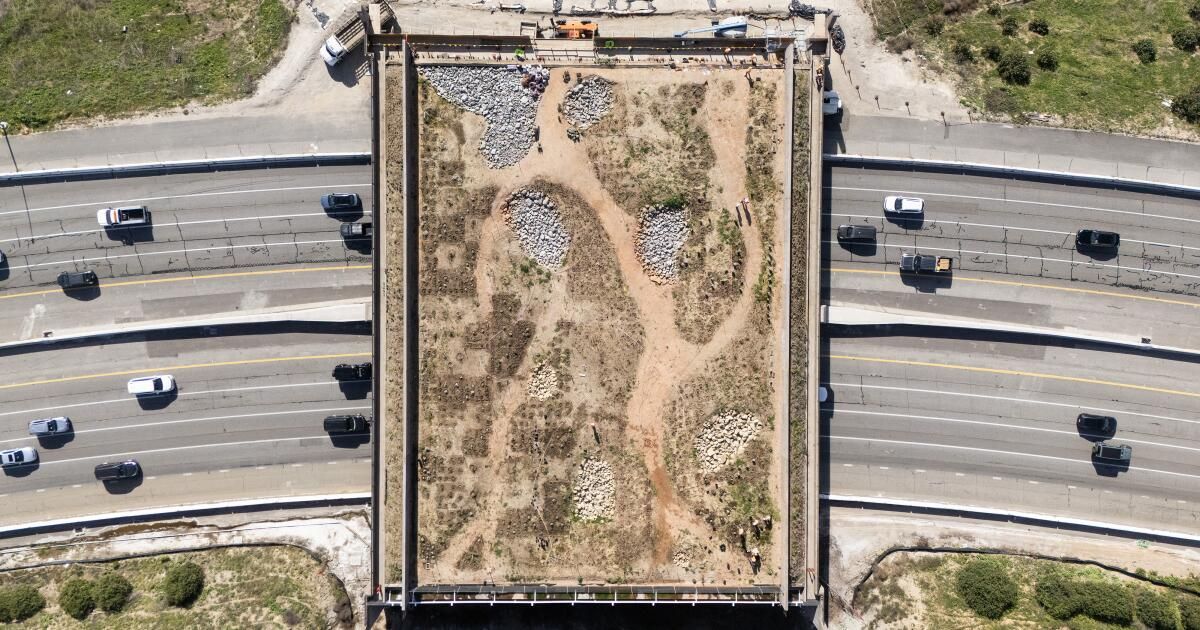
To the 300,000 drivers who travel through Agoura Hills on Highway 101 every day, the Wallis Annenberg Wildlife Crossing appears relatively unchanged from last summer, except for some leggy native shrubs growing along the exterior walls.
While activity appears to have stopped at what is touted as the world's largest wildlife crossing, there has been a lot of slow and expensive work at the site that is difficult to spot from the highway, said Robert Rock, CEO of Chicago-based Rock Design Associates and a landscape architect overseeing the project. This includes:
- Move power lines, water lines and other utilities underground, at a cost of nearly $20 million, along the south side of the crossing.
- Drill at least 140 deep holes along 175 feet of Agoura Road and fill them with concrete to create the foundation for the tunnel over the frontage road. The tunnel will support approximately 3 million cubic feet of soil connecting the south side of the crossing to the Santa Monica Mountains, roughly enough soil to fill half of SoFi Stadium, Rock said.
- Rework some of the non-wildlife-focused project designs to reduce rising construction costs. For example, an underground tunnel that would have allowed utility companies to enter and check their equipment has been reduced to a large conduit large enough that wires and cables can easily pass through it.
Rock and Beth Pratt, California regional executive director of the National Wildlife Federation and leader of the Save LA Cougars campaign, led a tour of the top of the crossing during a sunny day last week to discuss the status of the long-awaited project, which was originally scheduled to be completed in late 2025.
Crews are working on 70-foot-long wire rebar cages that have been placed in holes along Agoura Road and filled with concrete to create the foundation for a 175-foot-long tunnel over the frontage road that will support the south shoulder of the Wallis Annenberg Wildlife Crossing.
Record rainfall in 2022 and 2023 caused significant delays, pushing back the planned completion of the wildlife crossing until later this year.
“We want rain. We want water because that's part of making these landscapes healthy and vibrant,” Rock said, “but when you have 14½ inches of rain in 24 hours and an open excavation for the foundation of a massive structure that fills up like a giant bathtub and you have to vacuum up all that mud three separate times and re-compact the soil… you're going to have delays even if the contractors are moving at lightning speed.”
Rock said the new November or early December completion date is “aggressive but doable” since the utility move is already complete, and he expects work to move more quickly once the tunnel foundation is complete. The concrete tunnel will be built on site and then covered with earth this summer. Most of the land comes from a small hill on the north side of the interchange that was created when the highway was built in the 1950s.
The second and final phase of the project — securing shoulders that will allow animals to use the crossing — began last summer and is proceeding as planned, Rock said, but it's also painstaking, expensive and largely invisible work, moving overhead power lines underground and drilling thick holes about 70 feet deep. Once a hole is dug, a tall crane slowly slides into a rebar cage that resembles a wire mesh dinosaur column so the hole can be filled with concrete.
The work is hidden from most highway passers-by and those driving below, as Agoura Road is closed during business hours Monday to Friday.

Birds, lizards and insects have already been sighted atop the unfinished Wallis Annenberg Wildlife Crossing, which rises 30 feet above Highway 101 in Agoura Hills. “Build it and they will really come,” said Beth Pratt, California regional executive director of the National Wildlife Federation and leader of the Save LA Cougars campaign, as she looked east at Highway 101 traffic from the east edge of the interchange.
This project has more complexities than others across the country, Rock and Pratt said. Other crossings are typically located in more rural areas and are chosen based on ease of construction. The location of this crossing was blocked off (a narrow wilderness pass in a largely urban area between the Santa Monica Mountains and Simi Hills), so it faced challenges that other crossings typically don't, such as moving utilities, skirting heritage oak trees that no one wants to remove, or working around a large number of cars. “If we could have closed Agoura Road and the 101, Yo I could have built it in a year,” Pratt said, laughing.
Rising construction costs have been another complication. The expected cost of the entire project, $92.6 million, remained unchanged until last spring, when bids for the second phase “went through the roof again,” Pratt said.
Contractor CA Rasmussen's bids for Stage 1 of the project were 8% below Caltran's estimate, but bids for Stage 2 raised costs about $21 million higher than expected, raising the total projected cost to approximately $114 million.
About $77 million of construction costs will be paid for with state money, including a recent injection of $18 million to help cover the shortfall, “primarily from conservation funds such as voter-approved bond measures or mitigation dollars,” Pratt wrote in an email. Private donors have provided the remaining $37 million, approximately 32% of the project's total construction costs. About $29.4 million of those private donations came from Wallis Annenberg, the crossing's namesake, who helped kickstart the campaign with $1 million in 2016, following a “60 Minutes” report on the existential danger faced by mountain lions stuck on Los Angeles County freeways, Pratt said in an interview Friday.
Annenberg, who died last year, contributed $35.5 million to the project, including $29.4 million specifically for construction of the crossing, as well as funds to cover design costs, ongoing wildlife research in the region and the project's native plant nursery.
Construction costs have risen everywhere over the past year, largely due to uncertainty about how much even the most basic materials, like concrete, will cost, Rock said.
“If you're preparing a bid for a project and you don't know what the cost of something will be a month from now, let alone six months or a year from now, you're going to factor that speculation into the cost of your price, even when you're talking about something that should be a pretty stable price.” [cost]”Roca said.


1. Landscapers place hundreds of native buckwheat, sages and other plants on top of the wildlife crossing. 2. Robert Rock stands along flags marking places for plants to be placed on top of the bridge. 3. A landscaper loosens the roots on a purple sage just removed from its gallon pot to prepare it for planting. (Myung J. Chun / Los Angeles Times)
Some of that uncertainty is based on the wildfires that decimated large swaths of Altadena, Pacific Palisades and Malibu last January, he said, because the heavy equipment needed for the project was suddenly in huge demand to clear burned properties. And tariffs on Canada and Mexico, two of the country’s largest suppliers of cement, an essential ingredient of concrete, further increased prices on one of the project’s key materials, even among domestic providers, he said.
The project has enough money now to complete construction, Pratt said, but Save LA Cougars is still fundraising, trying to raise another $6 million to cover other non-construction costs including $2 million for the Santa Monica Mountains Conservancy, which owns the land, to maintain the crossing habitat (such as removing invasive nonnative black mustard plants that have taken over the north side of the crossing in the Simi Hills).
In an email outlining the costs, Pratt said the money will also provide $1.5 million to the National Park Service to continue the wildlife research that led to the creation of the crossing, when scientists discovered that the freeways crisscrossing the region were making it impossible for cougars and other wildlife to find suitable mates. It will also be used to fund education programs, maintain the crossing’s nursery and train volunteer docents leading popular tours around (but not on) the crossing.
“As this is being regarded as a global model for urban wildlife conservation and connectivity, we have to ensure the research and educational efforts continue for the long-term,” she wrote.
The project’s rising costs have created anxiety for her. “When I saw the Stage 2 bid, I almost had a heart attack,” Pratt said last week. But during the tour, she was too distracted by the progress on the crossing to dwell on the stress. In midsentence, she’d suddenly break off to excitedly note a young kestrel flying near the crossing or a honeybee foraging among some early flowers.
These days the top of the crossing is busy with workers planting hundreds of native plants grown from seed at the project’s nursery nearby. There are plugs of grasses and gallon pots of white sage, purple sage, California buckwheat, long-stem buckwheat, deerweed, narrow leaf milkweed and coyote bush. The top is divided into 10-by-10 grids bristling with small colorful flags designating where the plants should be placed.
Habitat restoration is a huge part of this project, especially since a wide swath of the area was destroyed by the Woolsey fire in 2018, allowing invasive mustard plants to get a firm hold especially on the north side of the crossing. The native plants selected for the crossing all grow nearby, but Rock said the builders also want to make sure they plant the sages, buckwheats and grasses in the same groupings you would find in nature.
Pratt’s stuffed cougar, representing the late P-22 whose bachelor life trapped in Griffith Park helped inspire the project, sat placidly amid workers moving native plants onto the site. She brings him to tours she said, to help remind everyone what the project is ultimately about — saving wildlife.

Native vegetation is being planted at the Wallis Annenberg Wildlife Crossing in Agoura Hills.
Wild animals seem curious about the status of the project. A small herd of mule deer have been spotted nosing around the site of the tunnel construction on Agoura Road and in October, a young female cougar named P-129 was briefly captured and collared in a glen of oaks near the south side of the crossing, said Pratt.
Animals can’t easily get on the crossing now unless they can fly. The top is about 30 feet above the freeway, and the north edge is roughly 50 feet from the hills where it will eventually be connected.
Those sides will have to be carefully filled in, a little on one side, then a little on the other to keep the structure from rocking and falling over, Rock said. Once the soil is packed into place, workers will have to add more native plants to cover those shoulders, about 13 acres in all.
Pratt has immersed herself in wildlife for decades. She recently completed writing a book, “Yosemite Wildlife: The Wonder of Animal Life in California’s Sierra Nevada,” about the wildlife near her home in Northern California, and she’s excited about the prospect of insects, birds and other critters investigating the plants now covering the crossing’s top.
The recent wildlife sightings have caused her to rethink which wild animal will be the first to cross. Originally, she said, she was betting on a coyote, but now she’s putting her money on mule deer.
Rock was quieter. He’s happy about the progress, he said, “but I’m more riddled with anxiety than pride right now because there’s still so much work to be done to make sure we’re giving everything the best possible chance for success.”
Navigating the obstacles while upholding the project’s goals such as creating a self-sustaining native habitat over one of the country’s busiest freeways is critical, he said, because the outcome will influence decisions about future crossings.
The project has had some serious problems, he said, “the kind where people go back into their shells because things are difficult, and they’ve hit a roadblock. But I’m hoping that what we’re doing can become a catalyst for people to take a chance and continue to push down the path even though things are challenging.”