On Saturday morning, about 35 hikers and at least three dogs joined staff from the Times and Zócalo Public Square for a history lesson and walk through Placerita Canyon State Park near Santa Clarita.
We met on a beautiful winter day outside the Placerita Canyon Nature Center and began our adventure with gentle stretches led by Times wellness writer Deborah Vankin, who has written extensively about how to stay limber into adulthood. We were soon greeted by Jack Levenberg, a docent and naturalist, with Sierra, a great horned owl, perched on his gloved hand. The bird of prey acts as an animal ambassador at the center.
Naturalist docent Jack Levenberg introduces Placerita Canyon Nature Center visitors to Sierra, an animal ambassador who lives at the center and provides education about birds of prey.
(Deborah Vankin / Los Angeles Times)
We begin our hike by heading to the Golden Dream Oak, where settlers first discovered gold in 1842.
Kevin Nunez, Tataviam Land Conservancy board member and cultural bearer, led a historical discussion, explaining that his Japchibit Village people are the original indigenous people of the San Gabriel Mountains, and that his family has traceable lineage to the Japchibit back to 1765.
“In the 1770s, the Spanish presence made landfall and began building missions in the Los Angeles County area,” said Núñez, the captain of the Japchibit. “My family was greatly affected because Japchibit was the political center of the Vanyume or mountain people of the Antelope Valley and the San Gabriel Mountains.”

Tataviam Land Conservancy board member Kevin Nuñez shares how Spanish settlers who discovered gold harmed indigenous people in the Los Angeles County area. He also spoke about the broader harm and violence that indigenous peoples suffered with colonization and mission building.
(Brittany Levine Beckman / Los Angeles Times)
Next, our group headed to the Canyon Trail, a 3.6-mile round-trip hike through a lush oak forest along Placerita Creek.
We paused to smell the spicy aroma of California sagebrush, which grows along the Canyon Trail. We also passed through dense stands of thick-leafed yerba santa, California buckwheat, sugar bushes, and chilicothe vines, and were treated to the squawks of California jays and a red-tailed hawk soaring overhead. A variety of hawks call Placerita Canyon their home.
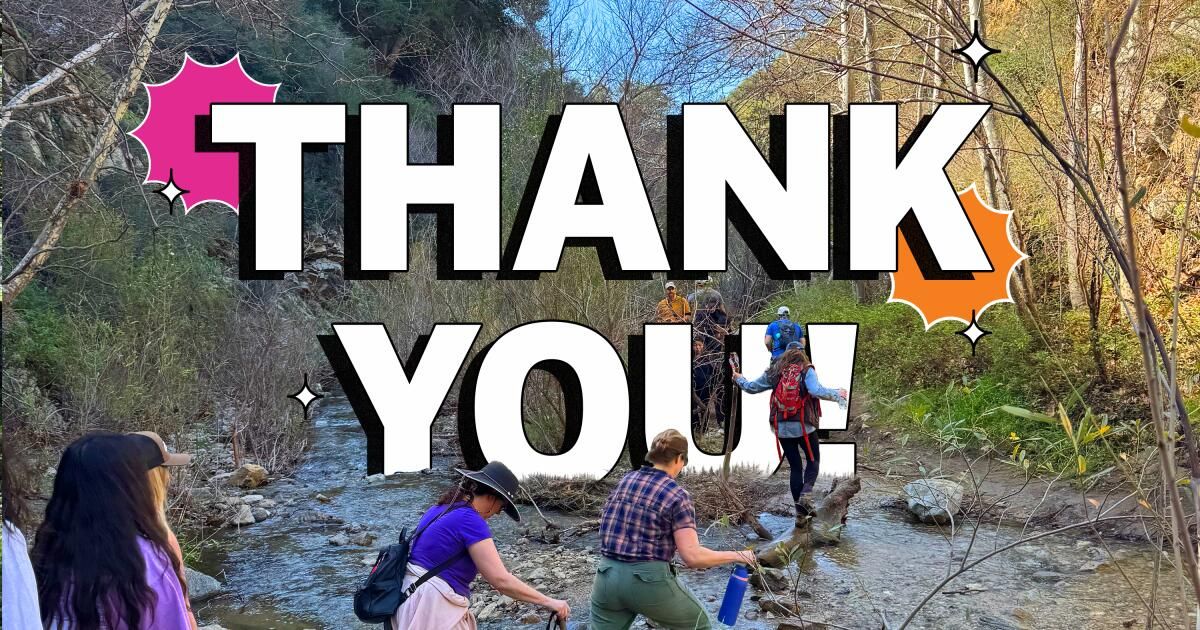
Our group deftly negotiated multiple water crossings and shared poles and shoulders to ensure we were all able to traverse the stream safely. None of us left the canyon dry-footed, but we ended up making new friends.

-
Share via
About 1½ miles in, we began to smell a sulfur-like aroma and knew we were close to one of the most interesting features of this hike. We climbed a steep slope to quickly discover signs of white oil bubbling from the ground.
“This very rare geological feature of translucent oil has been leaked by nature,” the sign said. “This special resource originates deep within the earth, in the Placerita Schist basement rock complex.”
Shortly after, we gathered under the shade of old oak trees in a large clearing with several picnic tables.
Just under two miles later, we rested at a large picnic area under the shade of tall old oak trees. Nearby was a stone fireplace and concrete foundation, the last remains of a house Frank Walker began building but never finished. The Walker family lived on the land since the 1920s. We sat together for about 20 minutes, sharing our favorite local hikes, including the Gabrielino Trail that runs through the San Gabriel Mountains.
The walk was part of California 175 — What Connects California?, a set of free Zócalo essays and events that brings together leaders and thinkers from all walks of life to imagine California's next 175 years.
Keep an eye out for the Times' next subscriber surge, coming sometime in the spring. In the meantime, want to learn more about the outdoors in Los Angeles? Sign up for The Wild, our weekly (free!) outdoor newsletter, where I bring you the best places to hike around Los Angeles County. See you there!