The small town of West Goshen, California, was exactly the kind of place community solar was designed for.
Near Visalia, most of its 500 residents live in mobile homes, where companies won't install roof panels without a solid foundation. And until recently, they used propane for heating and cooking, and price fluctuations in the winter posed difficulties for low-income families.
Community solar, in which residents get a discount on their bills by subscribing as a group to small nearby solar panels, was designed to help low-income residents, apartment dwellers, renters and others who can't put panels on their own roofs.
Over the past 11 years, New York, Maine, Minnesota, Massachusetts and other states have created thriving community solar programs. But California has built, at most, only 34 projects since 2015, and experts say that's generous accounting.
“We've had community solar for a dozen years, and it just hasn't produced anything of scale or anything notable,” said Derek Chernow, director of Californians for Local, Affordable Solar and Storage, a developers trade group that is pushing to get a more robust program off the ground. “Projects are not done in pencil.”
West Goshen residents were among the lucky few to become part of a community solar project in 2024.
“It's allowed us to breathe a little bit,” said resident and community organizer Melinda Metheney. His bill has been reduced by about $300 in the summer months, thanks to the 20% community solar discount, along with other low-income discounts and clean energy incentives, he said.
The West Goshen panels are located about 10 miles from the city, in a countryside surrounded by farms. Energy and climate experts agree that California must add much more clean energy to its grid, about 6 gigawatts by 2032, the California Public Utilities Commission said in a new plan last week.
Assemblyman Christopher M. Ward (D-San Diego), who in 2022 authored a bill to create a more effective community solar program, said the state needs to double its annual solar installation rate to reach that goal and is not on track to do so using only large utility-scale solar farms and individual rooftop panels.
“We need medium-scale community solar,” he said.

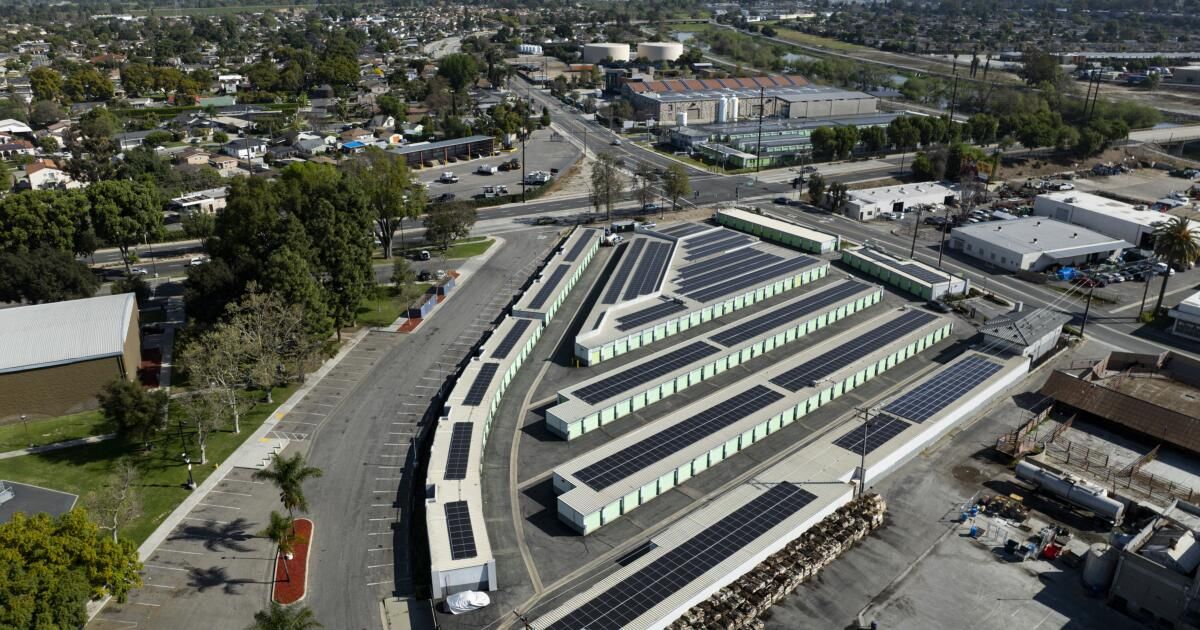
Energy and climate experts agree that California must add much more clean energy to its grid, about 6 gigawatts by 2032, the California Public Utilities Commission said in a new plan last week. Above, solar panels at Extra Space Storage in Pico Rivera.
(Kayla Bartkowski / Los Angeles Times)
He and a coalition of environmental groups, solar developers and the Utility Reform Network, a ratepayer advocacy group, worked to put his 2022 law into effect. They joined together to require utilities to pay community solar developers and customers for the electricity they feed into the grid using the same formula they use for people who install rooftop solar.
But in May 2024, the California Public Utilities Commission decided to go with a late proposal backed by the state's investor-owned utilities to pay for community solar at a lower rate.
The agency, along with its public advocate office, argued that crediting solar developers at a higher rate would increase bills for non-solar customers, who would still have to bear the cost of maintaining the grid. It's similar to the argument they've made to cut incentives for rooftop solar.
The new program relied on federal money, including the Biden administration's Solar for All, to sweeten the deal for developers. But the utilities commission spent very little of the $250 million available under that grant before the Trump administration tried to claw it back last summer, and is now mired in litigation.
At a legislative oversight hearing last week, Kerry Fleisher, the commission's director of distributed energy resources, blamed the loss on the failure to launch the new program.
“There has been enormous uncertainty in terms of the Solar for All funding that was intended to complement this program,” Fleisher said. “That's part of the reason this has taken longer than usual.” He said the commission still plans to release a schedule in the coming months.
Ward, the San Diego lawmaker who wrote the community solar bill, called the program “fatally flawed” in an interview.
He is now considering a bill to align the community solar program with what he initially envisioned: increased incentives, requirements for battery storage and compliance with state law requiring new homes to be built with solar power.
A study last year funded by a solar trade group found it could save California's power system $6.5 billion over 20 years. But Ward's effort to revive his program last year failed to be approved by the Assembly appropriations committee.
“Every other state in our country that has adopted similar community solar program models is working,” Ward said, adding that 22 states have programs comparable to the one solar advocates want in California. “The evidence suggests that, exactly as we feared years ago, this was not the way forward.”
California Public Utilities Commission spokesperson Terrie Prosper called California “a leader in cost-effective and lowest-cost solar deployment overall compared to any other state,” in an emailed statement.
By the commission's definition, the state has initiated 34 projects, representing 235 megawatts of community solar. But studies from groups like the Institute for Local Self-Reliance and Wood Mackenzie use different definitions of community solar and show California lags far behind at least 10 other states.
Meanwhile, advocates and developers involved in successful community solar projects in California say they were difficult to get off the ground.

Homes in the Avocado Heights area of Los Angeles County are part of a community solar project.
(Kayla Bartkowski / Los Angeles Times)
One that came online in May in the unincorporated communities of Bassett and Avocado Heights in the San Gabriel Valley provides solar electricity to about 400 low-income residents. They get 20% discounts on their electricity bills for subscribing to panels installed on two rooftops of Extra Space Storage buildings in Pico Rivera.
Organizers said it took them nearly five years to find the right location and meet utility requirements. They also obtained a grant in addition to the funding provided by the state public utility commission's solar program.
“It wouldn't have happened if it hadn't been for the grant,” said Genaro Bugarin, director of the nonprofit Energy Coalition that proposed and coordinated the project.
Brandon Smithwood, vice president of policy for Dimension Energy, the developer of the project in West Goshen, said he still hopes to see a community solar program in California that compensates projects for how they help the grid.
“We have seen that it can work and we know that what we have will not work,” Smithwood said at the hearing.