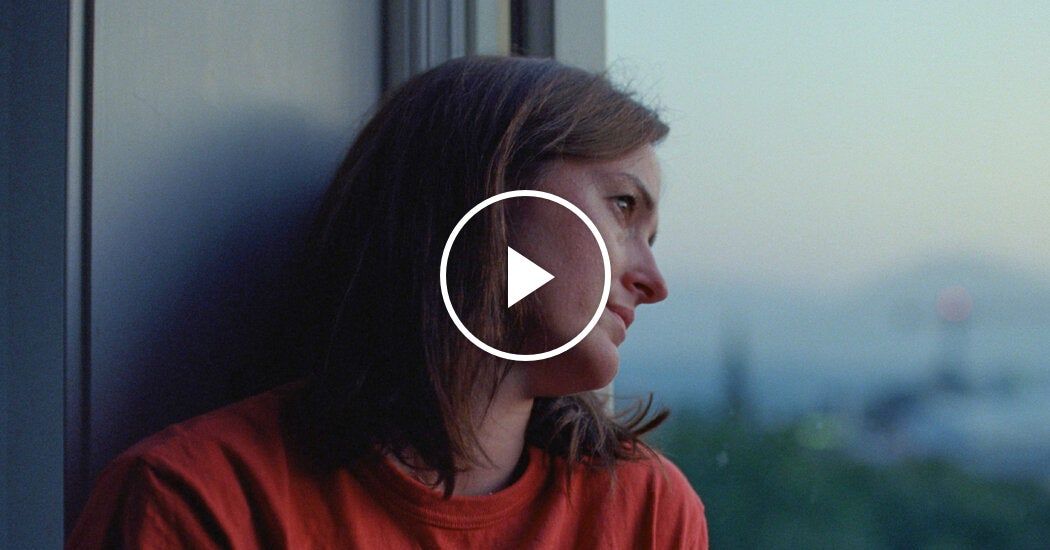
Hello, I'm Joachim Trier. I am the director and co-writer of “Sentimental Value.” So we wanted the film to start with a strong character scene, and Renate Reinsve was always in our mind when we wrote the character of Nora, the eldest daughter of this family, and introduced her professionally as an actress at the National Theatre, where Renate has also worked in real life. We did a lot of research into this beautiful old building where Henrik Ibsen used to perform his original works and for the first time in the late 19th century, so it's quite a renowned building. So Nora has stage fright. She is a star. She will take the stage as the protagonist of this great production about a witch hunt in Norway during the late medieval period that Eskil Vogt and I invented and wrote. We had to create a play here. But he is afraid to go on stage. And here we also have Anders Danielsen Lie, our wonderful friend from many films, who plays one of his colleagues in the theater. I was interested in exploring the avoidance mechanism of stage fright, which is almost like an image of something bigger, like something we can all feel, that we are deeply attracted to something that makes us who we are, but that makes us disgusted or afraid: to be what we could be. That ambivalence really puts us in a strange place for the character, but also in a very intriguing place because the film is about the ambivalence between people who work artistically and the inability to create a life and a home outside of that kind of fictional space in which they work. We also wanted to have a little fun at the beginning, have a little bit of a dynamic scene. There is a bit of running. There are comical bits where she asks her colleague to slap her even though he doesn't want to. But it is deeper. This is a real feeling of deep anxiety in her. Renate is an incredible actress. And it was quite difficult for her, actually, to get into this because she doesn't have stage fright, but she has to open up the possibility of having it in herself. And I think she does an amazing job. All these people around her, some of them are actors, some of them are not actors. We tried to find a group that would show how the ensemble spirit works in a theater. The film is also about two families, the family on a film set or in a theater group, and the family at home, and how you move between them. So I thought there was something like the mice in “Cinderella the Beautiful”: they are sewing her dress, and when she is about to appear on stage, no one in the audience will see how everything is taped together, anxiety and people barely making it. It looks very elegant and impressive. And I think that's for all of us who create something, even movies. It's barely duct-taped together and we just hope the audience feels something and engages with it. It is the mystery of creating something. There is also the comic idea of the pressure of an anticipating public. And I think after “The Worst Person in the World,” Renate, my co-writer Eskil Vogt and I, the whole team, had a little bit of stage fright. We had a little writer's anxiety. We had a bit of performance anxiety, how are people going to deal with the next one? Maybe they don't like it. All of that falls within the creative being. I am a third generation filmmaker. My grandfather was a film director. My parents were in movies. My other grandfather was a painter. I know that almost shameful need to express oneself in public and, at the same time, sometimes feel very depressed about it. And insecure and on some strange level, I think vulnerability is what also creates a space for the public to interact with the art. I hope they are reflected. Look, this is something human. It is not just a sophisticated construction. It is something that lives and breathes and there is risk in it. And that moves me a lot when I go to the theater, which by the way, is not my world at all. I had to explore a lot. I am a 100 percent cinematic person. I grew up loving cinema, and theater was something that I always admired, but I am moved by the risk that actors take, the vulnerability of going on stage to pretend that you are “Hamlet” for an entire night. There is something beautiful in that. And finally, here we see Nora gaining the power in herself to do so. And she's actually a very good actress.