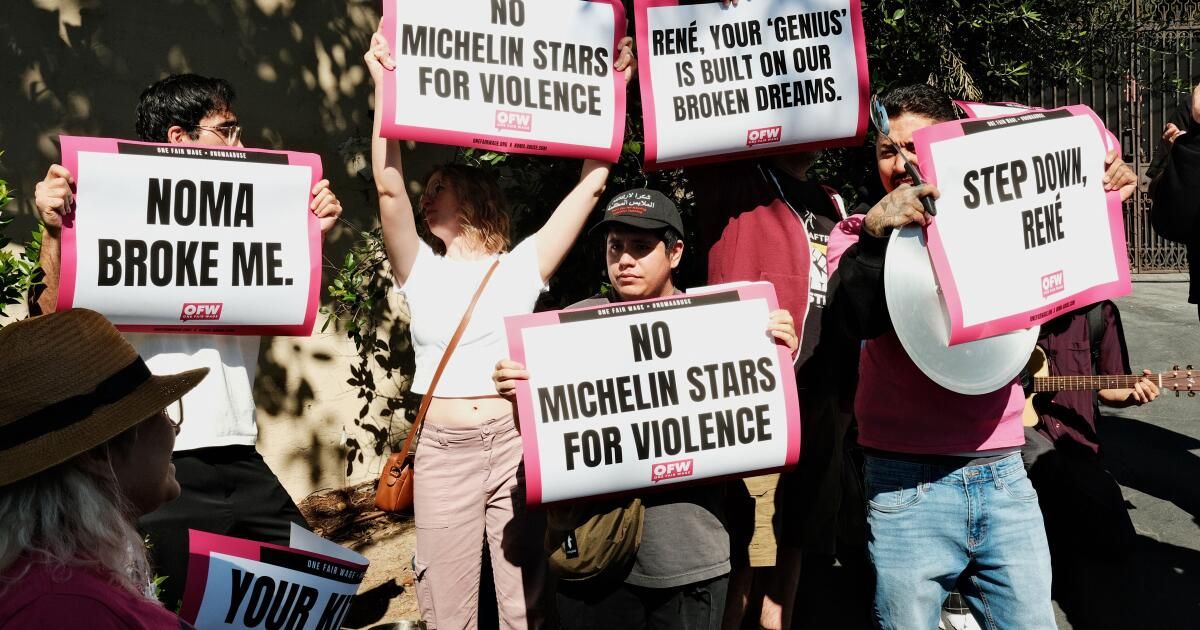
After several days of protests outside its controversial pop-up location in Silver Lake, Noma restaurant responded to a demand letter from workers' rights activists who led a campaign that resurfaced past abuse allegations and culminated in the loss of event sponsors last week and the abrupt “walking away” of renowned chef René Redzepi.
The Los Angeles pop-up, similar to others Noma held in Mexico and Japan, has generated controversy since its inception. News of its $1,500-per-person price tag especially angered skeptical locals. However, reserves were depleted almost immediately, Noma said.
On Thursday, prominent protest leader Jason Ignacio White received a letter from Noma, which he posted on Instagram. Noma indicated it is open to a discussion, as long as they agree to a set of “ground rules,” including a neutral third party to transcribe the meeting, confidentiality and dialogue without personal attacks.
The letter also called for an end to the protests, saying that “demonstrations outside the Noma pop-up and our other operations will permanently end once a meeting is scheduled and the attacks stop.”
White, reached by phone Friday, said the letter is under review. “What I can say is that we will not accept [the] “The protest will stop until there is a settlement agreement, or until there is some kind of agreement for our demands to be negotiated,” he said.
Protesters have pledged to maintain a presence outside the gate of Paramour Estate in Silver Lake, the location of Noma LA, for 16 weeks. The Copenhagen restaurant also plans to open a pop-up shop next month on Sunset Boulevard.
At the center of the movement is White, who worked at Noma for about five years in its fermentation lab. White has partnered with One Fair Wage, a nonprofit advocacy organization, to amplify calls for reform, including reparations for mistreated Noma staff, a fund for supportive services and living wages.
The campaign that unseated Redzepi was largely sparked by a series of social media posts by White detailing allegations of past abuses against former Noma employees and gradually gained traction online and in mainstream media. A New York Times investigation into Redzepi's behavior at Noma, published days before the Los Angeles pop-up launched, accelerated calls for accountability and included accounts of Redzepi punching staff in the ribs, poking them with a barbecue fork, threatening deportation and body shaming.
In addition to stepping away from Noma, Redzepi also resigned from MAD, the restaurant's nonprofit. A “workplace transparency review,” posted on Noma's website, includes new language about the restaurant's internal practices, such as training, hiring, compensation and benefits.
White has been depicted as a polarizing figure. The former Noma intern is now questioning an incident that White used as an opening attack to expose the restaurant's alleged toxic work culture.
White said one of Noma's catalyzing experiences that led him to speak out occurred in 2021, when an intern allegedly “burned her face” in the Copenhagen kitchen. White has recounted the incident several times on social media. In an interview, she said head chef Pablo Soto and other managers joked and laughed while the intern cried in the bathroom, until White convinced the team to call a car to take her to the hospital.
Jason Ignacio White, a former Noma employee, has become a leading voice driving reform in high-end kitchens.
(Ronaldo Bolaños/Los Angeles Times)
The former intern spoke to The Times and requested anonymity for fear of retaliation and so as not to be professionally associated with Noma or the accident.
The Times reviewed photographs of her facial burns and messages sent to her parents recounting the August 2021 incident. She disputed White's characterization of the Noma staff's response.
“I read his comments and I don't recognize anything that really happened in his text messages or comments,” he said of White's posts about his injury.
He no longer works in restaurants and learned about the posts from a friend last month. She said she considered contacting White directly, but feared he might take a screenshot of any communication and post it on social media.
He came to Copenhagen that summer at the age of 18 for an unpaid internship and called it “an extraordinary experience.” She said she had received extensive training in safe kitchen practices, but after eight or ten rotations in the Noma oven, one night she opened the door without stepping aside, causing the steam to burn her face.
When she felt her burns getting worse, the inmate said she approached Soto, who told her to wash her face while another staff member called for a car to take her to the hospital. She said she never cried or screamed, and that she never heard or saw anyone laugh, and that everyone treated her with respect, including Soto, who transported her, waited with her and took her home.

Protesters watch as guests arrive for lunch on day 1 of the Noma LA pop-up.
(Stephanie Breijo / Los Angeles Times)
“I don't think that moment is traumatic,” he said. “For me it is still one of the best life experiences I could have had at such a young age.”
Soto remains head chef at Noma and cooks at the Los Angeles pop-up. Since White's Instagram posts, Soto told The Times that he has received numerous “hate messages and personal threats.”
Soto, a Mexico City native who completed his first internship at Noma in 2012 and joined the team in 2017, said White's account “does not at all attest to who I am or how I behave at work.”
“In fact, I remember that it was something very serious. Nobody would have tolerated someone laughing at a girl burning her face,” Soto said.
Another former Noma intern also questioned White's account of the burning event, saying he never saw anyone laugh or mock. The intern, who also requested anonymity for fear of retaliation, said he worked closely with White in the fermentation lab and never experienced or witnessed abuse beyond White's alleged verbal abuse of lab inmates, who “were suffering under his command.”
“It was more on a psychological level,” said the former intern. He said White cursed at the interns and repeatedly accused them of breaking things they said they hadn't done.
White denied the allegations of verbal abuse. “Obviously, it's horrible to know that there are people who have worked with me who have been in an environment that I've created that made them uncomfortable,” he said.
“I have never insulted a Noma intern in my life, so I don't understand why they would say that,” he added. “I would encourage them to reach out to me and talk to me, because that would be the most important way for us to resolve that.”
White said all versions of the fire incident are valid.

Uyên Lê, left, chef and owner of Bé Ù restaurant, demonstrates outside the pop-up with former Noma employee Jason Ignacio White.
(Stephanie Breijo / Los Angeles Times)
“I really don't want to get too involved in this anymore,” he said. “I think it's unfair, and that's what happened, it affected me. And your side of the story, my side of the story matters, and [his] History matters.”
On the day of the pop-up's opening, White, who now leads fermentation seminars and programs at other restaurants, addressed the hurdles of his newfound visibility.
“I don't think you have to be a saint to stand against violence and abuse,” he said on March 11. “But at the same time, I'm making the best of it.”
The fast-paced nature of the restaurant industry creates constant, underlying pressure, said Andrew Moreo, assistant professor of hospitality management at Florida International University.
The element of urgency, combined with tight profit margins, long hours, and generally hot, cramped work environments with fire and knives, can create dangerous situations. “When you add all those factors together, it creates a very explosive environment,” Moreo said.
To change the culture, restaurant owners and managers must make a concerted effort to change their perspective, he said. Managers must see themselves as serving or supporting staff, rather than their staff being there to support them.
Portrayals of cuisines in the media, from “Hell's Kitchen” to “The Bear,” have also helped raise awareness. “The media is shedding light on [the industry] and it opened the eyes of the public and showed us that it is not right,” Moreo said.
White confirmed that he and other organizers plan to protest the upcoming Noma retail store, which is expected to sell fermented goods, coffee and other pantry items.
“We only talked about Rene's abuse in the New York Times,” said White, who estimates he has received more than 200 accounts of alleged abuse within Noma's various branches. “The amount of cultural abuse that happens inside a restaurant for so long is not the work of one person. It creates cycles of abuse and cycles of trauma that entangle people.”
Soto said Redzepi's announcement to move away from Noma has not affected the emerging player's career and that the team is staying the course. Reserves are still depleted.
Soto declined to answer whether he witnessed abuse during his nearly decade at the restaurant, but said he has seen corrections in the way staff direct each other and how they are trained, and that “toxic” staff have been “actively removed” from the team. “I know improvement is a process,” he said. “I am nothing but proud of the way we worked today.”
White and One Fair Wage said they would consider taking legal action against Noma if the restaurant does not address its list of demands. He said he also plans to shift focus to “address ethics policies” at other major industry institutions, such as the Michelin Guide, the James Beard Foundation Awards and the World's 50 Best Restaurants organization.
Times staff writer Suhauna Hussain contributed to this report.