Last update:
From Noida's Great India Place to struggling malls in Kochi and Nagpur, here's a closer look at 10 ghost malls in India and what retail data says about their decline.




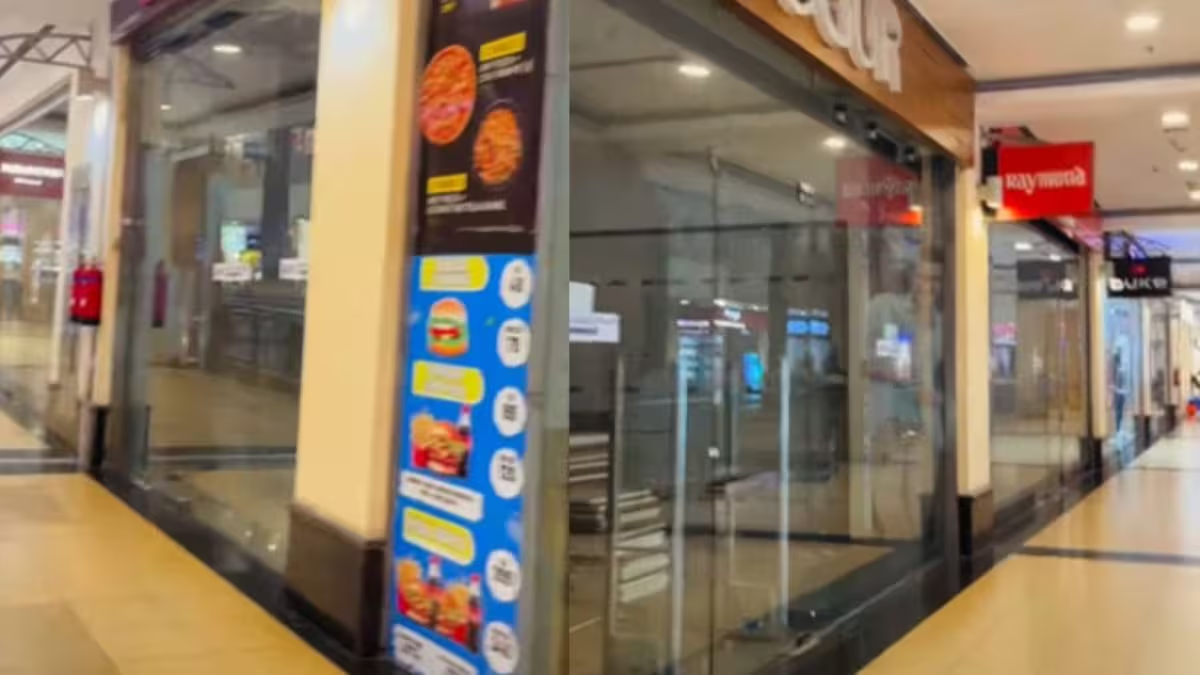
Great India Place (GIP) is located in Sector 18, Noida. (Photo credit: Instagram)
For over a decade, malls symbolized India's aspirational growth story. They were weekend destinations, date spots, family gathering places, and air-conditioned escapes from chaotic streets. But today not everyone is prospering.
According to a recent retail real estate assessment by global real estate consultancy Knight Frank India, nearly 20% of India's operational shopping malls – 74 out of 365 across 32 cities – fall into the category of “ghost malls”, defined as properties with more than 40% vacancy and consistently low footfall. The report highlights that many of these centers struggle due to a poor tenant mix, aging infrastructure, fragmented ownership or the emergence of newer, experience-driven shopping centers.
While not abandoned, these malls reflect a deeper shift in the way people shop in India.
Here are ten shopping centers and retail centers that have faced significant decline, according to media reports and retail studies:
1. The Great Indian Place (GIP), Noida
The Great India Place (GIP), once one of the largest and most visited malls in NCR, opened in 2007 and became synonymous with Noida's retail boom. However, after the launch of DLF Mall of India in 2016, which offered bigger global brands and modern design, GIP gradually lost popularity.
As NDTV reported, GIP suffered from fragmented ownership and lack of reinvestment, making coordinated upgrades difficult. Over time, the main tenants left and large sections became underused.
2. Big Gold Souk, Kochi
When Gold Souk Grande opened its doors in 2011, it was positioned as the largest shopping mall in Kerala. However, within a decade, traffic decreased dramatically.
According to local reports and coverage, most of the stores closed over the years. The media has described the mall as virtually empty, with only a handful of operational spaces remaining.
3. Raghuleela Mall, Vashi (Navi Mumbai)
Located in Vashi, this mall once attracted a constant traffic from the residents of Navi Mumbai. However, competition from newer developments and a lack of improvements led to reduced occupancy.
Public reports indicate that redevelopment plans have been considered, indicating that the mall may become a mixed-use property rather than continuing as a traditional retail space.
4. Various Shopping Malls in Kolkata New Town – Rajarhat Belt
A report by The Times of India noted that 6 out of 23 malls in Kolkata's New Town-Rajarhat area had less than 50% operational stores, with vacancy rates hovering around 55%.
Retail experts attribute this to oversupply in the region combined with changes in purchasing patterns.
5. ETA Mall, Bengaluru
The initial boom in Bengaluru's shopping malls produced several properties that later ran into trouble. ETA Mall in Binneypet is frequently cited in discussions of urban retail as one that has failed to sustain high footfall amid intense competition.
Reports in regional publications have noted declining relevance as consumers have moved towards larger destination shopping centers and high street formats.
6. TK Ramakrishnan Memorial Mall, Kochi
Built by a local municipality and opened in 2020, this shopping center struggled to attract sustained retail occupancy.
According to The Times of India, civic authorities later explored reusing the property due to limited interest from tenants.
7. AG Raghava Menon Memorial Mall, Kochi
This mall, another civically developed property in Kerala, also faced low leasing response after launch. Local reports suggested that alternative utilization models were being considered.
8.Ansal Plaza, Delhi
Ansal Plaza, one of Delhi's first shopping malls, was once a premium shopping address. However, multiple media reports over the years have documented a decline in tenant presence and reduced traffic, especially after the opening of new malls in Saket and Vasant Kunj.
Industry commentary often cites a weak leasing strategy and lack of repositioning as key factors.
9. Shopping Malls in Nagpur
Knight Frank data shows that Nagpur has vacancy rates close to 49%, one of the highest in India. Several shopping centers in the city struggle to maintain anchor tenants and steady traffic.
10. Shopping malls in Amritsar and Jalandhar
The Knight Frank study also highlights high levels of vacancy in second-tier cities such as Amritsar (around 41%) and Jalandhar (around 34%), reflecting structural retail stress in certain regional markets.
Why did these shopping centers have problems?
Retail analysts and real estate studies point to recurring patterns:
Excess supply of space in shopping centers without proportional consumer demand
Fragmented ownership, making coordinated updates difficult
Loss of anchor tenants, significantly reducing footfall
Rise of experiential shopping centers that focus on dining and entertainment
Shift towards retail and e-commerce
According to Knight Frank India, some of these underperforming malls still have revival potential. The consultancy estimates that repositioning or remodeling selected properties could generate significant rental value if done strategically.
The bigger picture
India is not witnessing the death of shopping malls but rather a correction.
The shopping centers that thrive today focus on:
Select Brand Blends
Entertainment-led experiences
Strategies for dining first
Continuous reinvestment
Those that failed were often static in a dynamic retail environment. Ghost malls are not ruins, they are reminders. From a retail model that once worked, but didn't evolve fast enough. And in India's rapidly transforming urban landscape, evolution is everything.
February 11, 2026, 22:21 IST