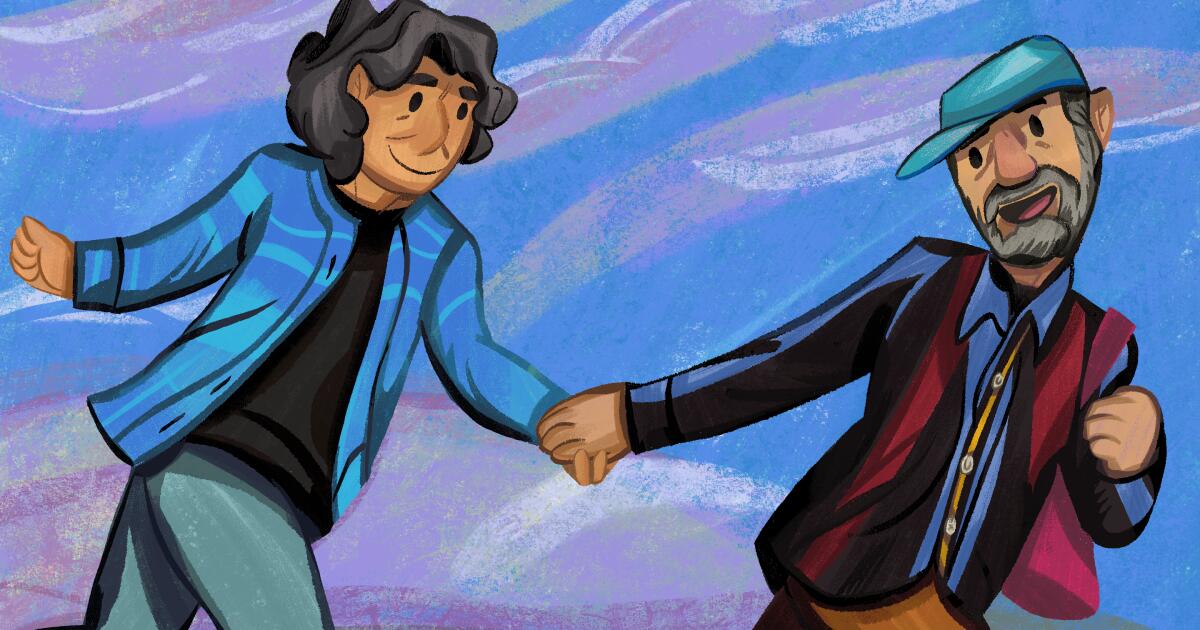
My father spent the 1970s selling hunger to America: sodas, waffles, chips, anything that promised satisfaction in 30 seconds. He also weighed 450 pounds and was always on a new diet with me as his little diet coach. All of his best material came from our kitchen table: “L'eggo my Eggo,” “Once You Pop, You Can't Stop,” “Coke Is It,” the lines he blurted out between bites.
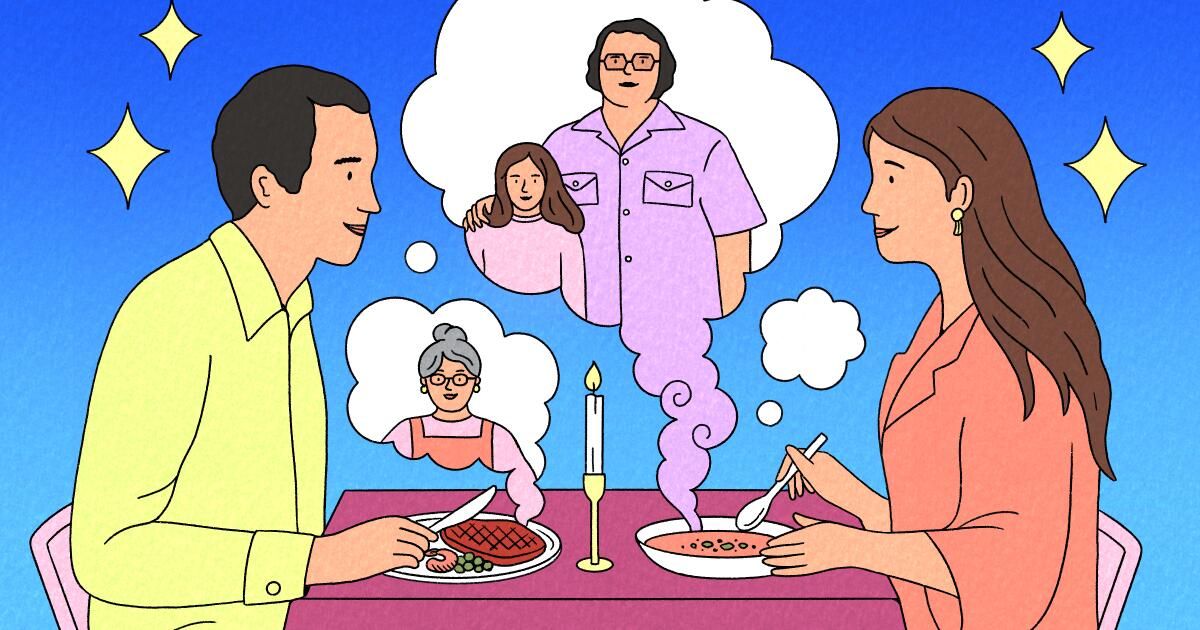
My grandmother Bella did the complete opposite. She comforted me, one recipe at a time, until I believed emotions had flavor. My father could sell convenience to the American consumer, but he couldn't give the same security to the girl sitting in front of him. Between my father, who treated cravings like a religion, and my grandmother, who treated food like therapy, I grew up thinking that connection was something you could taste before you could name it.
So when I met my Bumble date years after my divorce, it wasn't fireworks. It was somewhat calmer. A sensory memory. A familiar click in the body before the mind catches up.
The first meal we shared was at Dan Tana's: rare steak and shrimp swimming in oil and garlic. He ordered quickly, confidently, passing the plates back and forth as if this was something we'd always done. At some point during that meal, I felt that oyster-like disbelief when something simple tastes better than expected and you pretend not to notice because the surprise seems too intimate to say out loud.
After that night, we hit a rhythm. We went out to dinner a lot. Before I could even open a menu, she would tell the waiter, “Sauce aside, eat like a celebrity,” making me feel adored, not demanding.
The dishes were always exquisite. Slow-roasted bone marrow, branzino mixed with herbs, the kind of flavors that made us lean on and feed each other. He would study my face and say, “Do you love him or hate him?”, flashing me a warm smile.
On quieter dates, we watched movies in bed, talked about our kids, anything except what was forming between us. On the nights I stayed over, he would casually bring me matcha lattes in the morning, like it was no big deal, and every time, I felt like I'd won an Academy Award.
“Thank you, ladies and gentlemen!” I would exclaim.
And he shook his head, amused. “You're too easy to please.”
But what he didn't realize was remembering that I only liked a splash of milk and an extra shot of matcha fed a hunger in me that I didn't know I craved.
Our banter was fun, constant, and warm. Everything worked except when a question leaned into the future. It was then that something tightened, a brief, instinctive clamshell, and then loosened again just as quickly. But I kept going because the present was good. Because we laugh a lot. Because the world felt softer when I was with him.
So one Sunday night I asked him, “What are you going to do during the Jewish holidays?” He gave a rapid, unreadable blink. It disappeared before I could interpret it. We don't talk about that. We didn't need it. We were both leaving for our own family week. When I returned excited to see him and celebrate a big work milestone I had helped him prepare for, I got “the text.” Careful. Polite. And at the end, a line that opened a hole in my chest.
“I don't see a romantic future with you.”
I read it over and over again until my body rebelled. A wave of heat passed through me. I wanted to scream, but I stood there frozen, unable to breathe, as if someone had opened my chest and sucked the air out of me.
Suddenly, I was no longer a grown woman living in Hollywood. She was not a mother, nor a nutritionist, nor someone who had cared for people for years.
I was 9 years old. I was in Chicago. It was 1975. I was in my grandmother's kitchen, the place she loved most in the world. The only place I remember feeling safe. My fingers grabbed her apron. The smell of dill hanging in the air. His soup was bubbling. Nutrition, comfort, stability in the form of broth and firm hands. Then my mother’s voice cut through him: “Dawn, get in the car.”
When they pushed me into the truck, there were boxes everywhere. Clio awards, stacks of Playboy magazines with my father's signature, and when my mother came in behind me, she collided with my father's cigarette and the ashes ignited the map, burning a hole in the Midwest. My stomach was in knots. I continued to extend my hand towards my grandmother.
“Don't make me go.”
My mom, irritated, honked the horn and my dad stepped on the accelerator.
Decades later, standing in my kitchen, looking at the text message, the same feeling of nausea came over me. The ground moved. My friends, trying to support me, started texting me. “Don't you dare text him.”
But I did it.
“Hello.”
He responded immediately. That night we met for Japanese food and, without trying, got back into our swing in a Santa Barbara uniform and lamb chops cooked exactly the way we like them, crispy on the outside, tender on the inside, the kind of dish that cracks when you hit it with a knife and then gives way like warm silk. We weren't awkward. We weren't angry. We were not resolved. We were two people who kept meeting each other at a table, even when everything else was uncertain.
Then, sometime between courses, he looked up and said, “You remind me of my mother.”
The words hit something in me that I couldn't name. It is not a wound, but an internal tremor. He always told me that his mother was unpredictable. Warm one moment, stormy the next. Comforting and chaotic at the same time. I was none of those things. And I knew instantly that whatever he wanted to say was tangled and that my warmth might seem like a comfort to him, but also, unconsciously, a danger. That being cared for and burdened lived very close together in his body.
I didn't take it personally. I took it as information. Maybe I looked familiar to him in a way that conveyed security and alarm at the same time. One green light and one red light at the same intersection. And the strangest thing was that, in that very moment, he reminded me of my father, a man who could charm a room, fuel American slogans that defined a generation, win awards, and still feel unsettled where it mattered most: with me.
Two adults sitting at a table, reflecting childhood patterns that neither of us fully understood.
Later, when he took me home, something heavy dropped: his story, not mine to tell. The kind of truth that changes the room without explaining the entire plot.
Sitting there in his car, I realized it was never just the two of us. We both brought our ghosts, and they probably appeared before we even opened our menus. Maybe that's the real story. You can share the same cravings and still have to adjust the salt and heat as each new flavor combination comes together and develops.
The author is a nutritionist who wrote the best-selling book, “My Fat Dad: A Memoir of Food, Love, and Family, with Recipes.” Find her on Instagram: @DawnLerman.
Los Angeles Affairs chronicles the search for romantic love in all its glorious expressions in the Los Angeles area, and we want to hear your true story. We paid $400 for a published essay. Email [email protected]. You can find shipping guidelines. here. You can find previous columns. here.
Editor's Note: On April 3, LA Affairs Live, our new storytelling competition show, will feature real dating stories from people living in the greater Los Angeles area. Tickets for our first event are now on sale at the next fun thing.