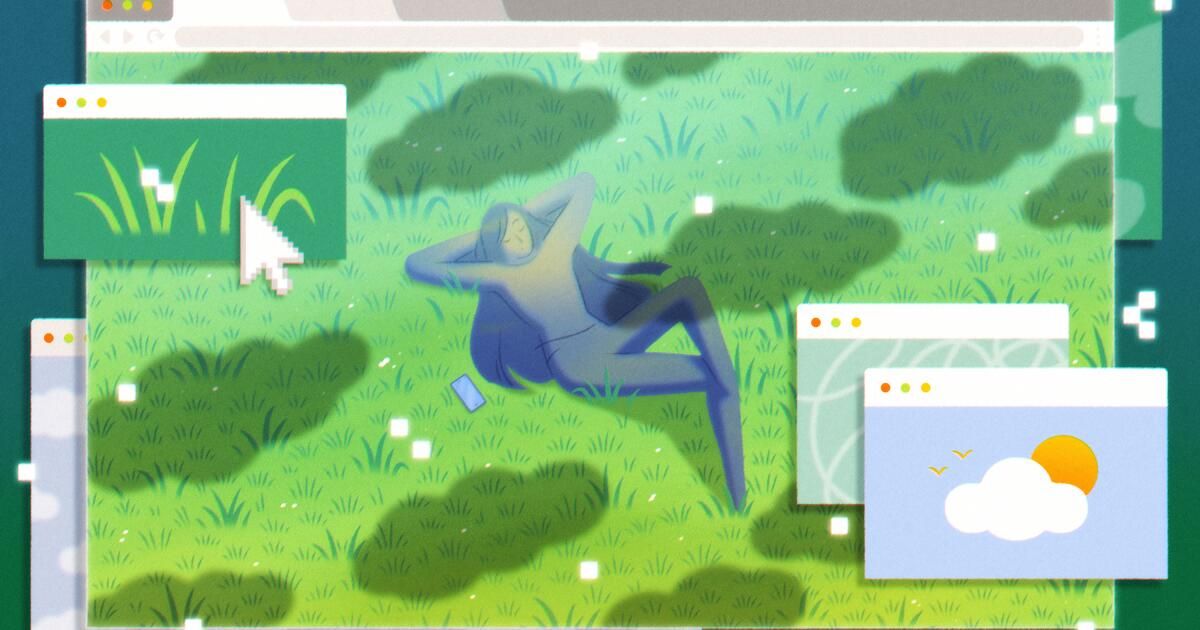
It's that time of year again: detox season. While many of us will start the new year by embracing Dry January (to cut back on alcohol) or doing juice cleanses (to lose weight), others will take “digital detoxes,” staying away from their devices more than usual or completely to enter 2026 with renewed energy and focus.

Shelf Help is a wellness column where we interview researchers, thinkers and writers about their latest books, all with the goal of learning how to live a fuller life.
But what happens when the detox ends and the chorus of text messages, rings, and social media notifications increases for the rest of the year?
Digital detoxes don't work, says author Paul Leonardi, professor of technology management at UC Santa Barbara, because they are temporary solutions that don't address our underlying tendencies and technological habits. Which is worrying because today we are drowning in digital connectivity (with other people, with news and information, with online data) and that can lead to a condition known as “digital exhaustion,” as Leonardi calls it.
The symptoms? Depleted energy, lack of concentration, feeling aimless when browsing online, and fear of returning “even one more email,” he says.
This is compounded by the havoc that excessive device use wreaks on our bodies: staring at a computer screen all day causes eye strain, endless scrolling on our phones can cause “tech neck,” blue wavelengths from screens disrupt our circadian rhythms, leading to poor quality sleep.
But if digital detox doesn't work, what will?
Leonardi's new book, “Digital Burnout: Simple Rules to Get Your Life Back,” focuses on reshaping our relationship with technology for the long term, helping readers develop healthier technology usage habits so they don't need to break up with the phone in the first place.
Think of Leonardi as a therapist and his book, a couples therapy couch that you sit on with your partner, a hyperactive smartphone that talks non-stop.
“A therapist doesn't say 'here's the answer,' right?'” Leonardi says. “A therapist tells you, ‘Here are a bunch of different things you can do, and which one will work best depends on your particular situation.’ That's really what this whole book is about.”
This interview has been edited for length and clarity.
How do we know we are suffering from digital burnout and how is it different from general burnout?
General burnout, as we apply it to our work, is like, “I'm done with this job.” You know, “work is killing me.” Digital burnout is a piece of burnout. It's this overwhelming feeling that “there's too much to process and it's too overwhelming for me to be constantly paying attention to all the tools, all the inputs, all the requests I'm getting from so many different sources.”
The first major symptom is apathy. “I really don't care about doing this job very well. I really don't care about returning this call.” The second is a feeling of hopelessness. Like, “No matter how much I do, there will always be more. I could go all day and my email would never fail.” It's like Sisyphus pushing the rock up the hill. The third is almost like a moth to the flame. “I know this is really making me cranky and fatigued and I should stay away from it, but I can't either.” It's this constant, almost vicious circle.

“Digital Exhaustion” by Paul Leonardi
(Riverhead Books)
Why is social media especially digitally exhausting?
It is a waste of our attention. Social media (all technology, but social media in particular) forces us to constantly disconnect our attention from one thing and focus it on another. And having to constantly disconnect and reconnect is a huge burnout factor. Then there is the inference. Inference is the type of effect that occurs when we constantly try to put all the pieces together when we obtain small fragments of data and information. We are like detectives putting the pieces together. That happens when we look at someone's social post and try to figure out, implicitly, is he or she a good person? Are they being bad? Are they friendly? Is your life amazing? Additionally, when we try to make inferences about what other people think of us based on our own social media posts: “Do you think I'm being arrogant because I post this information?” We never see the whole picture and putting those pieces of the puzzle together is exhausting. Finally: it is a true conduit to our emotions. It creates in us feelings of anxiety, feelings of fear, feelings of anger, but also feelings of excitement. And experiencing all that emotion is a source of exhaustion.
You say we switch between apps and online platforms about 1,200 times a day, on average. What effect does this “digital shift,” as you call it, have on our brains, and how can we protect ourselves?
Disconnecting and reconnecting our attention is very cognitively exhausting. As we move between apps, platforms, and websites, we have to constantly reorient ourselves. Even if you're changing [between] something as seemingly innocuous as Zoom and Microsoft Teams, that little switch means “oh, the button to share your screen is in a different place.” And the fact that you have to think about that has a little bit of stress associated with it.
The “tool audit” helps. The more we can reduce the number of changes we have to make, the better off we will be. So if you can get used to video conferencing on Zoom and not have to use Zoom once and Microsoft Teams again and Webex again, that's an easy way to reduce the switching costs that end up sapping our attention. [Also]”I live by a single thread.” The more we can push things into one channel, the fewer changes we will have to make. And the longer we can stay on a work path (or a set of similar tasks), the fewer changes we will have to make. So if I'm a professor preparing for a class, and I'm researching an article, preparing a presentation, and creating class notes, I might be in different applications. But the fact that everything is in service of the same general task, which is preparing for my conference, research shows reduces the fatigue associated with change.
We ask a lot more of people now, and that requires us to pay more attention to all these devices and apps and everything, which is really exhausting.
—Paul Leonardi

(Maggie Chiang / For The Times)
How is digital burnout changing family life? In the book, you talk about parents overwhelmed by endless coordination on group chats, school apps, and rideshare text messages.
Part of the problem is that because we have all these instant connections, people feel like they can make more last-minute changes. Then you can go into your team sports app and say, 'Oh, we're going to change the color of the socks for this game for our soccer team.' We wouldn't have done that 15 years ago because you couldn't have texted and contacted everyone on the team so immediately to ask them to change their socks. We ask a lot more of people now, and that requires us to pay more attention to all these devices and apps and everything, which is really exhausting. There is also a fear that many parents feel they are setting a bad example for their children by spending so much time on their devices.

Author Paul Leonardi.
(Photograph by Doug Ellis)
What are some guidelines for raising healthy children in the 21st century?
One of the things I think is really important is making sure you demonstrate, and role model, good behavior with your devices and platforms. So if you are mindlessly on your phone, your kids will also be mindlessly on their phones. And you're also sending them a signal that whatever is on the other end of your phone is more important than them. And children see that, observe and pick up on those signals. What is really important is the quality time we spend as parents with our children: that we are with them and not on our devices. And that sends a strong signal about our values.
Does AI exacerbate digital burnout or is it a possible solution?
At the moment, I think it's exacerbating it by giving us so much extra content to pay attention to. Simply because it's so easy for everyone to create content on a whim. Also, talk about technology is exhausting. We are constantly bombarded with reports about AI and all these predictions about how AI will take our jobs and change our relationships. It is exacerbating the problem of burnout. Where it could really help is if the tools could make better predictions about what information we need to make. [a task]. That prevents us from having to pause our work and access another application or search engine to find something. That's where it has real and promising potential to help us reduce our burnout.
It's up to us to figure out how to orient our tools so that they deliver their benefits without wearing us out.
—Paul Leonardi
His book is full of practical strategies to avoid digital burnout. What are some of your favorites?
In Zoom, turn off your own view. We end up paying too much attention to ourselves and worrying about how we present ourselves to others. It's like we walk around with a mirror in front of us all day. Another is to have very good intentionality about what you are doing on your devices. So when you pick up your phone, have an end goal in mind: “I'm picking up my phone because I need to check the weather.” If you don’t, then it’s very easy to get caught up in the next thing and the next thing.”
A third: treat coordination as a big problem that must be solved at once, instead of small problems that must be solved in the moment. A fourth: complementary opposites. Combine intense digital work activities with the use of your body, your hands and the physical world. The more people do that, the less they want to use their devices again.
One last strategy: think about controlling your visibility. We have been conditioned to lead these very public digital lives by posting everything and highlighting all our achievements. But the more we do that, the more things we have to pay attention to and the more worries we have about how others perceive us. So turn off the read receipts, write indicators, and analytics that make us feel watched. This is how we partly control our visibility. And remember: our technologies are neither inherently good nor bad. It's up to us to figure out how to orient our tools so that they deliver their benefits without wearing us out. That's really the central message of the book.