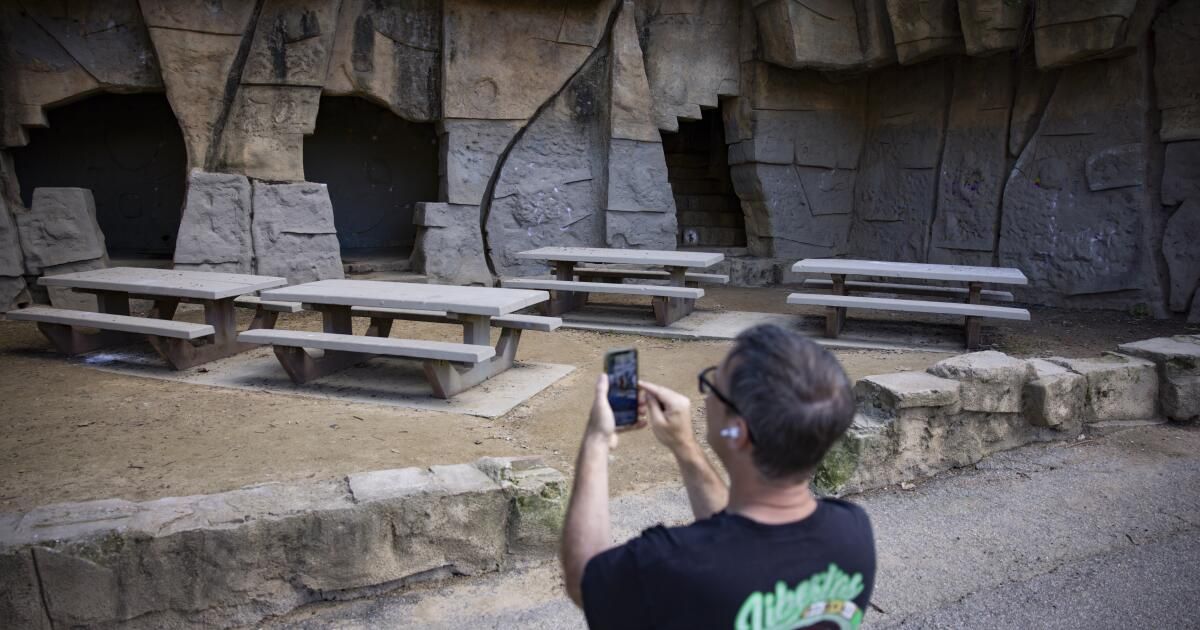
The remains of the original Griffith Park Zoo are imbued with memories of the past. Forgotten animal pens, decaying cages and stony bottoms now lie in various states of abandonment.
In other words, it's a prime location for a haunted narrative.
“Ghost in the Machine: The Old Zoo” is just that, a site-specific interactive experience where ghosts come to life through our mobile phones. In the story, our devices become a gateway to another world or, rather, an intermediate point between our universe and the afterlife. We'll see visions from a medium, hear fragmented memories, and explore a trail as we uncover a story that feels like an intimate look at a troubled past. And we'll learn a little bit of Griffith Park history along the way.
The augmented reality project is the vision of Koryn Wicks, a trained dancer and choreographer who has created her own pieces of immersive entertainment while working in the theme park's larger space. The project will be remounted this Friday and Sunday afternoon in Griffith Park to coincide with the naming of “Ghosts in the Machine” as an award finalist with IndieCade, a once in-person independent games festival that now exists primarily online.
Koryn Wicks, designer of “Ghosts in the Machine: The Old Zoo.” Wicks is an independent immersive creator working in the theme park space.
(Kayla Bartkowski / Los Angeles Times)

John Houser, 43, of the San Gabriel Valley, playing the augmented reality game “Ghosts in the Machine: The Old Zoo.”
(Kayla Bartkowski / Los Angeles Times)
“Ghosts in the Machine” exists as a testing app, hence the reason for the event-like approach to allowing guests to experience it. Wicks will be stationed outside the former zoo location for approximately two hours each day, facilitating downloads and answering questions about the self-guided experience.
Once those who choose to play are settled in with the game and near the old zoo, which opened in 1912 with a collection of just 15 animals and closed in 1966 to make way for the current animal park, they will receive a call. A medium, but “not like a famous medium,” has been trying to reach someone, anyone, and runs the risk of losing her memory while trapped between worlds. We are asked to turn on our camera and, through augmented reality, see an alternate version of the landscape in front of us, obscured by shades of blue and green and filled with static. The images feel fragile.
This medium, Phoebe, needs our help and if we agree, the game begins. We will be directed to follow a map to the anomalies around the old zoo. Things can get a little scary. An apparition will appear before us. However, Phoebe tells us that ghosts are not to be feared. A spirit, he says, is often lost and confused.
“I wanted to do a kind of haunted place,” says Wicks, 36. “I'm a big nerd about horror stuff. I really like it. I really like the idea of ghosts. I read this book called 'Ghostland' and it looked at ghost stories throughout American history and the way they're practiced and who gets chosen as a ghost versus who gets haunted. So the first few scripts I wrote were more meta, they were about ghosts in general. Then I gradually narrowed it down to a real story with characters. That's the dancer in me. I tend to think a little more abstractly.”
As the story was refined, it focused more on family ties. Without spoiling the experience, which should be able to be completed in just under an hour, “Ghosts in the Machine” gradually transitions from a haunt to a story that focuses on forgotten promises, lost loved ones, and the lonely pings that can arise from unresolved grief. “Ghosts in the Machine” begins with tension. It resolves as something more melancholic, a game-like story built for contemplation.

John Houser, 43, left, and Parker Cela, 26, right hold their phones to scan the stairs while playing the augmented reality game “Ghosts in the Machine” in Griffith Park.
(Kayla Bartkowski / Los Angeles Times)
And it is set in a perfect place to reflect. “Ghosts in the Machine” will take us up stairs, along trails and into now-deserted zoo enclosures as we try to free a spirit from purgatory. There are some game-like mechanics, as we will collect fragments of memories hidden throughout Griffith Park.
The park, Phoebe's character tells us, is a “beacon for spiritual phenomena.” Throughout, he will allude to stories of abused animals and the Griffith Park fire of 1933, increasing the feeling that we are in the presence of unnatural events. The space is dear to Wicks — it's where her husband proposed — but “Ghosts in the Machine” draws on more painful memories from her life.
“It had a lot to do with grief and memory,” Wicks says. “It can be very painful to engage with memory when we're grieving, and it can also be very complicated. Because there are good memories and there are also difficult memories. How do you hold space for both? That was something I was thinking about a lot at the time.”
The project was born during the worst days of the COVID-19 pandemic. Wicks, who had organized numerous small-group dance shows in the past, initially envisioned a show in which audiences would use their smartphones to follow a dancer through an outdoor space. Little by little it transformed into something more ghostly.
'Ghosts in the Machine: The Old Zoo'
With a small team, a day job, and the occasional teaching job, Wicks has found that keeping the app to the extent that it can launch successfully hasn't been feasible. For example, for this weekend's popups, the map feature had to be completely rebuilt. That's another reason Wicks will be on site, with the goal of helping those new to AR or troubleshooting various devices audience members may bring.
“I think we like to talk about technology having permanence, but it doesn't,” Wicks says. “Very few people still have their cassettes. Records still exist, but the technology is disappearing.”
Wicks is open to the idea of further developing “Ghosts in the Machine” and has sought institutional or commercial support. But she confesses that she has not yet found a solution.
Meanwhile, Wicks, who hopes to put on a show later this year that mixes dance with tarot themes, has created an experience that uses modern augmented reality technology and yet seems ephemeral. And that's appropriate, of course, for a ghost story.