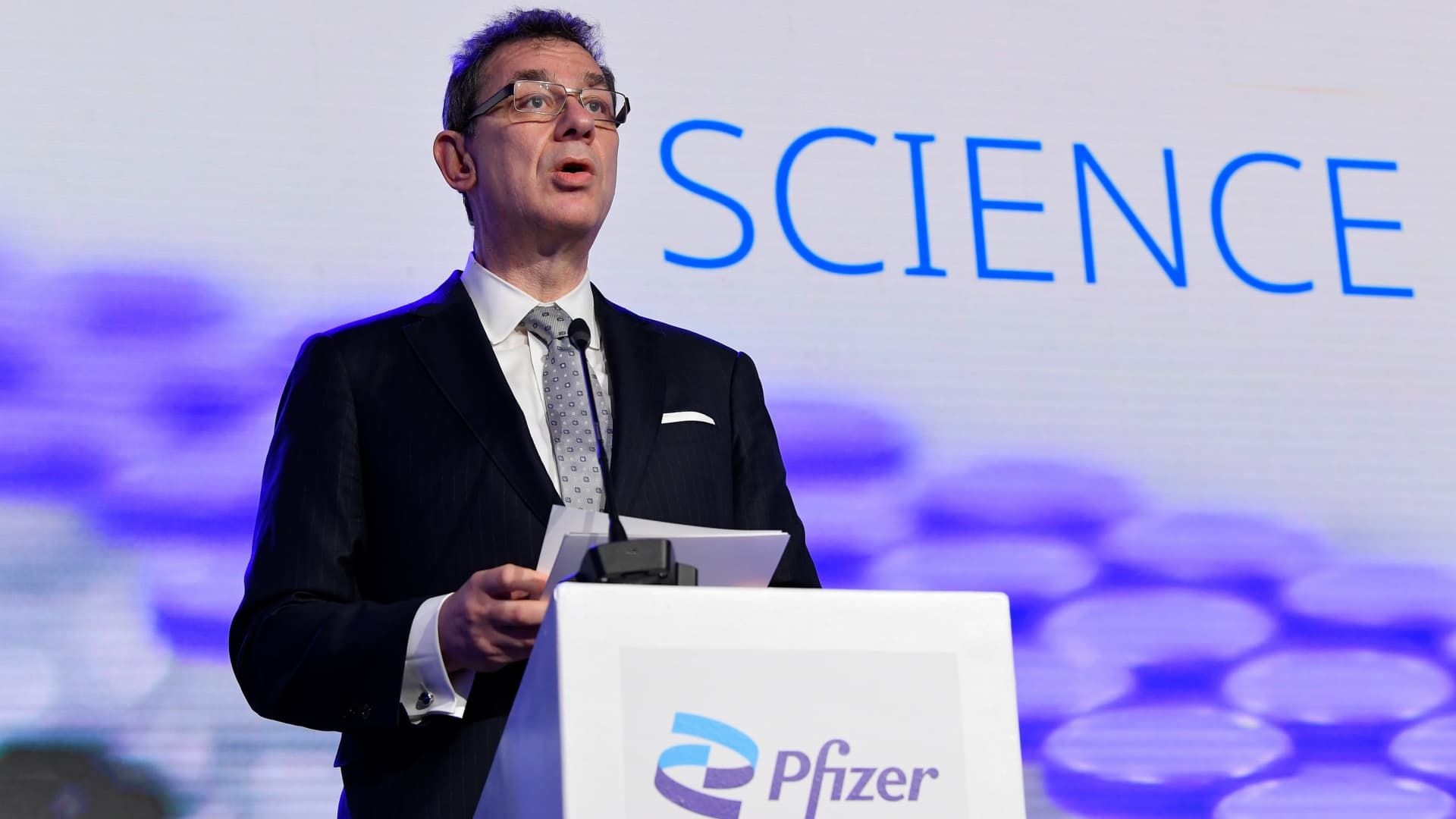
Pfizer CEO Albert Bourla speaks during a press conference with European Commission President Ursula von der Leyen after a visit to oversee the production of the Pfizer-BioNtech COVID-19 vaccine at US pharmaceutical company Pfizer's factory in Puurs, Belgium, April 23, 2021.
Juan Thys | Reuters
Pfizer on Tuesday said it had reached a licensing deal of up to $2.1 billion with YaoPharma to develop and market its anti-obesity pill, boosting the pharmaceutical company's push into the weight loss space.
Pfizer will pay YaoPharma, a subsidiary of Chinese pharmaceutical company Shanghai Fosun Pharmaceutical, an initial payment of $150 million. YaoPharma could also receive up to $1.94 billion in milestone payments, along with tiered royalties on sales if the drug is approved.
YaoPharma's drug works by attacking the same intestinal hormone, GLP-1, that NordiskThe successful weight loss injection Wegovy. But the pill is still in an early stage of development, meaning it will take several years to reach patients.
The deal will help Pfizer bolster and diversify its portfolio of anti-obesity drugs after a series of setbacks, including its decision to scrap two different pills in the past two years. The drugmaker boosted its prospects in the competitive space with its up to $10 billion acquisition of obesity biotech Metsera last month, following a fierce bidding war with Novo Nordisk.
“We look forward to contributing our expertise and resources to continue the development of this investigational small molecule GLP-1 that complements and strengthens our growing pipeline of new candidates for the treatment of obesity and its associated diseases,” Chris Boshoff, Pfizer's chief scientific officer, said in a statement.
Under the terms of the deal, YaoPharma will conduct a phase one trial of its drug, while Pfizer will take control of further development. Pfizer also plans to conduct studies combining YaoPharma's treatment with its own drug targeting another gut hormone receptor called GIP, which is currently in an intermediate stage of development.
That combination is not new in space: Eli LillyWeight loss injection Zepbound and diabetes drug Mounjaro use a dual approach targeting both GLP-1 and GIP.
In a note Tuesday, BMO Capital Markets analyst Evan Seigerman said there is limited information available about YaoPharma's drug, called YP05002. But Seigerman said he sees “obesity diversification as promising in the near term” for Pfizer.
He added that Pfizer's $150 million upfront payment reflects “prudent conservation of capital in light of Metsera's recent bidding war.”
The opportunity to enter the burgeoning weight-loss drug market could be huge for Pfizer. Some analysts expect the weight-loss drug space could be worth roughly $100 billion by the 2030s.
It's unclear exactly how many people use GLP-1 in the US, especially for obesity. But about 1 in 8 adults said they were taking a GLP-1 drug to lose weight or treat another chronic illness in November, according to a survey by health policy research organization KFF.