Merck on Tuesday reported fourth-quarter earnings and revenue that beat estimates due to strong demand for its Keytruda cancer immunotherapy and some newer products.
But the company released a modest 2026 outlook that fell short of Wall Street expectations as it prepares for some drugs to lose patent protection later this year and face generic competition. That includes type 2 diabetes medications, Januvia and Janumet, and Bridion, a treatment that helps restore muscle function that was blocked during surgery.
While those drugs are not top-selling products like Keytruda, their lower combined sales will likely put pressure on the company.
The pharmaceutical giant predicts that its revenue in 2026 will range between $65.5 billion and $67 billion. Analysts were expecting revenue of $67.6 billion, according to LSEG.
Merck also expects adjusted earnings to be between $5 and $5.15 per share. That compares with analysts' estimate of $5.36 per share, according to LSEG.
That range includes a one-time charge of about $9 billion, or about $3.65 per share, related to Merck's acquisition of Cidara, a biotechnology company that is developing a drug to prevent the flu.
The guidance includes “manageable impacts” from the drug pricing agreement Merck reached with President Donald Trump in December, as well as his administration's recent move to reduce the U.S. pediatric vaccine schedule, according to a company spokesperson.
Under that “most favored nation” agreement, Merck will voluntarily sell its existing treatments to Medicaid patients at the lowest price offered in other developed nations and guarantee that price for new drugs, among other efforts. In exchange, Merck will get a suspension of tariffs for three years.
Here's what Merck reported for the fourth quarter compared to what Wall Street expected, according to a survey of analysts by LSEG:
- Earnings per share: $2.09 adjusted vs. $2.01 expected
- Revenue: $16.4 billion vs. $16.19 billion expected
The company posted net income of $2.96 billion, or $1.19 per share, during the quarter. That compares with net income of $3.74 billion, or $1.48 per share, in the same period a year earlier.
Excluding acquisition and restructuring costs, Merck earned $2.04 per share during the fourth quarter.
Merck earned $16.4 billion in revenue during the quarter, up 5% from the same period a year earlier.
The results come as Merck cuts $3 billion in costs by the end of 2027 and prepares to offset revenue losses from Keytruda's upcoming patent expiration in 2028.
Merck shares closed more than 2% higher on Tuesday.
Keytruda drives growth amid Gardasil woes
Merck's pharmaceutical unit, which develops a wide range of drugs, posted revenue of $14.84 billion during the fourth quarter. That's 6% more than the same period last year.
Keytruda sales exceeded $8.37 billion during the quarter, an increase of 7% from the same period a year ago. Analysts were expecting revenue of $8.35 billion, according to StreetAccount estimates.
The increase in Keytruda's revenue was driven by greater acceptance of the drug for earlier-stage cancers and strong demand for the treatment for metastatic cancers, which spread to other parts of the body, the company said.
Sales of the more convenient subcutaneous version of Keytruda, which won approval last year, reached $35 million during the fourth quarter.
That version of Keytruda is key to Merck's efforts to offset likely declines in revenue after the drug's original formulation, which is administered intravenously, goes off patent.
Meanwhile, Merck's new drug Winrevair, which is used to treat a rare and fatal lung disease, posted $467 million in sales during the quarter, up 133% from the same period a year earlier.
Analysts expected the drug to generate $459 million, according to StreetAccount estimates.
The growth of Winrevair, which first entered the market in mid-2024, largely reflects increased acceptance in the US and its early launch in some international markets.
Merck continued to see problems with sales in China of Gardasil, a vaccine that prevents cancer caused by HPV, the most common sexually transmitted infection in the US.
Last February, Merck announced that it would stop shipments of Gardasil to China starting that month. In July, Chief Financial Officer Caroline Litchfield said the company would not resume shipments to China until at least the end of 2025, noting that inventories remain high and demand is still weak.
Gardasil generated sales of $1.03 billion during the quarter, down 34% from the same period a year earlier due to lower demand in China. Still, that was in line with what analysts expected, according to StreetAccount.
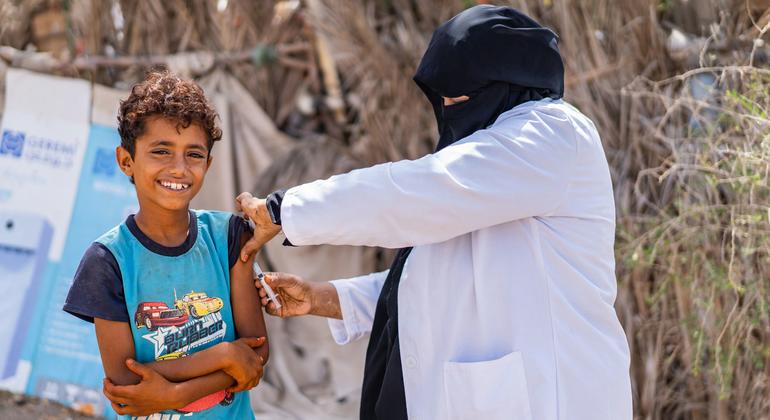
Gardasil's revenue could face more pressure in 2026. As part of the Centers for Disease Control and Prevention's changes to the pediatric vaccine schedule, the agency said children should receive one dose of the HPV vaccine instead of the two or three doses recommended on the label.
Merck's animal health division, which develops vaccines and medications for dogs, cats and livestock, posted nearly $1.51 billion in sales, up 8% from the same period a year earlier. The company said that reflects increased demand across all species.