A few years ago, Grace Guo began longing for places in New York City where going out with friends didn't have to involve alcohol.
Newly sober and surrounded by friends who also chose not to drink, Guo said she wanted alternatives to the typical social scene. After some research, she landed on Bathhouse and Othership: wellness clubs designed to create communities around improving health.
“Honestly, it's like going to a spa together and spending an afternoon together. I think for me, it feels a lot better than staying out late at night,” Guo told CNBC.
She is one of a growing number of people seeking memberships in clubs and other places that are structured around maintaining health while also acting as a place to foster connection.
And those spaces are also becoming booming businesses. Bathhouse, which opened in 2019 in Brooklyn, New York, told CNBC exclusively that it expects to reach around $120 million in revenue by the end of this year. He declined to disclose any of his other finances, as did Othership.
Many of these types of companies are privately held, but publicly traded gym chain Life Time also started betting on premium wellness a few years ago. While investors initially didn't like that reallocation of resources, it's now paying off: Life Time stock has more than doubled since October 2023.
Companies old and new are trying to reach consumers like Guo. The 31-year-old said she has seen an increased focus on health, wellness and peace of mind in her own social life and those around her, while seeking out so-called third spaces with that focus.
“I wonder where I can go to try to connect with a community, or where I can go to express a particular interest that I have and find like-minded people.” Guo said. “It's about finding a group of like-minded people, but also having the space and novelty to try something or pursue something.”
At Othership, between spending time in the sauna and cold bath and choosing a popular evening time, Guo said the health-focused socializing environment spoke to her.
“Having a space to go to where it gets us out of our routine and complacency is really important, and I think probably the most important thing is the fact that it overcomes a lot of the inertia of doing something,” Guo said.
'Loneliness is an epidemic'
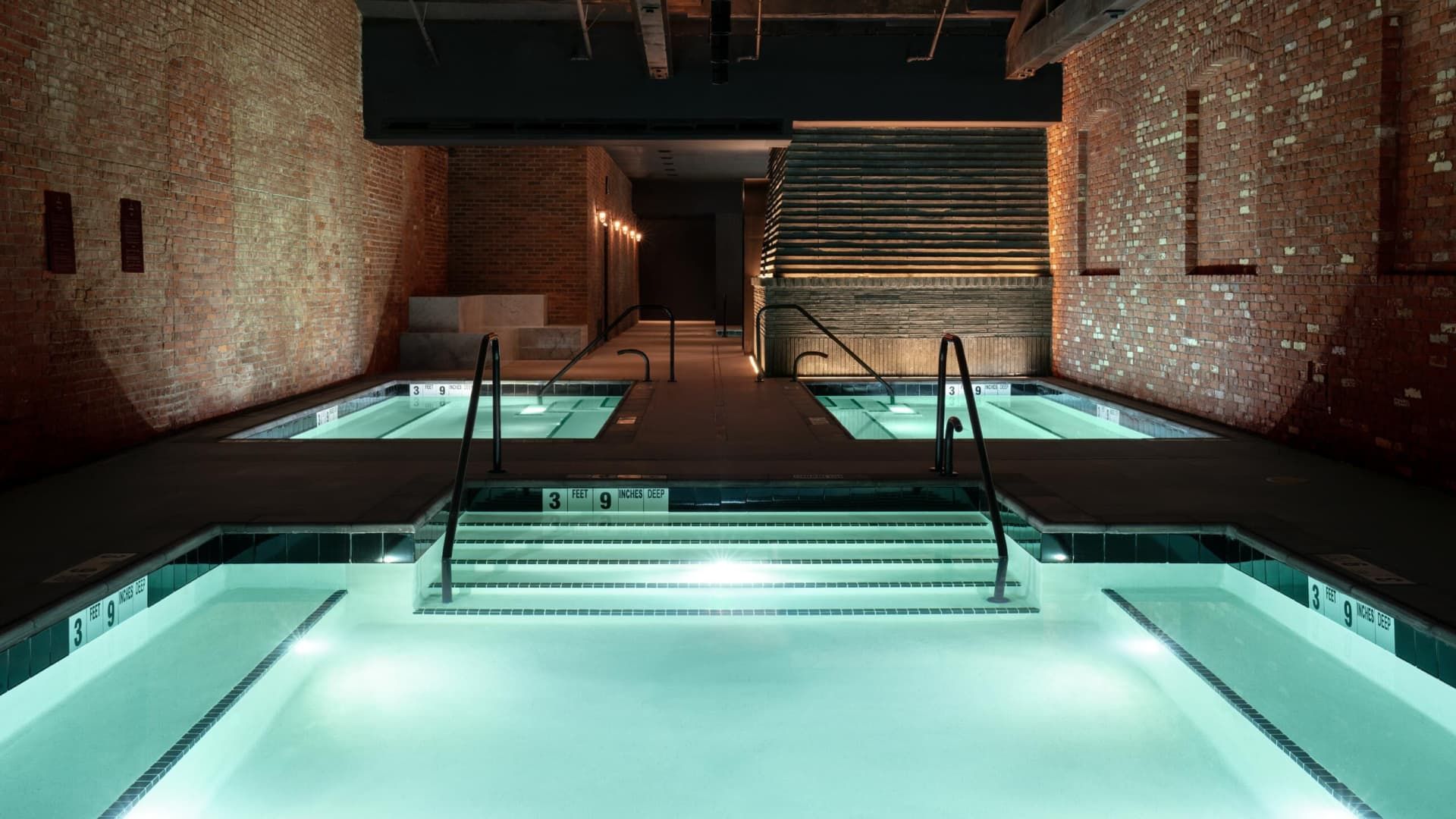
Bathing pools
Source: Bathhouse
The concept of third spaces is not new. The term was first coined by sociologist Ray Oldenburg in his 1989 book, “The Great Good Place,” to refer to spaces outside of home, or the first place, and work, the second place, where people gather and form relationships.
That definition came to encompass places like neighborhood coffee shops, libraries, bars, and more, where people from different backgrounds gathered in an informal setting with relatively low barriers to entry.
But at some point in recent years that definition has evolved and the importance of third spaces has flourished.
Richard Kyte, a professor at Viterbo University in Wisconsin and author of “Finding Your Third Place,” said he has been teaching courses on third places for nearly two decades, but only realized the term was becoming more widespread in recent years.
That turning point, Kyte said, also coincided with the pandemic, which forced the world into lockdown and virtually eliminated social gatherings for a period, while redefining them in the long term.
“During that time, suddenly, we were talking more about the cost of loneliness, the cost of social isolation. During the pandemic we really realized that this was not healthy,” Kyte told CNBC. “And at the same time that we were noticing that we needed these places more, we were seeing that a lot of them were closing. That kind of spurred renewed interest.”
It's a trend that has also been exacerbated by an increasingly digitalized society, he added, as younger generations crave more than just social media connections, even with the rise of artificial intelligence and chatbots.
“We have all this enormous investment in technology that increases the ease and convenience of being independent,” Kyte said, citing artificial intelligence companies that promote products posing as friends. “When we have people who turn more to their screens instead of seeking fulfillment through social interaction, it just takes all these people out of the group.”
According to Cigna's 2025 “Loneliness in America” report, 67% of Generation Z reported feeling lonely, along with 65% of millennials. A 2024 Harvard survey found that 67% of adults feel social and emotional loneliness because they are not part of meaningful groups.
Harry Taylor first founded Othership with his wife and friends to create a space that embraced the wellness trend while combating that isolation.
“We understand that there is a huge market for people to meet other people. Loneliness is an epidemic right now,” Taylor told CNBC. “We realized that just by doing this, people have the ability to come together and be themselves, be vulnerable.”
what is old is new
Third spaces have evolved to encompass specific purposes, justifying the price tag they often carry, as some membership clubs can earn thousands of dollars a month.
Wellness, specifically, has seen a recent boom, becoming one of the top categories for gifting items this past holiday season. Equinox President Harvey Spevak told CNBC last month that “health is the new luxury,” and the global wellness market is expected to reach nearly $10 trillion by 2030, according to estimates from the Global Wellness Institute.
Bathhouse, which operates approximately 90,000 square feet of facilities in New York City, offers a wellness experience based on the legacy of the bathhouses of Europe. The space has saunas and cold baths, both guided and unguided, starting at $40 for a walk-in session. The company's two New York locations serve approximately 1,000 customers each day.
“It was really evident that there wasn't a bathhouse-like concept that was really geared toward a modern consumer, especially in the United States,” co-founder Travis Talmadge told CNBC.
Talmadge said he and his co-founder were focused on creating a human experience, harnessing each person's body while building a community around shared activities.
“Our spaces are really large scale, so one of the nice things is that everyone feels like a background actor on the set, where there are so many people moving around,” Talmadge said. “You can have this really personal time, whether it's alone or with someone else, but then you're in this environment with a lot of people doing the same thing.”
Talmadge said the company has experienced “surplus demand” and has a “very healthy margin,” with plans to open seven more locations through 2027.
It's just one of many wellness spaces that are gaining popularity.
Othering is also tapping into a wellness mindset, incorporating practices from various cultures to address the “physical, mental, emotional, and spiritual.” It has locations in New York and Canada, with plans for further growth.
At Othership, members can choose from three options: a free-flow session, designed to allow members to use the space however they want; classes, which alternate saunas and cold baths with group activities; and social events, imitating alcohol-free clubs in an effort to be present.
Co-founder Taylor said that through Othership he has seen clients form new friend groups, propose to their partners in the sauna, and find belonging with others while nurturing their own health.
Creating alcohol-free spaces was one of Othership's founders' goals when creating the vision. Othership now hosts comedians, live musicians and more in its saunas to mimic similar spaces seen in big cities that are often associated with alcohol.
“There are so many social networks that give us the false perception that there is social interaction and engagement, but many of us have experienced when we are browsing, that almost the opposite is true,” Taylor said. “There's a void from that social satiation that we all need as human beings, so coming together and being so real with each other is what really creates a deep sense of belonging.”
Building community
Glo30 Skincare Studio.
Courtesy: Arleen Lamba
Wellness communities can form in other ways as well. Glo30, a 13-year-old membership studio with locations across the country, offers personalized skin care treatments to its members every 30 days, creating a schedule aligned with other members to foster community.
“Community building is not only about getting results and [feeling] well, but also being able to have common experiences and share what they feel,” Glo30 founder and CEO Arleen Lamba told CNBC.
While urban cities like New York and Los Angeles have seen a boom in wellness clubs, Lamba said its more than 100 locations represent the middle ground, in places like Texas, Arizona, North Carolina and more.
Each Glo30 appointment is scheduled on the hour at each location to create more opportunities for social connection, Lamba said.
“As people come into the studio, people come out of the studio, and we recognize that they recognize each other, in fact they would make new friends,” he said, adding that, especially after the pandemic, the company has seen an increasing number of social groups forming in the treatment rooms.
Lamba said he has seen the desire for social connection increase with the rise of social media, but that community building can often happen in non-traditional places, like Glo30. At the same time, that social interaction isn't as “overwhelming” as other venues like parties or large group events, allowing for intimate socializing, he said.
Over the past two years, Lamba said the number of Glo30 franchise units in development has grown by 67.5% as it sees increased demand for its services.
The boom in third spaces also goes beyond well-being. Exclusive memberships to restaurants, gyms, creative spaces, social clubs and more are gaining popularity as consumers look for ways to build a community outside their homes and offices.
At Glo30, Lamba said she has seen all types of customer bases at the company's facilities, from families to girl groups and couples.
“The third space is interesting because it creates a real connection,” he said. “We get to witness someone's life – their highs, their lows, their middles – and we are the constant, and that's what, to me, the third space is all about: no matter what kind of day you had, good, bad or average, this space belongs to you. And when you come to this space, people will know you, they will see you, they will appreciate you and they will be glad to be there.”