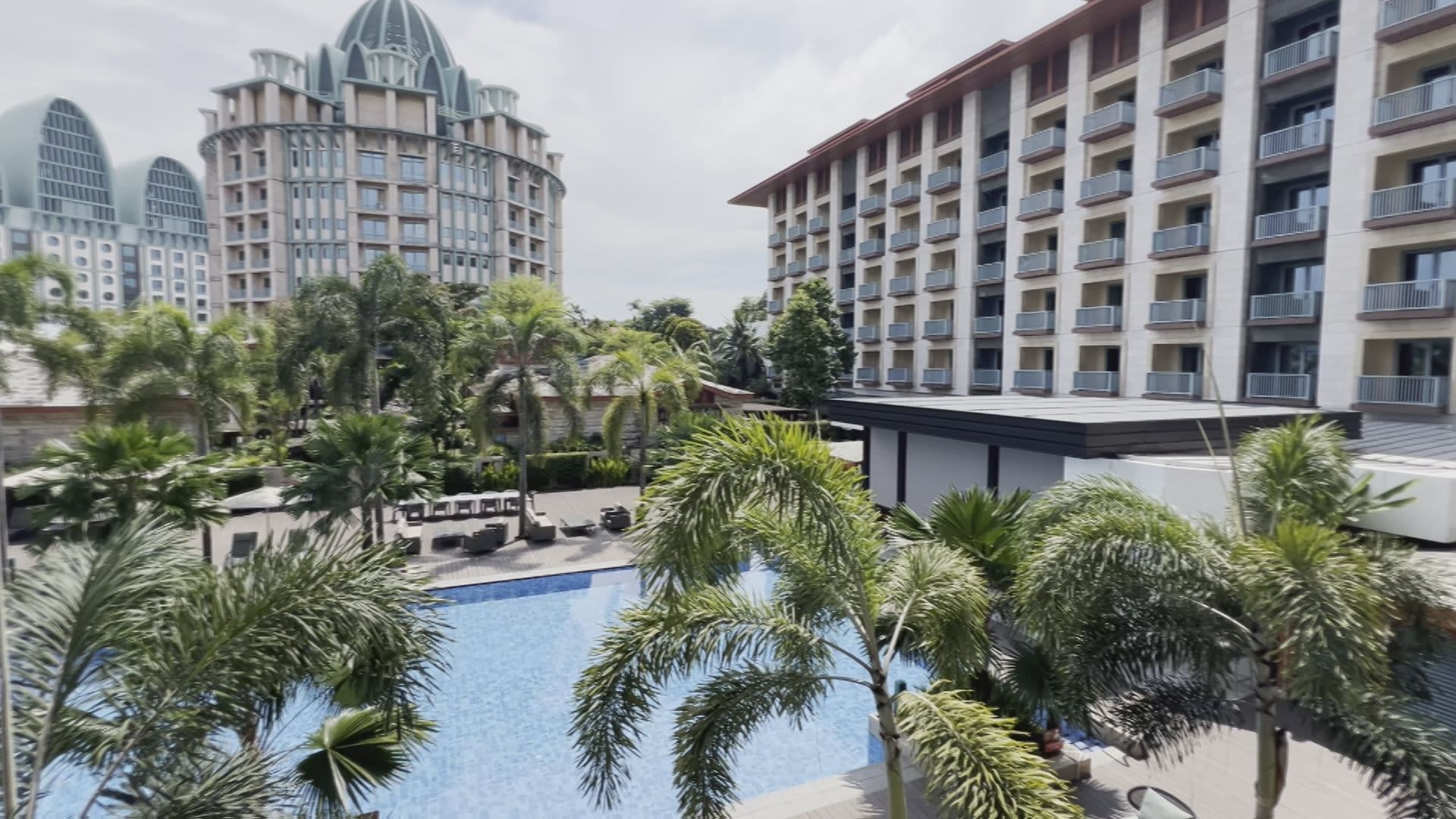
SINGAPORE – Sentosa Island features the luxurious five-star Ora and Michael hotels, with palm-fringed pools, lobbies flanked by luxury shops and a casino adjoining both hotels and bustling with gamblers. The Singapore resort is also where a group of federal employees from the US Food and Drug Administration were sent on a work trip in the final hours of the government shutdown.
The palm-fringed pool at the Ora Hotel on Singapore's Sentosa Island.
CNBC
Internal FDA records obtained by CNBC show that 31 agency employees traveled to Singapore in mid-November for a conference of the International Council for Harmonization of Technical Requirements for Pharmaceuticals for Human Use, or ICH, a trip that cost more than a quarter of a million dollars, or more than $8,000 per person, according to the documents. The trip was approved when the agency was operating with a reduced staff and limited resources, in part due to the shutdown.
The FDA is under significant pressure. The Trump administration proposed an 11.5% cut to the FDA budget this year. Nearly 1,900 employees were laid off and about 1,200 more took early retirement packages, according to testimony from FDA Commissioner Marty Makary in May. Additionally, senior management has been in turmoil, with former FDA chiefs publicly questioning the agency's handling of key issues such as vaccine policy.
Marty Makary, President Donald Trump's nominee to be commissioner of the U.S. Food and Drug Administration, attends a Senate Health, Education, Labor and Pensions Committee confirmation hearing on Capitol Hill in Washington, March 6, 2025.
Kent Nishimura | Reuters
Records show that FDA attendees at the Singapore conference ranged from deputy directors to a program coordinator. His trip was approved about a week before the 43-day government shutdown, the longest in U.S. history, ended. Most staff departed on Nov. 12, the same day the U.S. House of Representatives voted to end the shutdown, and the remaining travelers departed on Nov. 13 and 14, according to the documents.
The ICH, registered as a non-profit organization under Swiss law, says its goal is to unify global standards for drug development and approval. The conference, held Nov. 18-19, was held in a series of meeting rooms on the island resort grounds.
ICH told CNBC in an email that “approximately 500 people attended in person,” including regulators and pharmaceutical industry experts from around the world. He also wrote that “the FDA is one of the founding members of ICH” and helps develop requirements for “safe, effective, and high-quality pharmaceutical products.”
As part of the November meeting, three guidelines were adopted that aim to streamline global drug development and safety monitoring, according to the ICH. In a follow-up email, the organization said the first guideline provides a template to eliminate “inconsistent formats” in clinical trial protocols and facilitate electronic data exchange. The second seeks to ensure that post-approval safety reporting is “complete, accurate and timely” by aligning definitions and reporting practices, he said. The third adopted guideline sets international standards for real-world, non-interventional data studies to ensure they are “scientifically sound” and comparable across regulators.
FDA staff contributed to all three of these guidelines, according to conference documents.
The FDA said in a statement to CNBC that sending staff to the meeting was “mission critical” and that the purpose of the conference was “to support global alignment in drug development, approval standards and regulatory science.” An agency spokesperson said the conference required approval from leaders, including FDA Chief Operating Officer Barclay Butler. FDA delegate attendance in the previous two years ranged from 47 to 49, the spokesperson said, noting that the agency sent 31 this year.
Dylan Hedtler-Gaudette, acting vice president of policy and government affairs at the Project on Government Oversight, a nonpartisan watchdog group that advocates for government accountability, said the optics of sending dozens of FDA employees to an overseas conference during a government shutdown are not good.
Dylan Hedtler-Gaudette, acting vice president of policy and government affairs at the Project on Government Oversight.
CNBC
“The FDA is a critical organization that does really important work when it comes to our health care system, our food system and our medical device system,” Hedtler-Gaudette said. “I would hope that FDA leadership and the administration would place a higher degree of priority on ensuring that the organization and the agency have all the resources rather than having to attend specific conferences or events.”
Hedtler-Gaudette said that even if the conference is important, that doesn't help quell questions about the agency's priorities.
“At the very least, it's kind of bad looks and poor optics,” Hedtler-Gaudette said. “At worst, it could be some kind of dereliction of duty and a misuse of public resources.”
The tropical island of Sentosa in Singapore at sunset.
Tobiasjo | E+ | fake images
The FDA told CNBC that the trip did not rely on taxpayer money, saying it was funded through the agency's remaining user fees — money collected from companies that make drugs, devices and other medical products to pay for regulatory work, such as product reviews and inspections.
“Those dollars are still public dollars,” Hedtler-Gaudette said. “They still need to be treated and protected with as much respect as direct tax dollars.”
An internal email from Butler, dated Oct. 1, said user fees should apply only to work that is allowed to be funded by pass-through user fees and “activities that are necessary to address imminent threats to the safety of human life or protect property.”
The FDA itself seemed aware that any travel during the shutdown could be unwelcome.
“Due to the optics of business travel conducted during a shutdown, conference approval will be handled by senior FDA leadership on a case-by-case basis,” the FDA said in a document posted on its website in mid-November. On December 3, a day after CNBC asked the agency for comment on the document, it was no longer available on the website.
“The agency periodically updates its web pages to ensure that information remains accurate and consistent with current policy,” an FDA spokesperson told CNBC.
In an internal email chain between FDA directors and Chief Financial Officer Benjamin Moncarz, obtained by CNBC, Director Michelle Tarver sought to “reach a legal and optical consistency agreement on how we are handling travel during the span of appropriations.” Tarver proposed “canceling attendance at the conference and associated local, national and international travel.” He went on to say that the FDA would “allow virtual talks on exempt (i.e., user fee) topics only.”
In a Nov. 6 email exchange about the ICH conference, the discussion over whether to send staff to Singapore reached the highest ranks of the FDA. In the email, FDA Deputy Chief Financial Officer Sahra Torres-Rivera wrote that the agency had “agreed to limit in-person participation at conferences,” but noted that “the final decision ultimately rests with…leadership.”
Next year, the biannual conference will be held in Rio de Janeiro and Prague.