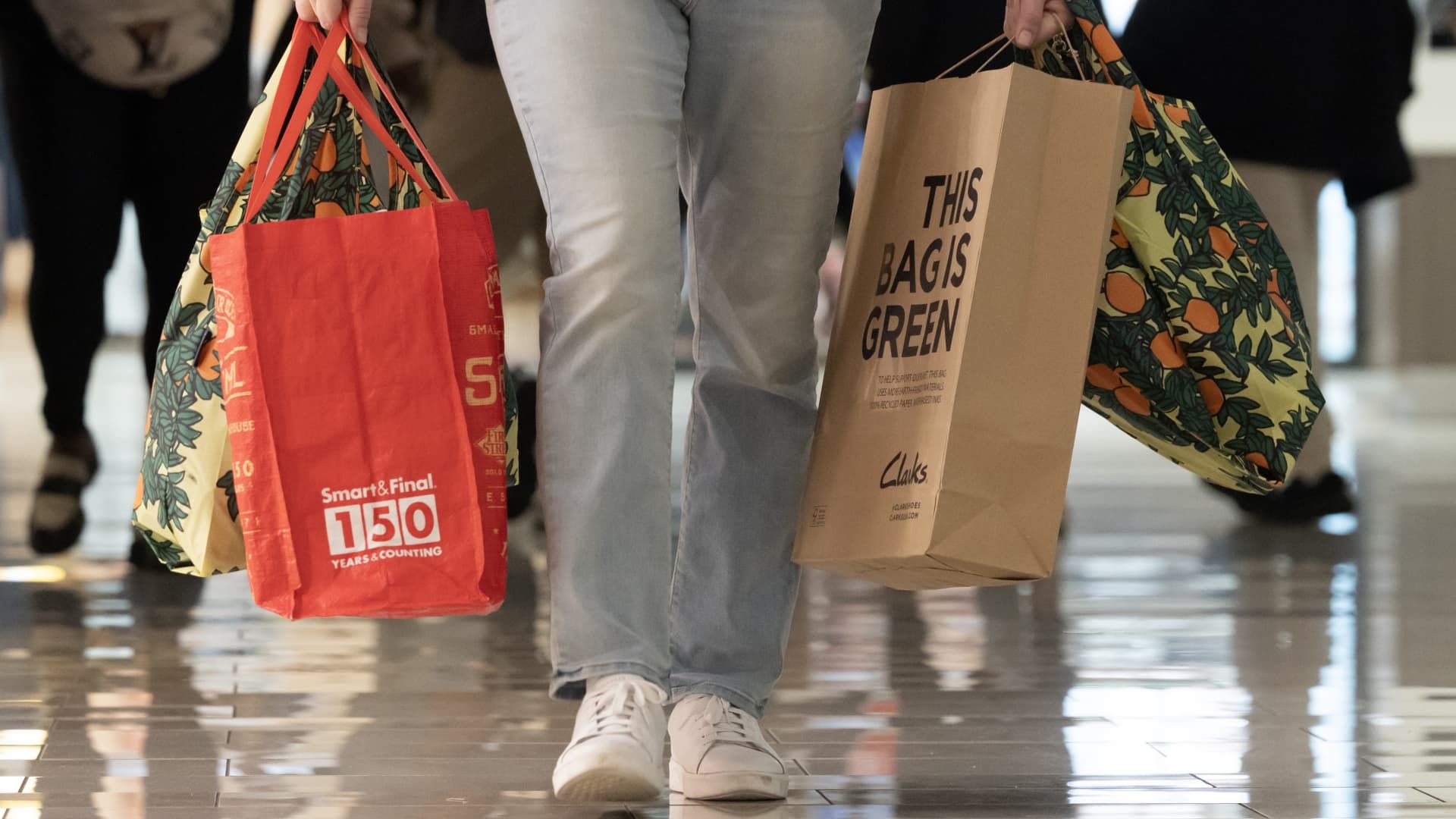
American consumers showed resilience this holiday season, driving retail spending up 4.2% year over year, according to preliminary data released Tuesday by Visa.
The Visa Consulting and Analytics report indicated that despite persistent economic headwinds, shoppers continued to spend, particularly on technology and personal goods.
The findings tracked payment activity over a seven-week period starting Nov. 1 using a subset of data from the Visa payments network in the U.S. and cover major retail categories, excluding spending on cars, gas and restaurants. The figures are also not adjusted for inflation.
In-store purchases accounted for the majority of Christmas spending, capturing 73% of total retail payment volume during the period, while online purchases accounted for the remaining 27%.
However, e-commerce was the main driver of growth, with online sales increasing 7.8% compared to last year, reflecting continued demand for convenience and early-season promotions.
“The underlying surprise here … is that consumer spending is holding up reasonably well in light of weaker consumer confidence than we had this time last year and a number of headwinds and inflation concerns,” Michael Brown, Visa's chief U.S. economist, told CNBC.
Brown noted that the 2025 holiday season marked a distinct shift in consumer behavior, citing the growing influence of artificial intelligence on the way shoppers find products and compare prices.
“We're seeing consumers using AI heavily to compare prices and then help choose the perfect gift,” Brown said. “This is the first holiday shopping season where about half of the consumers in that survey responded that they are going to leverage AI for one of those two tasks.”
The breakdown of spending categories highlights a shift toward personal goods and comforts, and a move away from home renovation projects.
Electronics emerged as the season's top-performing category, with sales up 5.8%. Visa attributed this jump to a refresh cycle driven by “high-performance devices in the age of AI.”
Clothing and accessories also posted strong numbers, up 5.3%. General merchandise stores (retailers that offer a “one-stop-shop” experience) saw a 3.7% increase.
In contrast, the home improvement sector struggled during the holidays. Spending on building materials and gardening equipment fell 1%, suggesting consumers prioritized gifts and gadgets over home maintenance at the end of the year.
Furniture and home furnishings were essentially flat, posting a gain of 0.8%.
While the overall figure is positive for the retail sector, the lack of adjustment for inflation means that “real” volume growth will likely be more modest depending on the final Consumer Price Index readings for the period.
Currently, Brown said, inflation-adjusted real spending growth remains around 2.2% this season.
“That's not so bad in light of the great uncertainty this year,” Brown said. “The consumer is not sure, they are cautious, but they are also smart when it comes to spending their money.”
Visa's numbers also point to a disconnect between sentiment and action this season.
According to the CNBC All-America Economic Survey released last week, 41% of Americans said they planned to spend less during the holidays this year, up 6 points from a year ago.
The CNBC survey found that the high cost of goods was becoming a major factor in determining how much shoppers spend and where they spend, suggesting that years of inflation and rising prices of imported goods due to tariffs are being felt at checkouts.