Ministers face pressure to act on the cost of living as the conflict with Iran threatens to drive up prices.
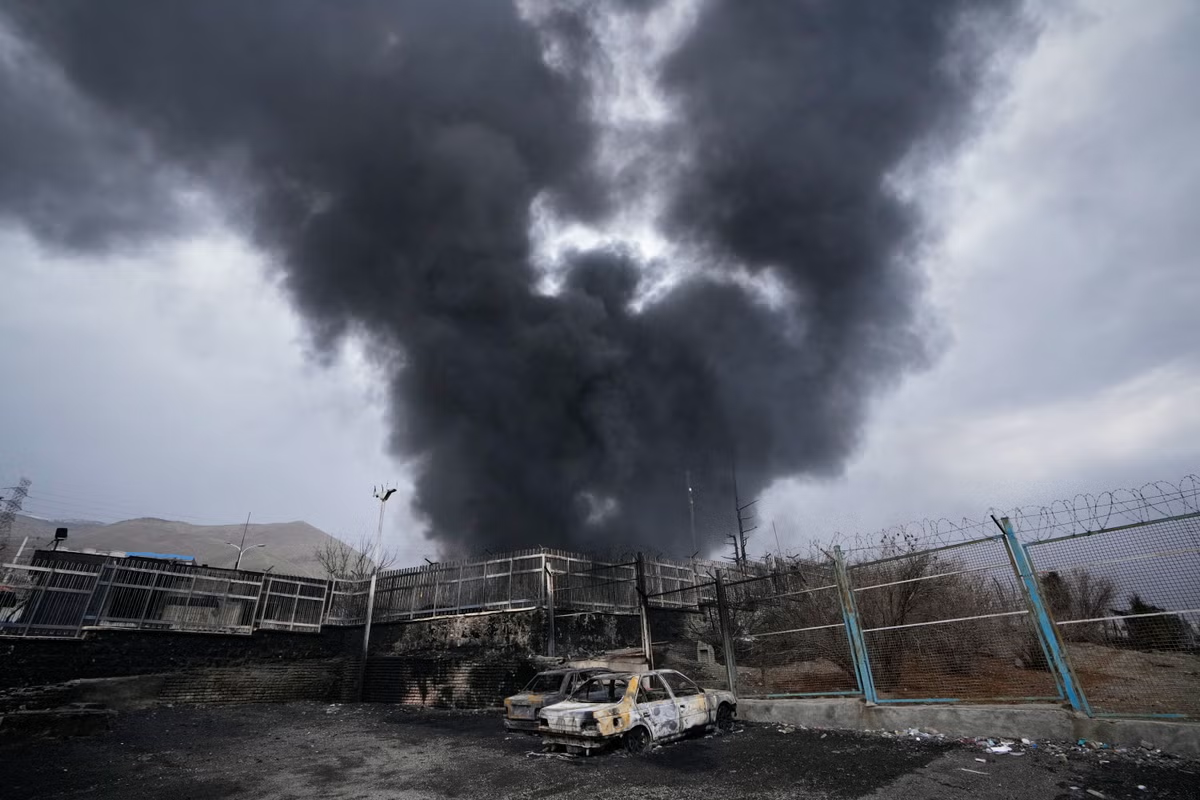
Oil prices have skyrocketed since the United States and Israel began attacks on Iran, topping $100 a barrel on Monday.
Although prices fell back below $90 when US President Donald Trump suggested the conflict was coming to an end (contradicting his own Defense Department), economists warned that war would mean inflation would stay higher for longer.
The British Chambers of Commerce predicted that inflation would remain “firmly above” the Bank of England's 2% target, highlighting the “highly uncertain” global situation.
Both Prime Minister Sir Keir Starmer and Rachel Reeves have acknowledged that the war is likely to cause economic damage to the UK, with the Chancellor telling MPs it will “likely put upward pressure on inflation” in the coming months.
Following a call with her G7 counterparts on Monday, Reeves said she was willing to support “a coordinated release” of international oil reserves to ease the economic impact of the crisis.
He also called for measures to “ensure the safety of ships passing through the Strait of Hormuz.”
Trump later took to social media to warn that if Iran did “anything to stop the flow of oil within the Strait of Hormuz,” the United States would “make it virtually impossible for Iran to ever rebuild.”
In a post on Truth Social he wrote: “If Iran does anything to stop the flow of oil within the Strait of Hormuz, the United States of America will hit it TWENTY TIMES HARDER than they have hit it so far.
“In addition, we will eliminate easily destructible targets that will make it virtually impossible for Iran to rebuild as a nation again. Death, fire and fury will reign upon them. But I hope and pray that does not happen!”
“This is a gift from the United States of America to China and all those nations that heavily use the Strait of Hormuz. Hopefully, it will be a gesture that will be greatly appreciated.”
Despite calling on the competition watchdog to prevent wartime profiteering, the Chancellor resisted calls to cancel a planned increase in fuel taxes in response to rising oil prices.
Fuel duty has been frozen since 2011 and was reduced by 5p in 2022 in response to the large-scale Russian invasion of Ukraine.
In his budget last year, Reeves said the 5p cut would be canceled between September 2026 and March 2027, but the Conservatives and Liberal Democrats have called on him to change course.
Shadow chancellor Sir Mel Stride said: “The latest developments in the Middle East make it even more important for Rachel Reeves to reverse course and scrap the fuel duty rise she announced in the Budget.”
Liberal Democrat leader Sir Ed Davey went further, saying the Prime Minister should convene the Government's emergency Cobra committee “to personally monitor the threat of brutal price shocks facing families, pensioners and businesses”.
Meanwhile, the Royal Navy continues to prepare the destroyer HMS Dragon for deployment to the eastern Mediterranean.
Defense Secretary John Healey confirmed that the ship, currently docked in Portsmouth, would set sail “in the coming days” before linking up with US air defense ships in the region.
The move aims to bolster defenses against missiles and drones, particularly around British bases at Akrotiri and Dhekelia in Cyprus.
But the Government has been accused of acting slowly, criticized both for not deploying the HMS Dragon before the US-Israeli attacks on Iran and for the time it took for the ship to leave port.
It is still unclear how long the conflict will last, with more attacks reported in Tehran as Trump claimed the US operation was “very complete” and the Pentagon said the US had “barely begun fighting”.
The United States has also withdrawn non-essential diplomatic staff from Saudi Arabia amid continued Iranian retaliation, while the United Kingdom has withdrawn dependent staff from the embassy in the United Arab Emirates “as a precautionary measure.”
Israel and the Iran-backed, Lebanon-based militant group Hezbollah have also continued to exchange missile fire.
Speaking in the House of Commons on Monday, Healey urged Hezbollah to stop attacking Israel and warned Israel not to expand the conflict to Lebanon.