The UK economy returned to modest growth in the final three months of 2025 amid pressure from budget uncertainty, newly released figures show.
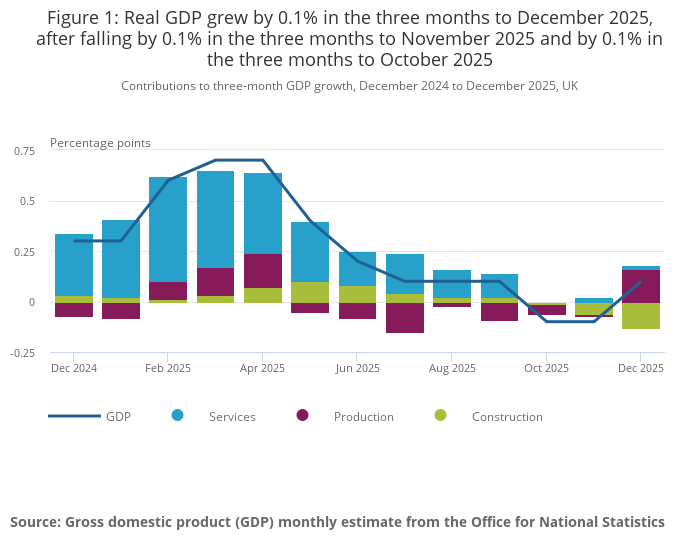
The Office for National Statistics (ONS) said UK GDP (gross domestic product) data grew by 0.1% in the latest quarter between October and December last year, following growth of 0.1% in the third quarter.
Some had suggested that fourth quarter growth could rise slightly after stronger-than-expected activity in November and that clarity following the autumn budget could have supported businesses in the run-up to Christmas.
The first quarter of 2026 is still expected to show a stronger level of growth, but a significant and sustained economic expansion remains dependent on inflation falling and businesses adapting to new higher cost levels, while unemployment also remains above 5 percent.
Earlier ONS figures showed the economy contracted 0.1 per cent in October and then expanded 0.3 per cent in November as the manufacturing sector was boosted by the recovery of production at Jaguar Land Rover after its major cyber attack.
The Bank of England on Thursday cut its growth forecast for 2026, from 1.2 percent to 0.9 percent, and for 2027, from 1.6 percent to 1.5 percent.
Liz McKeown, director of economic statistics at the ONS, said: “The economy continued to grow slowly in the final three months of the year, with the growth rate unchanged from the previous quarter.
“The often dominant service sector showed no growth and the main driver came instead from manufacturing.
“Construction, for its part, recorded its worst performance in more than four years.
“The growth rate throughout 2025 as a whole was slightly higher than the previous year, with growth seen across all major sectors.”
Get a free fractional share worth up to £100.
Capital at risk.
Terms and conditions apply.
Go to website
ADVERTISEMENT

Get a free fractional share worth up to £100.
Capital at risk.
Terms and conditions apply.
Go to website
ADVERTISEMENT
It comes after economists broadly predicted the economy had grown 0.1% in the quarter, following 0.1% growth in the third quarter.
The British Chambers of Commerce (BCC) has called for the government to take action to back up its words and help the economic recovery, pointing out that small businesses are holding back on spending due to persistent fears about rising taxes and other cost pressures.
“Improving prospects now depends on restoring business dynamism. The government must move from strategy to execution – supporting infrastructure projects, accelerating planning decisions, addressing skills gaps and strengthening support for exports – so that businesses can invest, export and grow,” said BCC head of research David Bharier.
Meanwhile, the Trades Union Congress (TUC) noted that annual growth was a recent high, but general secretary Paul Nowak also urged the Bank of England to cut interest rates more quickly to stimulate spending.
“It is positive that the economy continued to grow in December, and last year's growth of 1.3 percent was the strongest in three years,” he said.
“But many workers still don't feel the benefit in their pockets. Many working families have no money left to spend on the things that keep our economy moving.
“This vicious cycle must end. Ministers must remain focused on reducing workers' household costs and improving living standards this year.
“And the Bank of England must go further and faster with rapid interest rate cuts in the coming months.
“Britain needs to finally emerge from the cost of living crisis that has kept us stuck for too long – the priority must be helping families spend and businesses invest.”
Victoria Scholar, chief investment officer at Interactive Investor, said: “Economic activity was likely to recover post-Budget once that cloud of uncertainty moved into the rearview mirror in December.
“In addition, there could have been an improvement in the services sector as consumers spent on things like food and beverage, retail and hotels during the festive season.”
Sandra Horsfield, of Investec Economics, said: “The bigger picture is that the UK economy had defied the gloomy popular narrative and exceeded expectations throughout 2025: our forecast equates to 1.4% GDP growth for the full year, while the consensus forecast in January 2025 had been for 1.2% GDP growth.
“We project a similar story of resilience and consensus-beating performance for 2026, as investment in public services and, eventually, housing construction accelerate – the latter with a little help too from further falls in interest rates.
“The consensus forecast for this year is 1%, compared to our own forecast of 1.3%.”
However, RMS UK chief economist Thomas Pugh warned there was one overriding factor that could hamper those optimistic predictions: “noisy leadership” from within the government.
“Looking ahead, all signs are that growth is picking up sharply as budget uncertainty eases. We expect growth to reach around 0.5 per cent in the first three months of this year and the impact of previous rate cuts and sharp falls in inflation should start to show up as higher consumer spending later in the year,” he said.
“The biggest risk now is a prolonged and noisy leadership contest that could reopen Pandora's box of tax increases and inject a new bout of uncertainty into consumers and businesses, offsetting much of the improving economic fundamentals.”