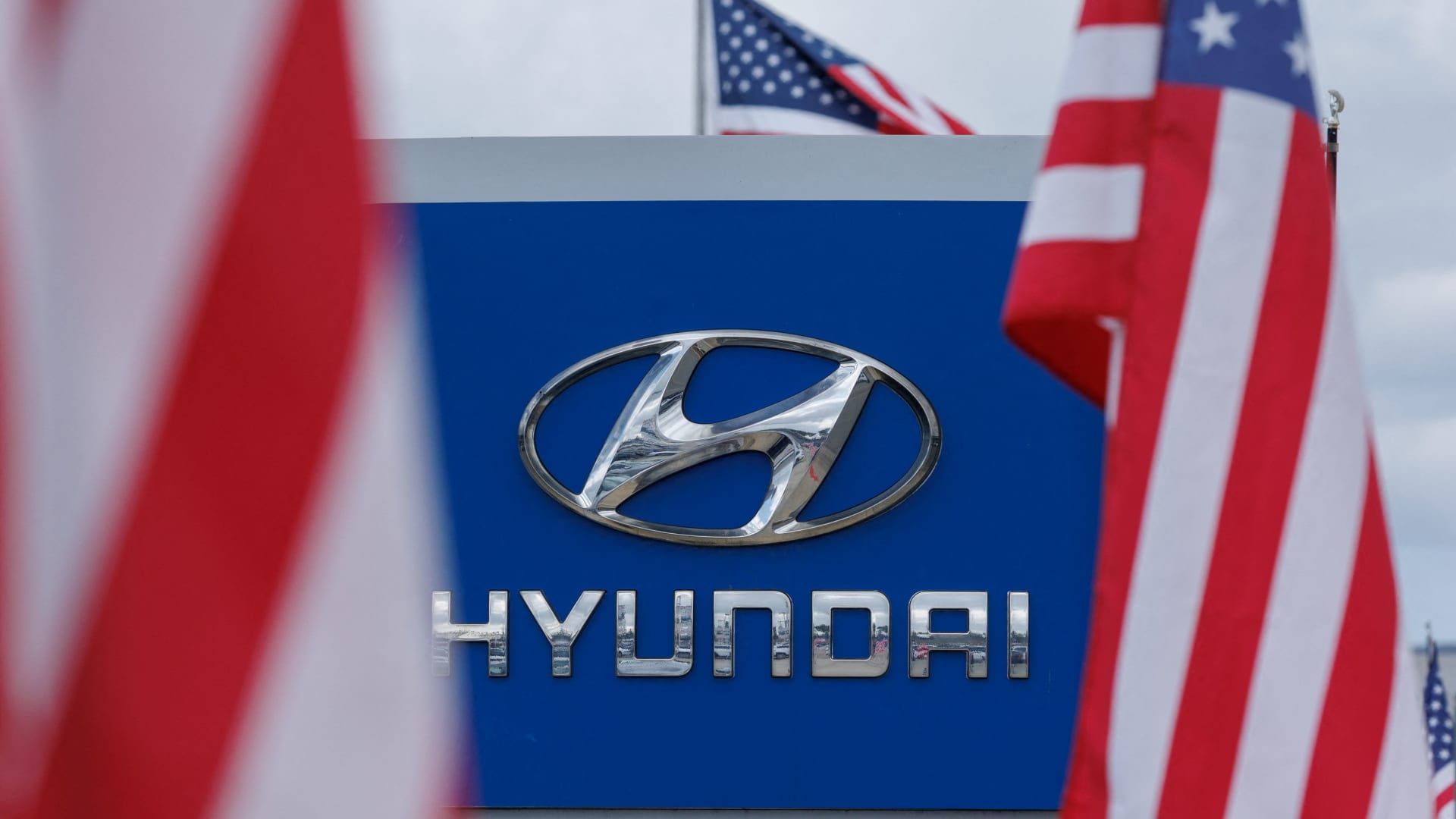
American flags fly in front of a Hyundai car dealership in Irvine, California, USA, March 27, 2025.
Mike Blake | Reuters
DETROIT – Hyundai Motor and general motors will become two of the biggest beneficiaries of lower US tariffs on imports, including vehicles, from South Korea.
The South Korea-based automaker is the largest U.S. importer of new vehicles from the country, followed by GM. Both automakers have paid billions of dollars in taxes so far this year after President Donald Trump imposed 25% tariffs on vehicles imported from South Korea and other countries in the spring.
Last week, the Trump administration confirmed its plans to reduce tariffs on certain products, including vehicles, to 15% from South Korea. A notice regarding the implementation of the trade agreement was published in the Federal Register on Wednesday. Other countries such as Japan and the United Kingdom have also negotiated lower tariff rates with the Trump administration.
Before the reduction, Hyundai reported that U.S. tariffs cost the company 1.8 trillion won ($1.2 billion) in the third quarter, up from 828 billion won ($565 million) in the previous quarter. GM more recently said its tariff impacts, largely from South Korea and Mexico, were expected to range between $3.5 billion and $4.5 billion in 2025.
GM Chief Financial Officer Paul Jacobson said Wednesday that the automaker initially expected tariffs on South Korean imports to cost $2 billion, but that the company has been able to offset many of those costs. He said GM expects the taxes to cost about $1 billion or less in 2026.
“We think that's going to be a tailwind next year, just not as much as 50%, because the final tariff bill we're going to pay this year for Korea was going to be a lot less than the $2 billion of things we've been working on,” Jacobson said during a UBS conference.
The announcement of the US tariffs comes after South Korea officially introduced legislation in its parliament aimed at fulfilling its promise to invest $350 billion for the United States over several years.
Hyundai Motor Group Chief Executive Euisun Chung delivers a speech as U.S. President Donald Trump, U.S. House Speaker Mike Johnson (R-LA), and Louisiana Governor Jeff Landry stand in the Roosevelt Room of the White House in Washington, DC, United States, on March 24, 2025.
Carlos Barria | Reuters
“Korea's commitment to U.S. investment strengthens our economic partnership and domestic jobs and industry. We are also grateful for the deep trust between our two nations,” U.S. Commerce Secretary Howard Lutnick said in a statement published Monday on X.
Hyundai North America CEO Randy Parker said tariffs remain a challenge, but higher than 25%, as the automaker aims for a sixth consecutive year of record U.S. retail sales in 2026.
“Fifteen percent is still 15 percent,” he told CNBC during a phone interview Tuesday. “Reaching 15% is a great milestone. It has been quite a journey to reach this agreement, which has been, I would say, quite extensive.”
Hyundai, including its separately operating subsidiary Kia in the US, has significantly increased its US sales and operations in recent years. But the automaker continues to import the majority of its vehicles (estimated at nearly 1 million units this year) from South Korea.
GlobalData estimates that more than 1.37 million vehicles, or about 8.6% of sales in the United States this year, will be vehicles imported from South Korea, making the country the largest exporter of vehicles sold in the United States, outside of Mexico.
Hyundai is expected to import more than 951,000 vehicles in 2025, according to GlobalData. That includes more than 369,000 for Kia and 582,000 for Hyundai and its Genesis luxury brand.
Hyundai aims for more than 80% of its U.S. vehicle sales to be produced locally by 2030, the company said this year. That compares to about 40% today.
Despite the tariffs, GM is estimated to import about 422,000 vehicles from South Korea to the United States this year, according to GlobalData. That would be a 3.6% increase compared to record imports of more than 407,000 units last year.
GM has increasingly used South Korean plants to produce popular entry-level crossovers for Chevrolet and Buick. Its U.S. sales of South Korean-produced vehicles, mostly base models, have risen from 173,000 in 2019 to more than 407,000 last year, according to GlobalData.
GM, in an emailed statement, said the company “appreciates that negotiators have finalized a trade agreement between the United States and South Korea.”
“GM's long-standing operations in Korea produce high-quality, affordable crossovers that complement our U.S. vehicles and domestic production, which will soon increase to 2 million units. We will be monitoring and reviewing the details,” GM said.
GM produces its Buick Encore GX and Buick Envista crossovers, as well as the Chevrolet Trailblazer and Chevrolet Trax crossovers, at plants in South Korea. The company has touted the vehicles as a pinnacle for the automaker's profitable growth in lower-margin entry-level vehicles.
Detainees are forced to stand against a bus before being handcuffed, during a raid by federal agents in which about 300 South Koreans were among 475 people arrested at the site of a $4.3 billion project by Hyundai Motor and LG Energy Solution to build batteries for electric cars in Ellabell, Georgia, U.S., on Sept. 4, 2025, in a still image taken from video.
US Immigration and Customs Enf | Via Reuters
The new trade deal between the United States and South Korea comes months after a period of tension between the two countries following an immigration raid at a battery plant jointly owned by Hyundai and LG Energy Solution in Georgia.
Some 475 workers, including more than 300 South Koreans, were arrested in the Sept. 4 raid at the Ellabell, Georgia, plant, according to U.S. immigration officials.