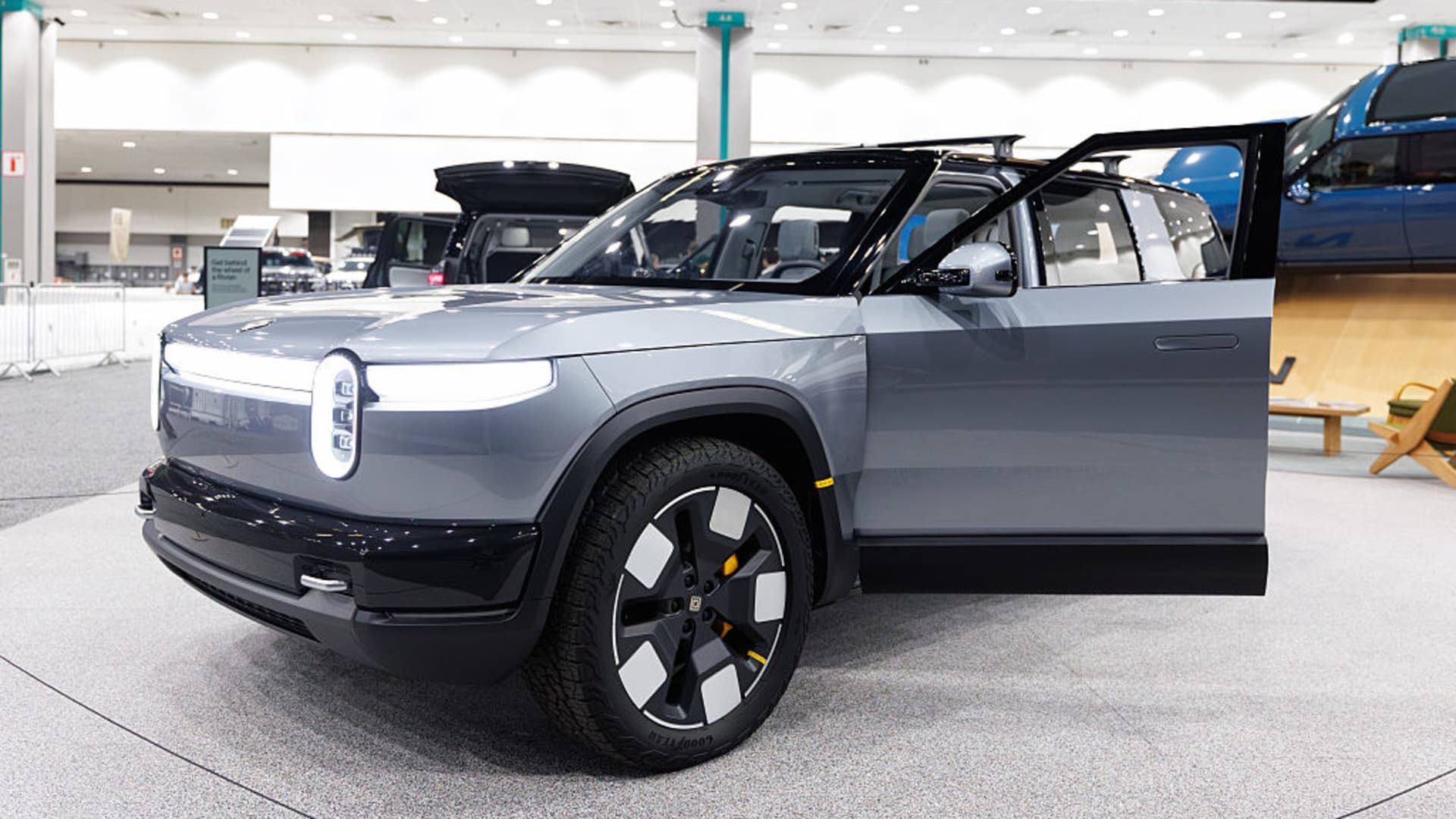
Rivian Automotive on Thursday beat Wall Street expectations for the fourth quarter and said it is targeting a significant increase in vehicle deliveries this year, but the automaker also warned that it will continue to lose money as it launches its crucial next-generation R2 vehicle.
Rivian's guidance for 2026 includes increasing vehicle deliveries to between 62,000 and 67,000 units, which would represent an increase of between 47% and 59% compared to 2025. That increase is expected to be helped by the launch of the R2 SUV during the second quarter.
Rivian CEO RJ Scaringe told CNBC's Phil LeBeau on Thursday that the R2 is expected to account for the “majority of the volume” of the business by the end of 2027, as it ramps up production at its single factory in Normal, Illinois.
The electric vehicle maker also said it expects 2026 adjusted pre-tax losses of between $1.8 billion and $2.1 billion and capital expenditures of between $1.95 billion and $2.05 billion. That compares with nearly $2.1 billion in adjusted pretax losses and $1.7 billion in capital spending last year.
Scaringe described the year 2025 to investors Thursday as a “founding year” for Rivian, while saying 2026 will mark “a turning point” for the company.
Rivian shares rose more than 20% in premarket trading on Friday after closing at $14, a drop of about 5%.

Here's how the company performed in the fourth quarter compared to average estimates compiled by LSEG:
- Loss per share: Adjusted 54 cents vs. expected loss of 68 cents
- Revenue: $1.29 billion vs. $1.26 billion expected
Rivian's full-year 2025 revenue, including $1.7 billion during the fourth quarter, increased 8% compared to $4.97 billion in 2024.
The company achieved its first annual gross profit, which investors are closely watching, of $144 million in 2025, including $120 million during the fourth quarter. This was driven by its software and services joint venture with Volkswagen that offset $432 million in losses for its automotive business last year.
This year's gross profit may not be as fruitful; Rivian CFO Claire McDonough describes it as a “transitional year” as R2 production ramps up.
Investors view gross profit as a key indicator of a company's profitability before operating expenses, interest and taxes.
Rivian's net loss last year was $3.6 billion, an improvement from a loss of $4.75 billion in 2024. That includes a loss of $804 million during the fourth quarter, accelerated by a decline in profits from the sale of regulatory credits, which was expected after the Trump administration's changes to federal fuel economy and emissions standards.
Rivian ended the fourth quarter with $6.59 billion in total liquidity, including nearly $6.1 billion in cash, cash equivalents and short-term investments.
It is necessary capital for Rivian. This year is a crucial one for the automaker as it tries to deliver on its promises of technological advancements and increased profitability with the R2.
The roughly $45,000 midsize vehicle, according to Rivian, is expected to cut construction material costs in half, reduce production complexity and significantly increase demand and sales.
Rivian said the R2 is expected to be produced initially in one plant shift, followed by a second shift later this year. The company said additional R2 details by model, including pricing, options and more, will be available on March 12.
Rivian has made significant progress with its first-generation R1 truck and SUV, but the market for such expensive electric vehicles, which start at $70,000, has slowed. It also continues to produce an all-electric delivery van, historically purchased by its largest shareholder, Amazon.