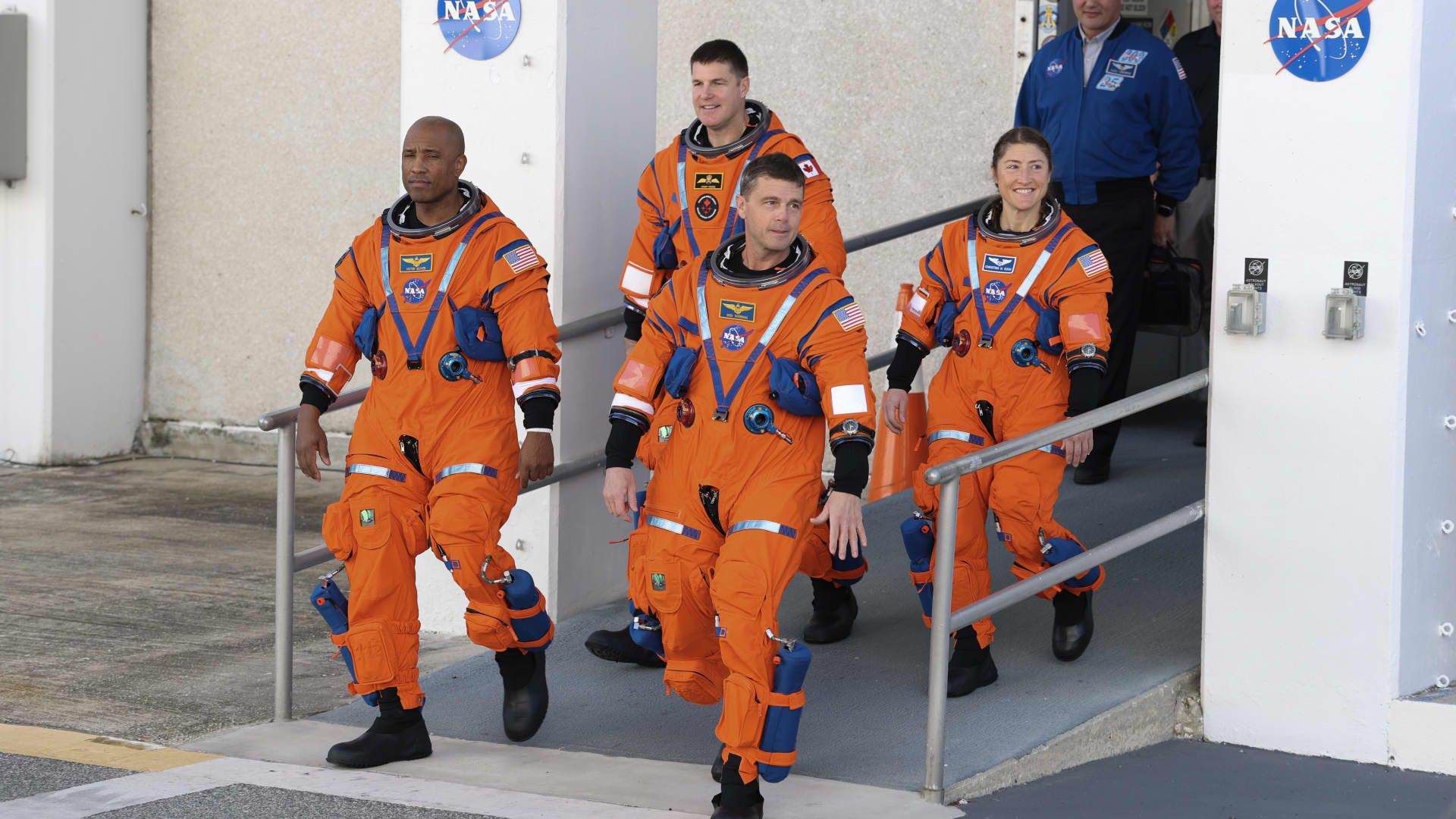
NASA is preparing to launch a mission to the Moon and it is making history for more reasons than one.
The launch of the space agency's Artemis II marks the first US trip back to the Moon in more than 50 years. It will also carry the first black astronaut and the first female astronaut to travel to the moon, although the mission will be a flyby without landing on the surface.
The launch, originally scheduled for early February and now delayed, will carry four astronauts around the moon and back, including Victor Glover and Christina Koch, the first black astronauts and the first woman, respectively, to make the flight.
The mission follows the success of the unmanned Artemis I launch in 2022 and marks NASA's next step toward eventually sending astronauts to Mars.
“The benefits of the Artemis program are technological, but also cultural,” Glover, a decorated U.S. Navy captain who traveled to the International Space Station, said in a NASA video from 2024. “What really means something to me is the inspiration that will come from it, inspiring future generations to reach for the moon, literally to reach for the moon.”
Koch began her career at NASA, starting as an engineer and then conducting scientific research before becoming an astronaut in 2013, also traveling to the International Space Station.
“What I'm most excited about is that we will take their enthusiasm, their aspirations and their dreams with us on this mission,” Koch said at the 2023 news conference when the mission's astronauts were announced.
Danielle Wood, a professor in the astronautics department at the Massachusetts Institute of Technology, said this mission builds on decades of NASA work, including lessons learned from its previously failed efforts.
“NASA has been thinking about this whole process, which is two decades long, and what we're going to do is prepare the government to focus on these more difficult next-generation missions and be able to do things that are not yet proven,” Wood told CNBC.
Wood said she is also grateful that NASA has committed to sending more diverse astronauts to space who “represent society in a broader way.” Although the space agency initially emphasized military training for astronauts, it said the opening up of those requirements has led to interesting developments.
“It's still true that there are a lot of firsts, a lot of glass ceilings, that Black women and Black men and women in general need to break — that's still real,” Wood added.
The mission will encompass more than just an exploratory trip to the Moon, he said. NASA will conduct scientific research on astronaut health, rocket and moon science. The mission is also working closely with other countries, such as Saudi Arabia and Germany, as part of “goodwill” agreements to pool resources for lunar research, Wood said.
“That's just one step to this new, larger form of operation,” he said.
Space historian Amy Shira Teitel, who has been studying space for more than two decades, said Artemis II is the beginning of NASA's next chapter of research.
“It's marking a new era of abandoning low Earth orbit, something we haven't done since 1972,” he told CNBC. “It's still an important step because, at the end of the day, we're still going to get information that can be applied to whatever the next step is.”
Still, Teitel has doubts about whether this launch will be the first step toward a lasting presence on the Moon. Between budget constraints, multiple launch delays and complicated political factors, Teitel said launching rockets on this mission is “widely considered a huge waste.”
This is happening even as the space sector (and the trip back to the moon) has become more crowded.
Elon Musk's SpaceX announced earlier this month that it was shifting its efforts from Mars explorations to lunar explorations. Texas-based rocket and spacecraft builder aerospace firefly and a Houston-based space startup Intuitive machines Both have sent spaceships to the moon.
And NASA plans to retire the International Space Station in favor of smaller space stations focused on the Moon and Mars, which will increase costs. The United States Senate has also promoted legislation to support NASA's advances and create thousands of aerospace jobs, especially in Alabama, where the Marshall Space Flight Center is located.
Although the launch of Artemis II will mark a significant step in NASA's history, Teitel said he prefers to remain cautiously optimistic about the future of space exploration, despite the obstacles.
“There are so many challenges with this program right now that come from politics, not from astronauts or engineers, just from the fact that space is so complicated and so rooted in politics and so expensive that it's hard to be as excited about this as the next step when everything else seems so tenuous,” Teitel said.