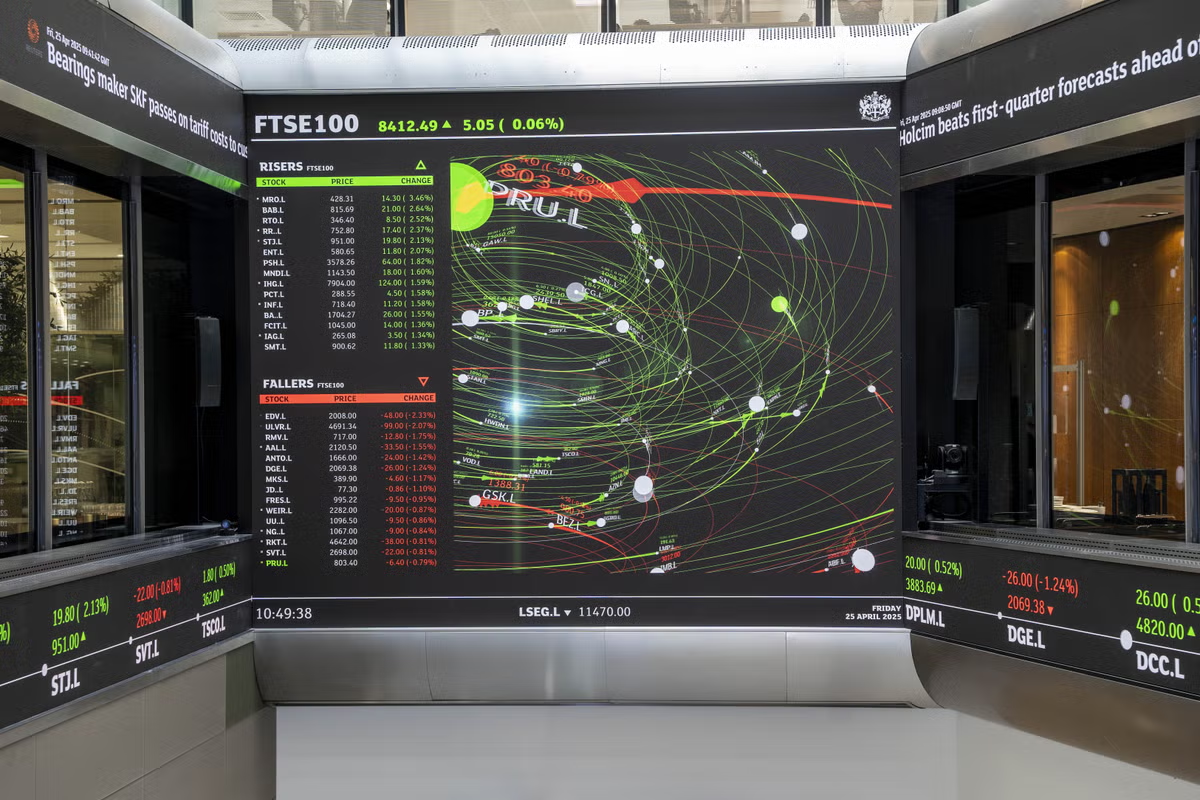
Stocks in London closed little changed on Friday, with blue-chip shares falling after hitting another record as investors held firm ahead of the long weekend in the United States.
“Investors have remained alert so far this year with ongoing geopolitical issues and mixed messages from the business world. A quieter day on the corporate reporting calendar gave investors a chance to catch their breath and take stock of events,” said Dan Coatsworth, head of markets at AJ Bell.
The FTSE 100 index closed down just 3.65 points at 10,235.29. It had previously reached a new intraday best of 10,257.75.
The FTSE 250 finished up 31.39 points, or 0.1%, at 23,311.37, and the AIM All-Share closed just 0.27 points higher at 804.75.
For the week, the FTSE 100 rose 1.1%, the FTSE 250 rose 1.2% and the AIM All-Share advanced 2.1%.
In European equities on Friday, the CAC 40 in Paris closed down 0.7%, while the DAX 40 in Frankfurt closed down 0.2%.
“There was a slightly negative tone to European stock indices on Friday,” said David Morrison, senior market analyst at Trade Nation. “It seemed that investors were more comfortable taking some risks off the table, no doubt aware that US markets will be closed on Monday for Martin Luther King Day.”
In London, the FTSE 100 was linked by weakness in mining stocks, a key factor behind the index's recent strength.
The price of copper fell 3.0% and silver plunged 3.7%, giving up some recent gains, while gold suffered less severe declines.
Gold was trading at $4,594.24 an ounce on Friday, up from $4,616.76 on Thursday.
In response, Endeavor Mining fell 2.7%, Anglo American fell 2.4%, Antofagasta fell 2.9% and Glencore fell 2.5%.
Bank of America strategists downgraded the mining sector to “underweight” and upgraded energy to “market weight.”
“After strong outperformance for mining, potential downside risks arising from macroeconomic factors in the sector are becoming difficult to ignore,” BofA said.
BofA noted that a historic divergence in commodity prices has led to a decoupling between European resources with a rise in metals prices in recent months, including a 50% rally in copper, along with a “reversal” in energy prices, with the price of oil falling 30% to four-year lows recently.
As a result, the copper-to-oil ratio has risen near a 40-year high, which in turn has led to a significant divergence between European resource sectors: mining has outperformed by 40% since April, while energy has underperformed by almost 15%.
“Resource sector prices appear stretched in both directions,” BofA added.
Brent oil rose to $64.48 a barrel on Friday, up from $63.55 on Thursday.
Pearson ended a miserable week for investors, with a new drop of 4.1%.
The educational publisher has seen its shares fall 12% this week after a poorly received trading update.
The stock drop was blamed on a previously undisclosed contract loss for testing American students in New Jersey, which will impact first-half growth, although analysts note that Pearson is confident the contract loss will have no bearing on other renewals in the coming years.
Property companies British Land and Land Securities rose 1.4% and 1.3% respectively, on hopes that lower interest rates will spark a recovery for the sector, while BAE Systems, up 2.3%, remained in favor amid geopolitical jitters.
Stocks in New York were little changed. The Dow Jones Industrial Average fell slightly, while the S&P 500 index rose 0.1%, as did the Nasdaq Composite.
Economic data showed that US industrial production rose faster than expected in December.
The Federal Reserve said that on a monthly basis, industrial production rose 0.4% in December, the same pace as in November, which was revised up from 0.2%. It was better than the consensus cited by FXStreet of a 0.1% rally.
On an annual basis, total industrial production was 2.0% higher in December than the previous year.
Wells Fargo analyst Shannon Glein said the underlying details show a “key theme from last year: everything high-tech and AI-related outperformed.”
“We expect this trend to persist in the future, but it is also worth noting that the slow but steady increase in all industrial production compared to last year is a sign that broader activity may be starting to recover,” he added.
The pound was trading lower at $1.3382 at the close of the London Stock Exchange on Friday, down from $1.3388 on Thursday.
The euro stood at $1.1596, down from $1.1607.
The 10-year US Treasury yield was quoted at 4.21%, widening from 4.16%. The yield on the 30-year US Treasury bond was trading at 4.82%, down from 4.78%.
Back in London, Genus led gains on the FTSE 250, advancing 7.8%, after reporting adjusted pre-tax profit for the six months to December 31 would be around £50m, above expectations.
Berenberg noted that it was “the second guidance increase in the past three months, making it one of the most notable within our coverage.”
“Importantly, the improvements are driven by strong trading activity in the PIC (pig) business, reflecting the benefits of the group's shift towards a royalty-driven model. This is increasing defensiveness and earnings predictability and sets a very positive tone for a year which we believe has more positive catalysts to come,” the bank added.
The biggest risers on the FTSE 100 were BAE Systems, up 47.0p to 2,088.0p, NatWest, up 13.8p to 652.8p, Smiths Group, up 50.0p to 2,612.0p, Schroders, up 8.6p to 467.0p and National Grid, up 20.5p to 2,088.0p. 1,201.5 pence.
The biggest fallers on the FTSE 100 were Pearson, down 39.6p to 939.0p. 478.6p.
Monday's global economic calendar features a wealth of data from China, including GDP, retail sales and industrial production.
Inflation figures will be released in Canada, while US financial markets are closed for Martin Luther King Jr. Day.
Monday's UK corporate calendar includes a trading statement from building materials company Marshalls.
Later in the week, business reports will be released from luxury goods retailer Burberry, sports retailer JD Sports Fashion and miner Rio Tinto.
Contributed by Alliance News.