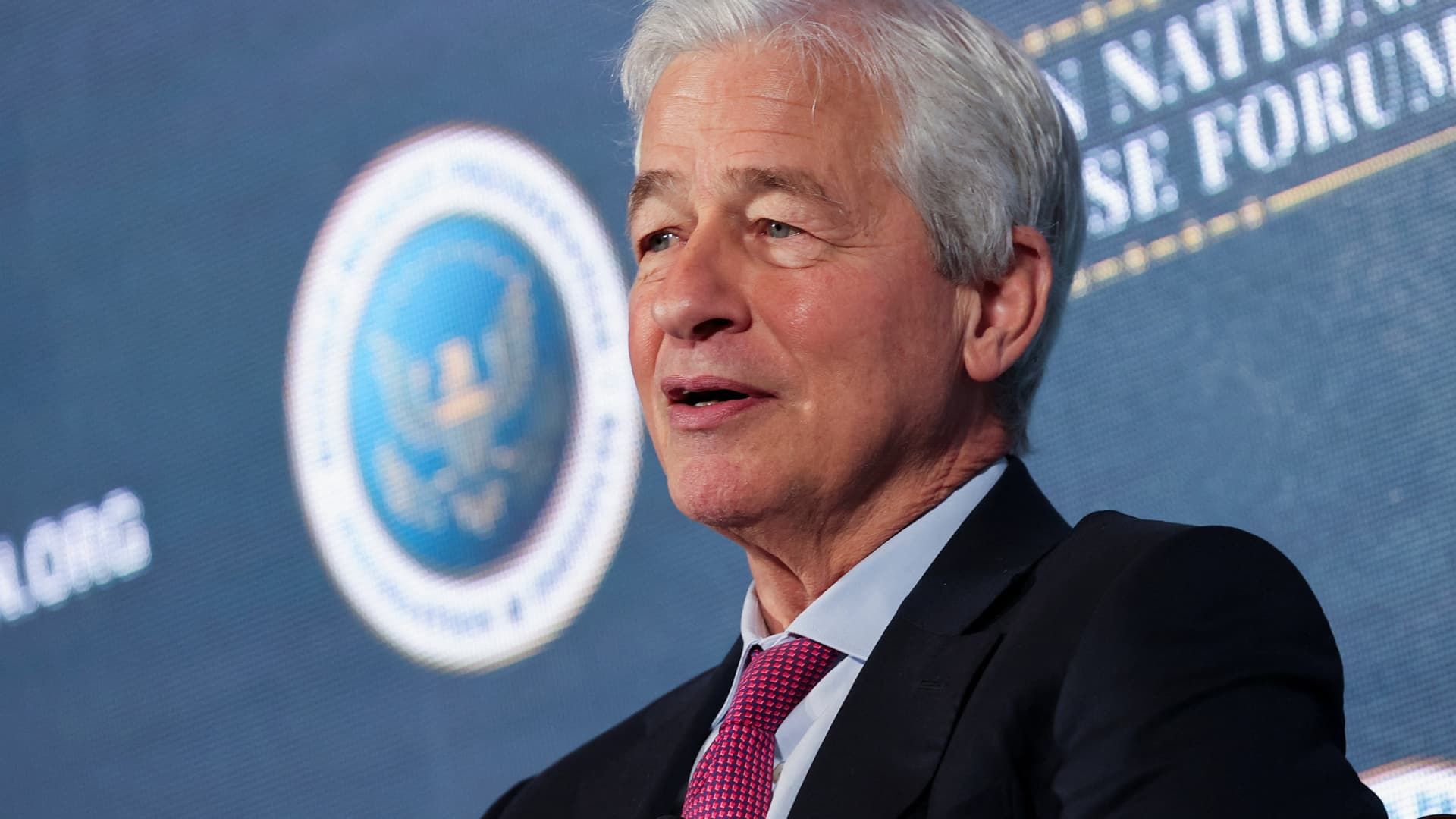
JPMorgan Chase CEO Jamie Dimon calls for a broad commitment to American ideals as his bank navigates geopolitical uncertainty, a faltering economy and the revolutionary impact of artificial intelligence.
Dimon, in his annual letter to shareholders released Monday, noted the country's 250th anniversary as “the perfect time to rededicate ourselves to the values that made this great nation ours: freedom, liberty and opportunity.”
“The challenges we all face are significant. The list is long, but at the top are the terrible war and ongoing violence in Ukraine, the current war in Iran and broader hostilities in the Middle East, terrorist activity and rising geopolitical tensions, importantly with China,” Dimon said. “Even in difficult times, we are confident that America will do what it has always done: look to the values that have defined our unique nation and sustained our leadership in the free world.”
Dimon, the longtime leader of the world's largest bank by market capitalization, is among the most outspoken American corporate leaders. Your annual letter offers not only an overview of your company's performance, but also broad perspectives on the global situation.
In Monday's letter, Dimon pointed to headwinds, including global conflicts, persistent inflation, private market turmoil and what he called “poor banking regulations.”
Dimon said that while regulations like those implemented after the 2008 financial crisis “accomplished some good things… they also created a fragmented and slow system with costly, overlapping and excessive rules and regulations, some of which weakened the financial system and reduced productive lending.”
He specifically cited the negative consequences of capital and liquidity requirements, the current construction of the Federal Reserve's stress tests, and a “poorly managed” process at the Federal Deposit Insurance Corporation.
Dimon also said JPMorgan's reaction to revised proposals for Basel 3 Endgame and a surcharge for global systemically important banks, or GSIBs, issued by U.S. regulators last month, were “mixed.”
“While it was good to see that the recent proposals for Basel 3 Endgame (B3E) and GSIB attempted to reduce the increase in required capital from the 2023 proposals, there are still some aspects that are frankly absurd,” Dimon said.
The CEO said that with the proposed added surcharges of around 5%, the bank would need to hold “up to 50% more capital on the vast majority of loans to US consumers and businesses compared to a large non-GSIB bank for the same set of loans.”
“Frankly, it's not right and it's un-American,” he said.
On trade and geopolitics
Dimon identified geopolitical tensions as the main risk facing his bank, namely the wars in Ukraine and Iran and their impacts on commodities and global markets, regarding war as “the realm of uncertainty.”
“The outcome of current geopolitical events may well be the defining factor in how the future global economic order will develop,” he said. “Then again, that may not be the case.”
He also cited a “realignment of economic relations in the world” brought about by US trade policy. US President Donald Trump has made tariffs a signature policy of his second term, introducing higher tariffs on dozens of trading partners and import categories.
“The trade battles are clearly not over and it should be expected that many nations are analyzing how and with whom they should create trade agreements,” Dimon said. “While some of this is necessary for national security and resilience, which are paramount, it is difficult to determine what the long-term effects will be.”
In private markets
Dimon also discussed recent turmoil in private markets, as fears over loans made to software companies spur massive redemption requests into private credit funds.
“In general, private credit does not tend to have great transparency or rigorous valuation 'markups' of its loans; this increases the possibility that people will sell if they believe the environment will worsen, even if actual realized losses barely change,” Dimon said.
The executive added that the actual losses are already greater than they should be in relation to the environment.
“Whatever the outcome, it should be expected that at some point insurance regulators will insist on more rigorous ratings or downgrades, which will likely lead to demands for more capital,” he said.
About AI
Dimon reiterated Monday that the pace of AI adoption is unlike any previous technology. He said that while its implementation will be “transformative”, it remains to be seen how the AI revolution will unfold.
“Overall, investment in AI is not a speculative bubble; rather, it will provide significant benefits. However, at this time, we cannot predict who the ultimate winners and losers will be in AI-related industries,” Dimon said.
“We won't bury our heads in the sand. We will implement AI, like we implement all technology, to do a better job for our customers (and employees),” he wrote.
JPMorgan has been at the forefront of Wall Street companies introducing AI at all levels of their business. Last year, Derek Waldron, JPMorgan's chief analytics officer, gave CNBC an early demonstration of how it uses agent AI to speed up work and improve outcomes for clients and shareholders.
In February, Dimon said AI was reshaping JPMorgan's workforce and that the bank had “huge redeployment plans” for employees.
“We've focused on some of the 'known and predictable' events and some of the 'known unknowns,'” he said. “But big technological changes like AI always have second- and third-order effects that can deeply impact society… We should also be attentive to this type of transformation.”
— CNBC's Leslie Picker and Ritika Shah contributed to this report.