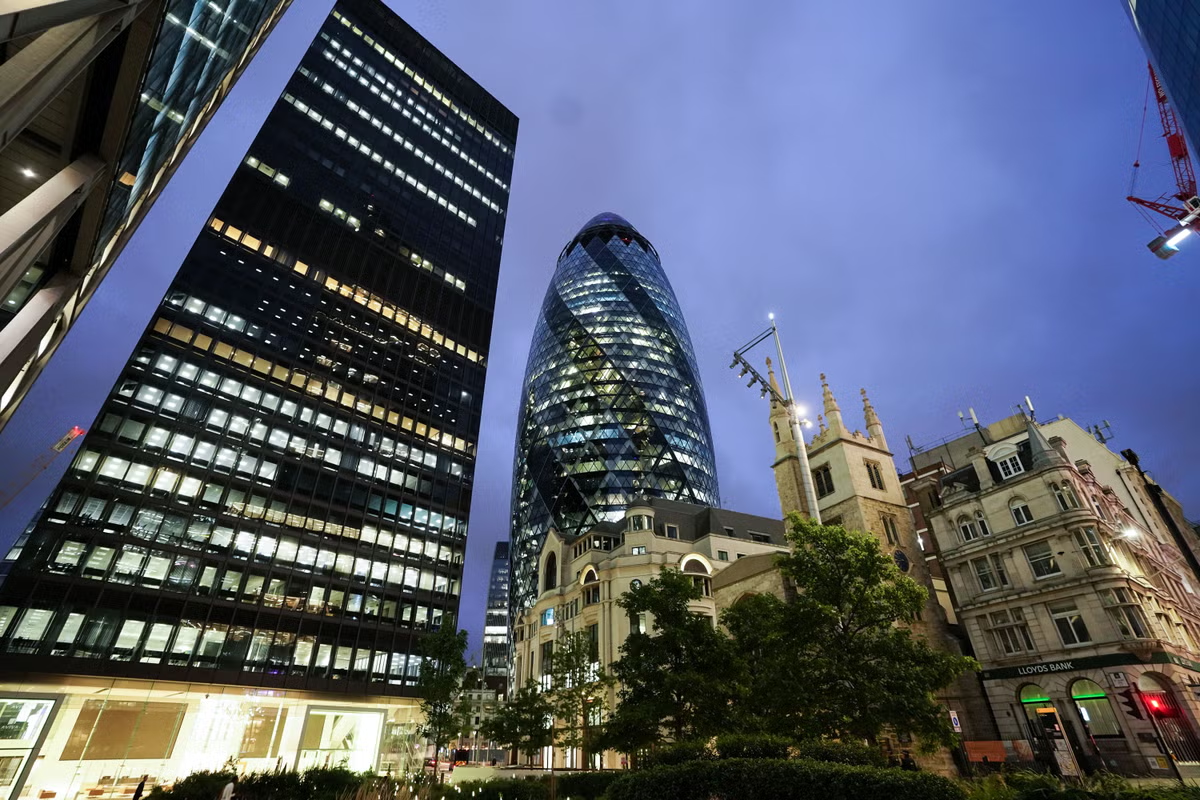
The FTSE 100 ended a volatile week in moderate fashion on Friday, closing slightly lower, despite a host of encouraging economic data as retail sales, consumer confidence and business activity recovered.
The FTSE 100 index closed down 6.61 points, or 0.1%, to 10,143.44.
The FTSE 250 closed 53.40 points lower, or 0.2%, at 23,317.53, and the AIM All-Share closed up 5.08 points, or 0.6%, at 822.75.
For the week, the FTSE 100 fell 0.9%, the FTSE 250 was flat and the AIM-All Share rose 2.5%.
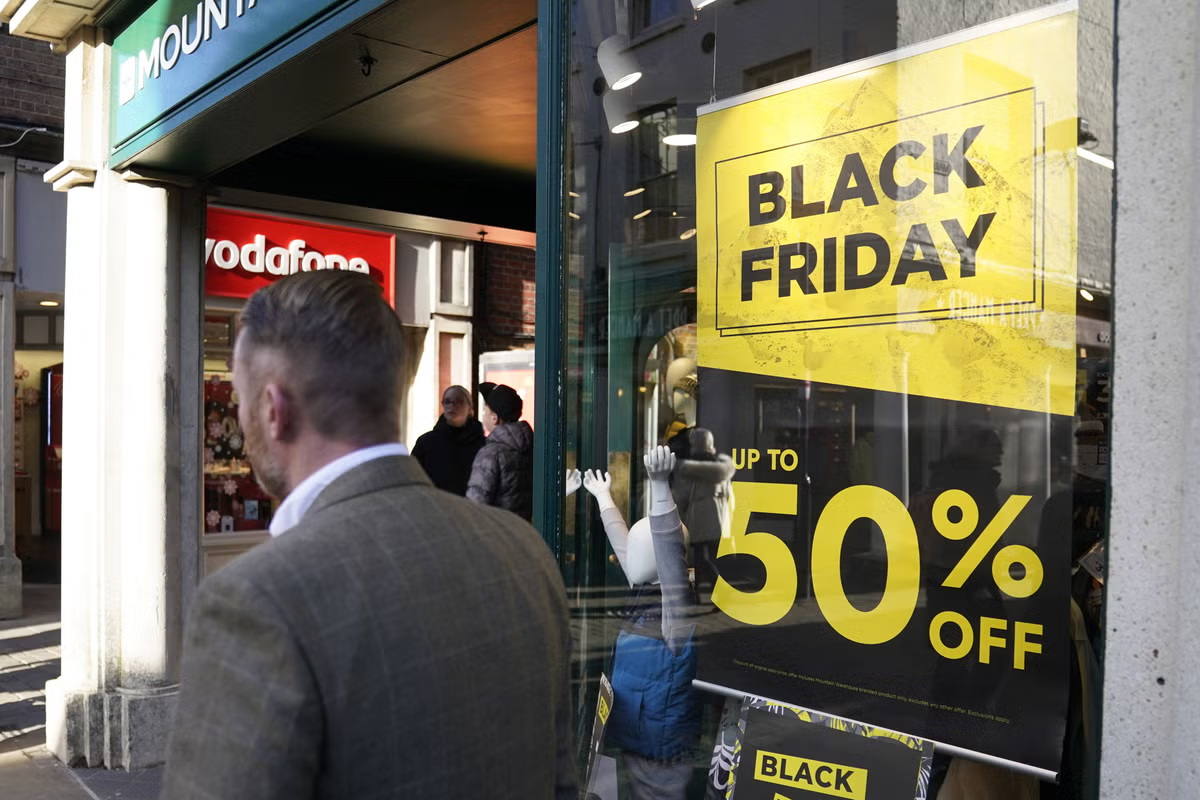
In London, economic data was in focus after UK retail sales unexpectedly rose in December.
The Office for National Statistics said retail sales volumes rose 0.4% in December, following a 0.1% drop in November, beating a forecast cited by FXStreet for a 0.1% drop.
The 0.1% fall in November was not revised, while the ONS revised up October's reading to a fall of 0.8% from a previous fall of 0.9%.
Additionally, UK consumer confidence improved slightly in January, supported by stronger expectations for personal finances over the next 12 months, survey results showed on Friday.
The overall GfK Consumer Confidence Index score rose to -16 points in January from -17 in December, matching the consensus forecast cited by FXStreet.
Completing the trio of better news, growth in the UK's manufacturing and services sectors accelerated in January, preliminary data released by S&P Global showed.
The UK Composite Purchasing Managers' Output Index rose to a 21-month high of 53.9 points in January from 51.4 points in December, easily beating the FXStreet-cited consensus of 51.7.
Composite data is calculated using a weighted average of the services and manufacturing readings.
The flash PMI for the services sector improved to 54.3 points in January from 51.4 points in December, beating the consensus of 51.7.
The preliminary manufacturing PMI rose to 51.6 points in January, a 17-month high, from 50.6 points in December.
“As the year turns, we are seeing encouraging signs from the UK economy,” said Deutsche Bank chief economist Sanjay Raja.
“The revisions have made the UK's outlook a little brighter”, retail spending is “recovering”, survey data has been “stronger” to start 2026 and there are some “tepid” signs of stabilization in the labor market, he added.
JPMorgan analyst Allen Monks noted that the January PMI increase could typically be associated with annualized GDP growth of 1.9%.
But he added a warning. “The main problem is that the level has not yet been maintained for more than a month, which needs to be taken into account when interpreting the UK survey,” he said.
“There was a similar rise in the UK survey in August, which reversed sharply. As such, it is difficult to have much faith in the UK survey until it maintains an upward shift,” Mr Monks added.
But while he took due caution with the PMI data, he said the retail sales and consumer confidence figures “support the growth outlook.”
Firm data also supported sterling.
The pound was trading higher on Thursday at $1.3567 at the close of the London Stock Exchange, up from $1.3437 on Wednesday.
The pound was further boosted by comments from Megan Greene, a member of the Monetary Policy Committee, who argued that looser monetary policy in the US could push up inflation.
“In my view, this would give even greater cause for concern about the risk of UK inflation persisting rather than weaker demand, justifying a slower withdrawal of monetary policy restrictions in the UK,” he said.
The US Federal Reserve meets next week but is expected to leave interest rates unchanged after three consecutive quarter-point cuts.
To counter Greene's fears, Wells Fargo analysts expect two 25-basis-point rate cuts at the Fed meetings in March and June, but said “risks to our forecast appear increasingly skewed toward later and possibly smaller easing this year.”
“Indeed, given our view on how growth will evolve this year, there is a strong argument that the longer they wait to cut, the greater the hurdle will be to justify on economic grounds the need for further easing.”
The euro stood at $1.1758, down from $1.1707.
Against the yen, the dollar was trading at 157.99 yen, down from 158.18 yen.
In European stocks on Friday, the CAC 40 in Paris closed down 0.1%, while the DAX 40 in Frankfurt closed up 0.2%.
In New York, financial markets were mixed at the close of the London stock market.
The Dow Jones Industrial Average was down 0.5%, the S&P 500 was up 0.2%, while the Nasdaq Composite was up 0.6%.
The 10-year US Treasury yield was trading at 4.25%, down from 4.27% on Thursday. The 30-year US Treasury yield was quoted at 4.84%, down from 4.87%.
On the FTSE 100, gold miners Fresnillo, up 2.1%, and Endeavor Mining, up 2.2%, were back in fashion as gold and silver prices closed to rise.
The yellow metal was quoted on Friday at $4,984.07 per ounce, after reaching another all-time high and approaching $5,000 per ounce, compared to $4,874.8 on Thursday.
Meanwhile, the price of silver rose 4.8% late on Friday, surpassing $100 an ounce.
“Concerns about US public finances, political pressure on the Federal Reserve and lingering global risks are keeping gold well priced on the declines. Despite signs of near-term overbought, the metal is on track for a strong weekly gain, and the price action suggests pullbacks are being treated as opportunities rather than trend breakouts. This is a high-risk trading environment,” said David Morrison, senior market analyst at Trade Nation.
As for silver, Morrison said the metal continues to outperform in the “most extraordinary way.”
“This really looks like a market in the midst of a boom, with rumors of tight supply and a huge short squeeze generating fresh buying momentum.
“There is a lot of (fear of missing out) out there and that has the potential to push prices up even further. But of course, the longer this rally goes on, the greater the risk of getting caught in a weak leg. Silver appears to be on the rise here.”
Oil majors BP and Shell were in demand, up 1.6% and 0.5% respectively, as the price of oil rose, after the Financial Times reported that the United States threatened to curb the supply of cash for Iraq's oil sales.
Brent oil rose to $65.76 a barrel on Friday, up from $64.26 on Thursday.
Insurer Aviva fell 5.2%, while sector peer Admiral extended its losing streak, losing 5.8% on Friday, taking its weekly loss to 13%.
Goldman Sachs and RBC Capital Markets downgraded Admiral earlier this week.
Elsewhere, C&C shares fell 9.3% as it reported weak trading in the run-up to Christmas due to tepid consumer confidence amid UK budget jitters.
Mecca Bingo owner Rank fell 4.7%, while William Hill owner Evoke fell 2.5% as Deutsche Bank moved from “buy” to “hold” after taking into account tax changes to the betting industry in the November budget.
The biggest risers on the FTSE 100 were Beazley, up 36.0p to 1,152.0p, Glencore, up 10.85p to 501.0p, Endeavor Mining, up 92.0p to 4,366.0p, BAE Systems, up 42.0p to 2,027.0p and Fresnillo, up 84.0p to 501.0p. 4,168.0p.
The biggest fallers on the FTSE 100 were Burberry Group, down 79.0p to 1,195.5p, Admiral Group, down 162.0p to 2,650.0p. 418.3p.
Monday's global economic calendar includes the Ifo report on the business climate in Germany and durable goods orders data in the United States. Decisions on interest rates in the US and Canada will be made later in the week.
Next week's UK corporate calendar includes full-year results from lender Lloyds Banking Group plus trading statements from accounting software provider Sage and miner Antofagasta.
– Contributed by Alliance News.