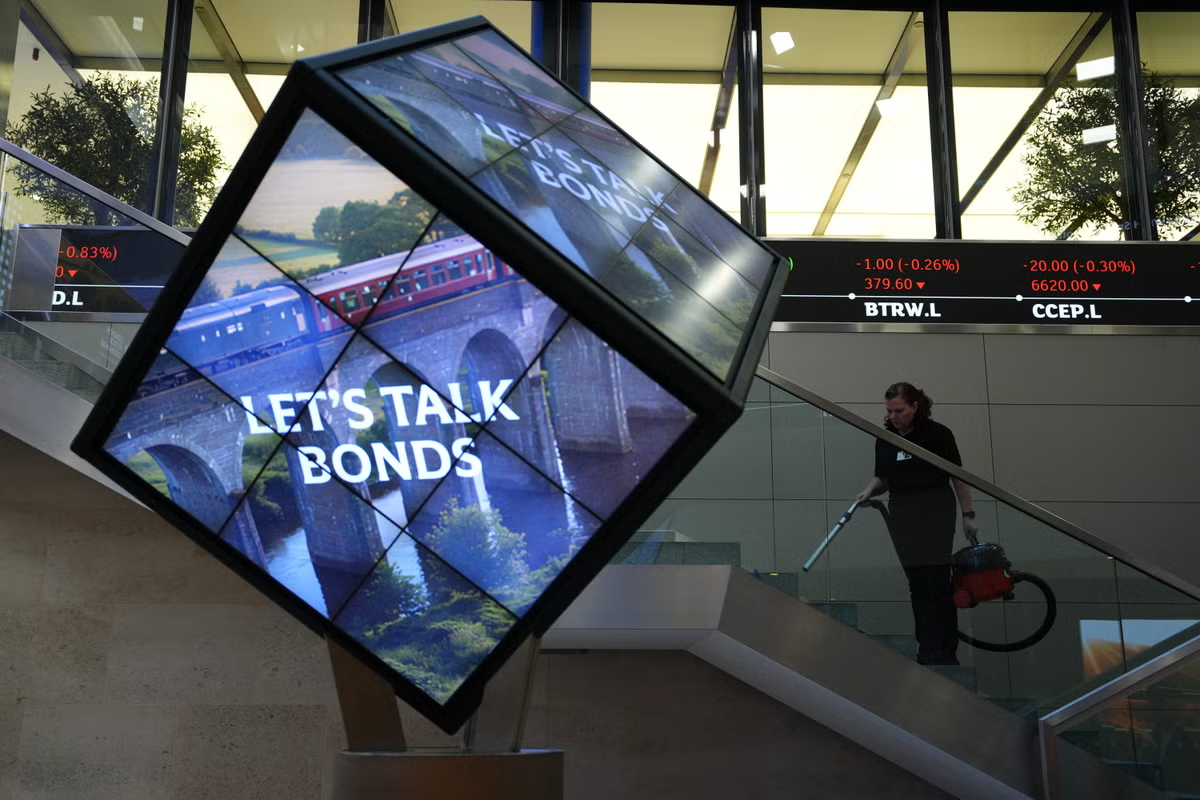
The FTSE 100 made modest progress on Thursday after Donald Trump backed down on his threats to impose tariffs, but underperformed European peers amid weakness in mining, energy and defense stocks.
The FTSE 100 index closed up 11.96 points, or 0.1%, at 10,150.05.
The FTSE 250 finished 299.64 points higher, or 1.3%, at 23,370.93, and the AIM All-Share closed up 9.08 points, or 1.1%, at 817.67.
US President Trump said on Wednesday night that he had reached a framework for a deal on Greenland after a meeting with NATO chief Mark Rutte and would waive planned tariffs on European allies.
“We have formed the framework for a future agreement regarding Greenland and, indeed, the entire Arctic region,” Trump said in a post on Truth Social.
The US president did not provide any details about the framework, but added that his threats of tariffs against European countries that resisted his attempt to acquire Greenland were already off the table.
Kathleen Brooks, head of research at XTB, said: “Tariff risk is now on the back burner, and this week's price development tells us that financial markets fear tariffs more than geopolitical risks.”
Brooks said there is still a way to go before markets reverse this week's overall losses, but noted that the sell-off in recent days “sent a jolt of volatility through financial markets, but did not lead to a rout.”
This suggests that investors remain “dip buyers” and that market fundamentals “remain strong.”
In European stocks on Thursday, the CAC 40 in Paris closed up 1.0%, while the DAX 40 in Frankfurt closed up 1.2%.
In New York, financial markets rose as the London stock market closed.
The Dow Jones Industrial Average rose 0.9%, the S&P 500 rose 0.7%, while the Nasdaq Composite rose 1.0%.
The 10-year US Treasury yield was trading at 4.27%, unchanged from Wednesday. The 30-year US Treasury yield was quoted at 4.87%, down from 4.89%.
Data showed that US economic growth in the third quarter was slightly stronger than expected, according to figures from the Bureau of Economic Analysis (BEA).
US gross domestic product expanded 4.4% on an annualized basis, quarter-over-quarter, in the three months through September 30. The BEA's previous estimate said growth was 4.3%.
“The increase in real GDP in the third quarter reflected increases in consumer spending, exports, government spending and investment. Imports, which are a subtraction in the GDP calculation, decreased,” the BEA said.
The pound was trading higher at $1.3498 at the close of the London Stock Exchange on Thursday, up from $1.3437 on Wednesday.
The euro stood at $1.1749, down from $1.1707. Against the Japanese yen, the dollar was trading at 158.27 yen, down from 158.18 yen.
In London, figures showed that UK public sector net borrowing rose less than expected in December.
According to the Office for National Statistics, net borrowing was £11.58 billion in December, below the market consensus estimate cited by FXStreet of £13.5 billion.
The December total was above November's net borrowing of £10.94 billion, which was revised down from £11.65 billion. But it is down 38% since December 2024.
Danni Hewson, head of financial analysis at AJ Bell, said: “The significant fall in public borrowing in December will be a relief for the Treasury, especially as January's figures are likely to look even better with an expected rise in self-assessment income.”
Ms Hewson said spending was “increased” compared to the previous year, mainly due to increases in benefit payments and pay rises, but that was more than offset by an increase in cash flowing into the government's coffers.
However, he noted that the outlook is “not so rosy” for the entire financial year to date “with total debt to the end of December at levels seen only twice before.”
“The deficit is shrinking, but the pace of reduction is glacially slow. With further increases in benefit payments on the way in April, the pressure on the public purse remains uncomfortable,” Ms Hewson added.
On the FTSE 100, defense stocks BAE Systems and Babcock International shed 3.7% and 1.4% on cooler geopolitical temperatures.
Miners were another weak spot after recent gains. Antofagasta fell 2.2%, Glencore 2.0% and Anglo America 1.7%.
Insurer Admiral fell another 4.6% as RBC Capital Markets downgraded its rating from “outperform” to “sector perform”, the day after Goldman Sachs downgraded its shares.
While the weakening oil price weighed on BP, which was down 1.9%, and Shell, which was down 2.2%.
Brent crude oil traded lower on Thursday at $64.26 a barrel, down from $64.82 on Wednesday.
On the FTSE 250, Computacenter led the way, up 10%, after trading better than expected in 2025.
The service provider, based in Hatfield, Hertfordshire, said business performance in the fourth quarter, and in 2025 as a whole, exceeded its expectations.
As a result, the FTSE 250-listed company expects full-year adjusted pre-tax profit to be no less than £270 million, “comfortably ahead” of market expectations of the company at £253.6 million. It would represent growth of up to 6.3% from the £254 million reported in 2024.
“This is a strong pre-announcement, with results above expectations, earnings improvements to come and encouraging messages about the process and outlook,” JPMorgan analysts said.
Senior rose 8.8% as it said it expects full-year adjusted pretax profit to be “comfortably above previous expectations,” boosting forecasts for the second time in three months.
The company, based in Royston, Hertfordshire, manufactures components and systems for aerospace and defence, land vehicles and energy customers.
He said trading since the November update has been “stronger than expected, especially in the aerospace sector.”
On AIM, Kitwave soared 33% as it accepted a £251m takeover bid from New York investment firm OEP Capital Advisers.
The cash offer values each share in the food wholesaler, based in North Shields, North Tyneside, at 295 pence.
Gold was trading at $4,874.80 an ounce on Thursday, after reaching another all-time high, up from $4,833.66 on Wednesday.
The biggest risers on the FTSE 100 were: St James's Place, up 62.5p to 1,511.0p; Hikma Pharmaceuticals, rose 48.0 pence to 1,568.0 pence; JD Sports Fashion, up 2.56p to 84.62p; Spirax, up 220.0p to 7,370.0p; and ConvaTec, up to 7.0p at 236.6p.
The biggest fallers on the FTSE 100 were: Admiral Group, down 136.0p to 2,812.0p; BAE Systems, down 77.0p to 1,985.0p; ICG, down 52.0p to 1,940.0p; Rio Tinto, fell 155.0p to 6,486.0p; and Shell, down 59.5p to 2,674.0p.
Friday's global economic calendar includes a series of preliminary composite PMI readings, a revision to interest rates in Japan overnight, plus data on consumer confidence and UK retail sales.
Friday's UK corporate calendar has a trading statement from currency and asset manager Record.
Contributed by Alliance News