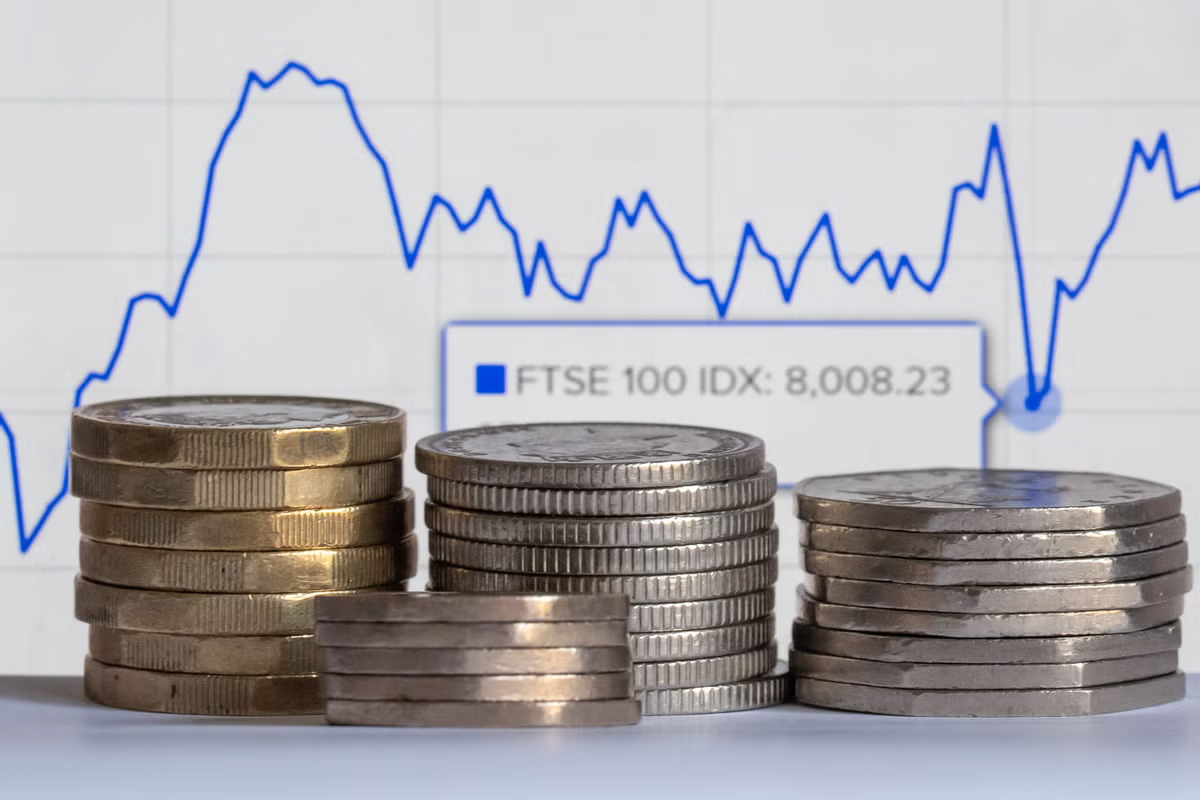
The FTSE 100's record run stalled on Wednesday as falling metals and oil prices hit the blue-chip index.
The FTSE 100 index closed down 74.52 points, or 0.7%, at 10,048.21.
The FTSE 250 index closed up 88.92 points, or 0.4%, at 22,880.81, and the AIM All-Share index closed up 2.08 points, or 0.3%, at 781.58.
AJ Bell analyst Russ Mould said the FTSE 100's fall came amid “murmurs about the fate of Greenland and lower oil and precious metals prices.”
“In addition to pledging to deliver between 30 million and 50 million barrels of Venezuelan oil to the United States following weekend attacks in the country, which raised concerns about crude oil oversupply and put pressure on prices, President Trump is exploring options to acquire Greenland, and military action apparently has not been ruled out,” Mold said.
In a post on his Truth Social platform, Trump said the oil would be sold at market prices and that the profits would be controlled by him as president to ensure they were used “for the benefit of the people of Venezuela and the United States.”
Brent oil was trading at $60.37 a barrel at the close of the London Stock Exchange on Wednesday, up from $61.59 on Tuesday.
David Morrison, senior market analyst at Trade Nation, said: “President Trump's promise to restructure Venezuela's oil industry and encourage US companies to rebuild infrastructure has raised expectations for higher production over time.
“As global demand growth continues to slow, the prospect of rising supply acts as a headwind for prices, regardless of geopolitical headlines. Until that balance changes, oil is likely to remain under pressure.”
BP and Shell shares fell 3.4% and 3.3% respectively.
Miners also retreated as metal prices halted recent strong gains.
Gold closed at $4,458.54 an ounce on Wednesday, down from $4,485.16 on Tuesday, while the price of silver fell 3.8% and copper fell 3.0%.
Reflecting this, Antofagasta fell 4.4%, Fresnillo fell 4.8% and Endeavor Mining fell 1.7%.
Latent geopolitical tension led to gains for defense contractors BAE Systems, up 2.4%, and Babcock International, up 3.8%.
Elsewhere, economic data showed that UK construction companies experienced another sharp drop in activity in December, although the pace of decline eased, according to the results of a survey published by S&P Global.
The seasonally adjusted S&P Global UK Construction Purchasing Managers' Index rose to 40.1 points in December from 39.4 in November, but was below the expected 42.3 points.
The PMI remained below the neutral 50.0 mark that separates growth from contraction for the 12th consecutive month, with its second-lowest reading since May 2020.
Tim Moore, economic director at S&P Global Market Intelligence, commented: “UK construction firms once again reported challenging trading conditions and declining workloads in December, but the speed of the slowdown moderated from the five-and-a-half-year record seen in November. Many firms cited subdued demand and fragile customer confidence.”
However, listed housebuilders were in demand as bond yields fell on hopes of lower interest rates in the UK this year.
Britain's 10-year bond yield fell noticeably to 4.41% on Wednesday from 4.49% on Tuesday, and briefly fell below 4.40% to levels last seen on November Budget Day.
Property firms Land Securities and LondonMetric rose 3.2% and 3.8% respectively, while housebuilders Barratt Redrow and Persimmon rose 3.3% and 2.8%.
The pound was trading at $1.3472 at the close of the London Stock Exchange on Wednesday, up from $1.3500 on Tuesday.
The euro fell slightly to $1.1685 from $1.1689.
Figures showed eurozone inflation slowed slightly at the end of 2025, with the annual rate falling to 2.0% in December from 2.1% in November, according to a preliminary estimate published by Eurostat.
The print was in line with the consensus cited by FXStreet and would be within the European Central Bank's 2% inflation target.
In European stocks on Wednesday, the Cac 40 in Paris closed up 0.1% and the Dax 40 closed up 0.9% in Frankfurt, surpassing 25,000 points for the first time.
New York stocks were mixed at the London close on Wednesday.
The Dow Jones Industrial Average fell 0.3%, the S&P 500 rose 0.1% and the Nasdaq Composite advanced 0.4%.
The 10-year US Treasury yield was trading at 4.15% on Wednesday, down from 4.20% on Tuesday. The 30-year US Treasury yield was at 4.82%, down from 4.88%.
US data on Wednesday was mixed, with a strong ISM services PMI print offset by a surprise drop in job openings.
The figures come ahead of Friday's U.S. jobs report, which will likely determine whether or not the Federal Reserve cuts interest rates in January.
Morgan Stanley estimates that general and private payrolls rose by 75,000 in December, reaccelerating from their summer decline.
“We think some of the summer's weakness and some of the recent rally are overdone, but the positive reading still likely reduces immediate labor market concerns at the Federal Reserve,” the trader said.
“However, our 4.6% forecast for the unemployment rate keeps the Federal Reserve on track to cut it in January,” Morgan Stanley believes.
“If we are wrong, labor demand bounces up and the unemployment rate falls, there is less impetus for the Federal Reserve to cut, as we expect, in January,” the trader added.
Back in London, Relx rose 2.1% as JPMorgan highlighted its attractions.
“We believe Relx's 'AI glass' is not even half full, but overflowing and that the share price pullback represents a compelling buying opportunity,” analyst Daniel Kerven said in a research note.
Meanwhile, Vodafone rose 2.8% as Berenberg upgraded its rating from “hold” to “buy”, highlighting the potential for share buybacks from expected strong increases in free cash flow.
But Diageo shares fell 4.1% as Bloomberg reported that a Kenyan beer distributor sued to block the spirits maker's planned $2.3 billion sale of East African Breweries to Japan's Asahi Holdings.
The biggest risers on the FTSE 100 were Babcock International up 53.00p to 1,441.00p, LondonMetric Property up 7.10p to 196.00p, Segro up 24.40p to 743.60p, Barratt Redrow up 12.30p to 385.00 pence and IMI, which rose 82.00 pence. at 2,616.00p.
The biggest fallers on the FTSE 100 were Fresnillo, down 178.00 pence to 3,500.00 p., Antofagasta, down 155.00 pence to 3,387.00 p. 28.20p to 743.60p.
Thursday's local corporate calendar includes trading statements from hot sandwich seller Greggs, clothing and homewares retailer Marks & Spencer Group and grocer Tesco.
Thursday's global economic calendar includes eurozone unemployment and PPI figures, weekly US jobless claims data and the UK's Halifax house price report.